7 Best Payroll Management Software in India
.webp)
Table of contents
One unstitched HR platform to manage your entire workforce, from Hire to Re-Hire.
Talent Management solutions built for growing and exceptional people
Built-in compliance tools that update with changing regulations
Automated payroll, attendance, and leave management
Insights that help HR leaders make faster, better decisions

Key Takeaways
- ZingHR is the top pick for enterprises with 1,000+ employees. Zero-touch payroll automation, real-time attendance-to-salary reconciliation, and AI-driven statutory compliance run from a single unified platform.
- Agentic intelligence flags payroll anomalies before salaries are disbursed. We reviewed seven platforms across automation depth, statutory compliance coverage, and payroll-HRMS integration.
- Pricing transparency and scalability completed the criteria. Indian businesses process payroll against PF, ESI, PT, LWF, TDS, and gratuity obligations that vary by state, headcount, and employment type.
- The four New Labour Codes, including the 50% basic wage rule, demand immediate payroll restructuring. Delayed adoption triggers penalties, audit failures, and employee disputes.
Salary errors and missed statutory filings cost employee trust, regulatory standing, and CHRO credibility.
For many payroll teams, running monthly salary cycles through spreadsheets still consumes 4-5 working days. It’s a cycle that ends with someone sending an apology email at midnight about a wrong deduction.
Software compresses that cycle to hours. More importantly, it transforms payroll from a reactive administrative function into a governed, auditable process aligned to the CFO's risk agenda.
The consequence of getting it wrong ranges from reconciliation fire drills to statutory penalties. Payroll management software removes the manual intervention points where those errors originate.
This guide reviews seven platforms for Indian enterprises in 2026, evaluated for automation depth, compliance coverage, and integration architecture.
How We Analysed These 7 Tools
Our review drew on information from G2, Capterra, and Gartner Peer Insights, alongside four key criteria: payroll automation depth, statutory compliance breadth, HRMS integration quality, and pricing transparency. We also assessed New Labour Codes readiness and employee self-service capabilities as part of our evaluation process.
1. Payroll Automation Depth
A qualifying platform automates salary calculations, statutory deductions, payslip generation, and bank disbursement. Platforms that also automate PF/ESI/PT challan filing and run pre-payroll validation checks scored highest.
The distinction between tracking payroll obligations and executing them defined the tier separation.
2. Statutory Compliance Coverage
Core compliance covers PF, ESI, Professional Tax, LWF, and TDS. Enterprise-grade platforms extend this to multi-state PT slab management, Form 16 and Form 24Q generation, gratuity computation, and full and final settlement processing.
New Labour Codes readiness, especially the 50% basic wage rule and digital record mandates, added further weight.
3. Payroll-HRMS Integration
Standalone payroll tools create reconciliation gaps with attendance and leave data. We assessed how tightly each platform connects payroll to core HR functions, eliminating the dual-entry risk that causes salary mismatches and audit exceptions.
4. Pricing Transparency
Enterprise buyers need clarity on total cost of ownership before committing. We specify whether pricing is published or quote-based as of May 2026, and whether bundling obscures actual per-employee costs.
Quick Analysis: 7 Best Payroll Management Software in India
Seven platforms assessed by payroll automation capability and target segment appear in the table below. Trial availability is listed for each.
Seven payroll management software platforms compared by target segment and key payroll features, with trial availability.
1. ZingHR
Verdict: The strongest pick for enterprises with 1,000+ employees who need payroll accuracy, statutory compliance, and workforce intelligence running from a single platform. ZingHR's zero-touch payroll engine and AI anomaly detection close the gap between salary processing and statutory governance.
ZingHR Key Payroll Features
ZingHR automates payroll execution through its agentic hcm platform. These capabilities define its standing as the best payroll management software for enterprise-scale Indian operations:
- ZingZeroTAP payroll engine: ZingHR's industry-first zero-touch payroll processes salaries with zero manual interventions. Every pay structure, every location, and every statutory deduction runs through a self-reconciling engine that closes on time, every cycle.
- Attendance-to-payroll real-time sync: Leave, shift, and overtime data feed directly into payroll from the attendance module. Loss of pay deductions, shift differentials, and overtime payments calculate automatically without manual data transfer or reconciliation.
- PF/ESI/PT/LWF/TDS automation: Direct integration with statutory portals handles challan generation, filing, and submission. All statutory deduction workflows flow through a single interface connected to EPFO and ESIC portals.
- Multi-state PT slab management: Auto-applies the correct Professional Tax slab based on employee work location and state-specific rules. Essential for organisations operating across Maharashtra, Karnataka, West Bengal, and other high-variation states.
- AI-powered payroll anomaly detection: ZingHR's agentic intelligence engine, Ghrowth AI, flags unusual overtime patterns, duplicate salary entries, and wage structure mismatches under the new Wages Code before payroll runs. Anomalies surface before they become disbursement errors.
- New Labour Codes readiness: Wage restructuring validation against the 50% basic wage rule, digital register generation, and full and final settlement within 48 hours are native capabilities embedded in the platform architecture.
- Employee self-service for payroll: Payslips, Form 16, investment declarations, and reimbursement tracking are accessible through mobile and web portals. Employees resolve payroll queries without raising HR tickets.
ZingHR Pros
- Deepest India-specific payroll automation. It covers multi-state statutory deductions and New Labour Codes readiness natively. No partner integrations or manual configuration required for core compliance acts.
- Unified HCM platform. Payroll and compliance share a single data layer with attendance, leave, and performance modules. Every salary input flows directly into the disbursement engine, ensuring full reconciliation without dual entry.
- Board-level payroll governance. Real-time dashboards surface pending obligations, statutory deadlines, and payroll completion status across all establishments. CHROs and CFOs gain payroll visibility on demand.
ZingHR Cons
- Purpose-built for enterprise scale. The platform's depth targets organisations with 100+ employees. SMEs managing simple payroll structures may find the capability set more than required.
- Implementation requires payroll process mapping. Teams invest in configuring state-specific rules, pay structure templates, and escalation workflows to maximise the payroll engine's output. Complex multi-state operations should plan for a structured onboarding phase.
ZingHR is Best For
Enterprises with 1,000+ employees operating across multiple Indian states gain the most value, particularly those in BFSI & Microfinance, Manufacturing, Pharma, Retail & QSR, and Healthcare. Multi-location payroll complexity, contract labour, and shift-based pay structures create compounding risk alongside statutory filing obligations. If your payroll footprint spans 5+ states and you need a payroll management software that disburses, files, and resolves, ZingHR is the platform.
ZingHR Pricing
Quote-based, scaled to headcount and module selection. All payroll automation and statutory filing activity is covered within the quoted price.
Book a demo for a tailored pricing walkthrough based on your state footprint and workforce complexity.
2. Darwinbox
Verdict: An India-first HCM platform with solid payroll automation and workflow-driven approval layers for mid-to-large enterprises. Darwinbox handles PF/ESI/PT/TDS processing natively within its payroll module, and integrates payroll tightly with attendance and leave. Enterprises managing complex contract labour or 10+ state operations may encounter depth limitations at the compliance execution layer.
Darwinbox Key Payroll Features
- PF/ESI/PT/TDS payroll automation: Core statutory calculations are automated within the payroll module. Salary structures, deductions, and statutory contribution rates are configurable for Indian wage components.
- Attendance and leave integration: Payroll reads directly from attendance and leave records. Loss of pay deductions, approved leave encashments, and overtime additions feed into payroll without manual data transfer.
- Workflow-driven payroll approvals: Approval workflows route payroll runs through designated stakeholders before disbursement. Enterprises building governance layers across multiple approvers gain a structured payroll sign-off architecture.
- Multi-company payroll support: Payroll managers overseeing multiple legal entities operate from a unified interface. Each entity maintains separate pay structures and statutory configurations within a shared administrative environment.
- Employee self-service: Payslips, Form 16, and investment declaration forms are accessible through a clean self-service portal, reducing payroll queries raised to the HR desk during tax filing season.
Darwinbox Pros
- Modern UI and structured payroll governance. The interface is intuitive for HR and finance teams managing payroll alongside broader HR functions.
- Robust India-first payroll foundation. Wage structure configurations and statutory deduction formulas are built for Indian payroll from the ground up.
Darwinbox Cons
- New Labour Codes readiness is partial. Comprehensive digital register generation, 48-hour full and final settlement processing, and OSH code compliance mapping remain in early stages of development.
- Multi-state PT slab granularity has limits. Organisations operating across 10+ states report manual intervention requirements for PT edge cases in states with frequent slab revisions.
- Complex payroll structures require configuration depth. Enterprises with variable pay, contract labour payroll, or shift-heavy pay structures may require significant configuration investment to match the automation depth of purpose-built payroll engines.
Darwinbox is Best For
Mid-to-large Indian enterprises with 500-3,000 employees operating across 3-5 states. IT/ITes companies and professional services firms with standard payroll complexity and a preference for integrated HCM will find Darwinbox's all-in-one approach effective.
Darwinbox Pricing
Quote-based, scaled to employee count and module selection. Pricing is competitive relative to global platforms. Demo available upon request through the Darwinbox website.
3. Keka HR
Verdict: The most modern payroll platform for companies with 50-500 employees seeking India-specific compliance with a clean, fast setup. Transparent entry-level pricing and quick deployment make it a strong choice for growing businesses.
Keka HR Key Payroll Features
- Automated PF/ESI/PT/LWF/TDS processing: Core statutory deductions calculated automatically within the payroll engine. Monthly PF and ESI returns generated from payroll data. TDS computation and Form 16 generation follow the same integrated path.
- Attendance-linked payroll: Payroll reads directly from Keka's attendance module, ensuring LOP deductions, shift-based pay, and overtime payments are computed accurately against verified attendance records. No manual data transfer between modules.
- Reimbursement and expense integration: Employee expense claims sync directly into payroll after manager approval. Flexible components, bonuses, and one-time payouts integrate without manual adjustments to the payroll run.
- Payroll audit trails: Complete version history and statutory reports are maintained for inspection readiness. Payroll runs generate audit-ready records without manual documentation.
Keka HR Pros
- Fast implementation for SMEs. Typical deployments complete in two to four weeks. HR teams with limited technical resources manage setup independently, with pre-configured salary structures and compliance as part of onboarding.
- Modern interface with genuine ease of use. Payroll and compliance workflows require minimal training. HR generalists operate the platform comfortably for standard monthly payroll cycles.
Keka HR Cons
- Multi-state compliance has edge cases. Organisations operating in 5+ states encounter manual workarounds for PT slab variations in states like West Bengal and Jharkhand that fall outside the platform's automated rules.
- Contract labour and complex shift payroll sit outside core scope. Enterprises with significant contract workforces, factory-based shift pay structures, or CLRA payroll obligations need supplementary tools or deeper platforms.
- Payroll depth plateaus at mid-scale. Companies crossing 500 employees or expanding beyond three states find compliance automation capabilities approaching their limit. AI-driven anomaly detection and pre-payroll audit engines, standard on enterprise-grade platforms, become relevant at this inflection point.
Keka HR is Best For
Growing SMEs with 50-500 employees operating in one to three Indian states. IT/ITes startups and professional services firms with primarily white-collar workforces and standard statutory payroll obligations. Companies evaluating payroll management software in India for the first time will appreciate Keka's low barrier to entry and India-first compliance design.
Keka HR Pricing
Pricing is customized, with rates depending on factors such as the number of employees, chosen HR and payroll features, integrations, and the scope of implementation.
4. PeopleStrong
Verdict: A strong option for large Indian enterprises where payroll complexity is driven by shift work, distributed operations, and high-volume attendance processing. PeopleStrong combines payroll, workforce management, and compliance into a single platform, making it particularly effective for retail, manufacturing, logistics, healthcare, and other workforce-intensive industries.
PeopleStrong Key Payroll Features
- PF/ESI/PT/TDS compliance automation: Statutory deductions, filings, and compliance workflows are automated within the payroll engine for Indian regulatory requirements.
- Shift and overtime payroll management: Complex shift premiums, overtime calculations, and workforce scheduling rules flow automatically into payroll calculations.
- Multi-location payroll administration: Payroll teams can manage multiple business units, locations, and employee categories through a unified payroll environment.
- Employee self-service payroll portal: Employees access payslips, tax documents, reimbursement claims, investment declarations, and payroll-related requests through mobile and web applications.
PeopleStrong Pros
- Strong attendance-to-payroll integration. Shift schedules, overtime calculations, and attendance records flow directly into payroll, reducing reconciliation effort before salary processing.
- India-focused compliance automation. PF, ESI, PT, and TDS processes are embedded within payroll operations, reducing manual compliance administration.
PeopleStrong Cons
- Implementation requires workforce configuration. Complex attendance rules, performance management, shift structures, and overtime policies often need detailed setup during deployment.
- Less suitable for smaller organisations. Businesses with simple payroll requirements may not need the workforce management depth that drives much of the platform’s value.
PeopleStrong is Best For
Large enterprises with 500+ employees, particularly in retail, manufacturing, healthcare, logistics, and services, where payroll depends heavily on attendance, shifts, overtime, and workforce scheduling data.
PeopleStrong Pricing
Quote-based pricing determined by employee count, payroll complexity, workforce management requirements, and selected modules.
5. SAP SuccessFactors
Verdict: Best suited for multinational enterprises that need payroll governance across multiple countries, legal entities, and compliance frameworks. SAP SuccessFactors combines payroll administration with broader workforce planning, talent management, and analytics capabilities.
SAP SuccessFactors Key Features
- Compliance and audit controls: Built-in governance, approval workflows, audit trails, and reporting capabilities support enterprise payroll controls.
- Workforce analytics: Payroll costs, workforce trends, headcount metrics, and compensation insights are available through enterprise reporting tools.
- Employee self-service: Employees can access payslips, tax documentation, personal information updates, and payroll-related requests through self-service portals.
SAP SuccessFactors Pros
- Strong multinational payroll governance. Organisations can standardise payroll controls, approvals, reporting, and compliance processes across multiple countries.
- Deep integration with workforce data. Employee changes, compensation updates, organisational structures, and workforce planning activities connect directly to payroll operations.
SAP SuccessFactors Cons
- Higher implementation complexity. Enterprise deployments often require significant configuration, consulting support, and internal project ownership.
- Premium total cost of ownership. Licensing, implementation, and ongoing administration costs are considerably higher than India-focused payroll platforms.
- Excessive for straightforward payroll needs. Smaller organisations processing payroll in a limited number of jurisdictions may find the platform unnecessarily complex.
SAP SuccessFactors is Best For
Multinational enterprises and large organisations managing payroll across multiple countries, business entities, and compliance frameworks that need strong governance and workforce visibility.
SAP SuccessFactors Pricing
Custom enterprise pricing based on employee count, countries supported, modules selected, and implementation scope.
6. RazorpayX Payroll
Verdict: The standout choice for startups and fintech-first companies that need salary disbursement speed alongside statutory compliance automation. RazorpayX Payroll's differentiator is its direct banking integration, salaries disburse through Razorpay's banking infrastructure without a separate bank file generation step. Depth beyond payroll and statutory filing is limited compared with full-suite HRMS platforms.
RazorpayX Payroll Key Features
- One-click salary disbursement: Salaries disburse through Razorpay's banking rails via UPI, IMPS, and NEFT across 100+ banks. No separate bank file generation or payment reconciliation step is required between payroll finalisation and employee payment.
- Contractor and freelancer payments: Full-time employees, contractors, and freelancers are paid from the same payroll dashboard with correct TDS treatment for each employment type.
- 45+ integrations with HRMS and attendance tools: Attendance and leave data feeds into payroll through pre-built integrations, eliminating manual data reconciliation before payroll runs.
RazorpayX Payroll Pros
- Fastest salary disbursement experience in the category. Razorpay's banking infrastructure eliminates the payment lag inherent in traditional payroll-to-bank workflows. Salaries reach employees faster with fewer payout failures.
- Plug-and-play setup. Most startups complete initial payroll configuration in under an hour. The onboarding flow is optimised for speed rather than deep configurability.
RazorpayX Payroll Cons
- HRMS depth is limited. RazorpayX Payroll is payroll-first by design. Organisations seeking integrated performance management in HRM, workforce analytics, or a full employee lifecycle platform need to integrate with a separate HRMS.
- Not designed for enterprise payroll complexity. Multi-entity payroll, complex shift structures, contract labour payroll at scale, and multi-state PT management at enterprise depth require supplementary platforms.
- Banking-infrastructure dependency. Organisations with specific banking relationships or treasury requirements may find the Razorpay banking rails model less flexible than standard payroll bank file outputs.
RazorpayX Payroll is Best For
Startups and digital-first companies with up to 500 employees that prioritise salary disbursement speed and automated compliance over HRMS depth. E-commerce, SaaS, and technology firms already using Razorpay for customer payments will find the integration story compelling. Companies evaluating payroll management software with a fintech-native architecture gain the most from RazorpayX's banking-first design.
RazorpayX Payroll Pricing
The Prime plan starts at ₹2,499 per month and supports up to 20 employees. The Elite plan is priced at ₹5,499 per month for up to 50 employees, with additional employees charged at ₹150 per employee per month. Enterprise pricing for organizations with more than 100 employees is available on a custom quote basis.
7. ADP India
Verdict: A global payroll leader with a strong India presence for MNCs and large enterprises that prefer managed payroll services over in-house processing. ADP's India offering covers both self-service software and fully outsourced payroll operations. The outsourced model makes it a strong fit for global enterprises with India operations.
ADP India Key Payroll Features
- Managed payroll services: ADP handles the complete payroll cycle, including salary calculation, statutory deductions, payslip distribution, and compliance filings, on behalf of the client organisation.
- Multi-country payroll compliance: ADP's global infrastructure extends India payroll capabilities to APAC, EMEA, and LATAM payroll operations under a unified reporting layer. MNCs with India as one node in a global workforce benefit from consolidated payroll visibility.
- PF/ESI/PT/TDS compliance: All core Indian statutory obligations are managed within ADP's payroll operations framework. Regulatory updates apply through ADP's compliance monitoring function without client-side configuration.
- Payroll analytics and reporting: Management reporting on payroll costs, statutory obligations, and workforce pay trends is delivered through ADP's reporting infrastructure. CFOs access payroll spend data without building custom reports.
ADP India Pros
- No operational burden. HR and finance teams that prefer to outsource payroll execution rather than manage in-house gain the most from ADP's managed service model.
- Global payroll consolidation. MNCs managing payroll in 10+ countries benefit from a unified payroll architecture with India as one integrated node. Payroll reporting consolidates across all geographies.
- Enterprise-grade security and compliance governance. ADP's global compliance infrastructure, audit frameworks, and data security standards meet the stringent requirements of BFSI and Pharmaceutical enterprises.
ADP India Cons
- Premium pricing for India-only operations. Organisations evaluating payroll management software exclusively for Indian statutory compliance face a steep cost-to-value curve compared with India-first platforms that deliver equivalent compliance automation natively.
- Less flexibility for India-specific customisation. Deep configurability for India-specific pay structures, multi-state PT slab management, and New Labour Codes compliance tooling may trail India-built platforms in responsiveness to local regulatory changes.
- Limited control. Organisations that prefer to run payroll in-house with full visibility into every processing step may find ADP's managed service model less suitable than self-service platforms.
ADP India is Best For
MNCs and large enterprises with 1,000+ employees globally, where India payroll is one component of a multi-country payroll consolidation strategy. BFSI, IT, and Pharmaceutical firms with stringent governance requirements and a preference for outsourced payroll operations. Organisations that want to remove payroll execution from internal HR bandwidth gain direct value from ADP's managed service architecture.
ADP India Pricing
Quote-based. Pricing reflects both software licensing and managed service scope. Implementation costs, per-employee processing fees, and regulatory update service terms vary by engagement size and service level.
How to Choose the Right Payroll Management Software
Company size, state footprint, and whether you need self-service software or managed payroll operations determine which platform matches your processing reality. Integration architecture shapes the minimum viable feature set.
1. Employee Count Drives Automation Depth Requirements
Organisations under 500 employees operating in one to three states can manage payroll effectively with platforms like Keka HR.
Once headcount crosses 1,000 and state coverage expands to five or more, manual workarounds multiply and AI-driven anomaly detection becomes operationally necessary. ZingHR's zero-touch payroll engine and pre-payroll validation are designed for exactly this threshold.
2. State Footprint Determines PT Slab and Compliance Complexity
Every additional state adds Professional Tax slab variations, LWF contribution schedule differences, and state-specific minimum wage notifications.
Enterprises spanning 10+ states need a platform with native multi-state rule engines that auto-apply the correct rates without manual configuration for each payroll cycle.
3. Payroll-HRMS Integration Protects Data Integrity
Standalone payroll tools create reconciliation gaps with attendance and leave data. Unified HCM platforms consolidate payroll and core HR on a single data layer, eliminating dual-entry risk and the salary mismatches it produces. Teams evaluating at the HRMS layer should compare the best HRMS software in India on how natively payroll ties into core HR, since that integration is what prevents the mismatches above.
Enterprises already running SAP or Oracle ecosystems should weigh the cost of India localisation against India-first alternatives that deliver payroll compliance natively.
How ZingHR Approaches Payroll Management
ZingHR treats payroll as a governance function. The platform's agentic intelligence architecture replaces reactive salary-chasing with proactive payroll oversight, delivering real-time payroll accuracy data to the CHRO and CFO.
1. Zero-Touch Payroll That Closes On Time, Every Time
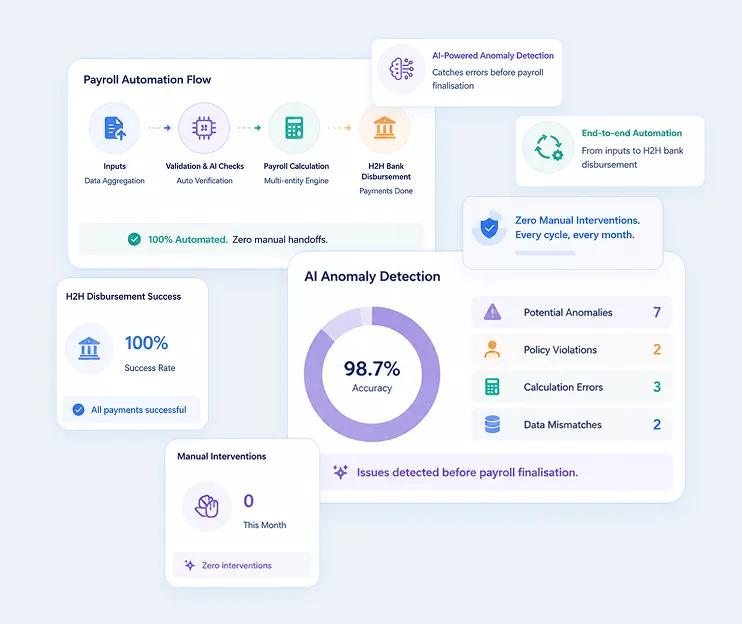
ZingZeroTAP, ZingHR's industry-first zero-touch payroll engine, processes every pay structure, every location, and every statutory deduction through a self-reconciling system.
Attendance records, shift data, overtime, leave balances, and payroll calculations operate within a self-reconciling framework that continuously validates payroll inputs before salary processing begins.
2. Agentic Intelligence That Catches Errors Before They Become Salaries
Payroll mistakes rarely originate during salary disbursement. Most begin much earlier through incorrect attendance data, wage structure mismatches, overtime anomalies, or compliance configuration gaps.
ZingHR’s AI-powered intelligence layer analyses payroll inputs before payroll execution. The platform flags unusual overtime patterns, attendance inconsistencies, and wage structure issues that may affect statutory compliance or salary accuracy.
3. Built for India's Payroll Reality
India processes payroll against PF, ESI, PT, LWF, TDS, and gratuity obligations that vary by state, employment classification, and salary band.
ZingHR's payroll and workforce management engine is purpose-built for this complexity, managing multi-state PT slab configurations, New Labour Codes wage restructuring, and full and final settlement processing within 48 hours are all present as native capabilities.
4. Board-Level Payroll Intelligence
Payroll has become a strategic reporting function for CFOs, CHROs, and leadership teams. Beyond salary disbursement, organisations need visibility into payroll costs, workforce trends, compliance obligations, and operational risk exposure.
ZingHR’s cloud-based payroll software surfaces data through real-time reporting and workforce analytics, helping leadership teams monitor payroll performance across business units, employee categories, and locations.
Payroll operations become measurable through indicators such as processing accuracy, workforce costs, compliance status, and payroll completion progress.
Your Payroll Reality Should Decide Your Platform
Every platform in this list addresses a specific dimension of India's payroll management challenge. The right choice depends on your scale, state footprint, and whether you need a payroll tool that processes salaries or one that governs payroll as a strategic function.
ZingHR delivers the deepest combination of zero-touch payroll automation, AI-driven anomaly detection, and multi-state statutory compliance for enterprises with 1,000+ employees across multiple Indian states.
New Labour Codes readiness and real-time attendance-to-payroll reconciliation operate within the same unified HCM platform, powered by agentic intelligence. It is the payroll management software built for the CHRO who carries board-level accountability.
Match the platform to your payroll reality. Then move from evaluation to execution.
Book a demo to see how ZingHR's agentic intelligence HCM platform handles your enterprise payroll.
Frequently asked questions (FAQs)
Payroll management software automates salary calculation, statutory deductions (PF, ESI, PT, LWF, TDS, and gratuity), payslip generation, and bank disbursement. It replaces manual spreadsheet-based payroll processing, ensures compliance with Indian labour laws, and reduces payroll cycle time from days to hours. Indian businesses need it because manual payroll exposes them to statutory penalties, employee disputes, and audit failures. Multi-state operations multiply this risk with varying PT slabs and LWF rules across every state jurisdiction.
Enterprise-grade payroll platforms cover EPF (Employees' Provident Fund), ESI (Employees' State Insurance), Professional Tax, Labour Welfare Fund, Tax Deducted at Source, and gratuity calculations. Payroll-first tools like Keka HR and PeopleStrong handle all five natively. Full-suite platforms like ZingHR extend this to multi-state PT slab management, New Labour Codes wage restructuring validation, digital register generation, and full and final settlement processing within 48 hours.
The four New Labour Codes consolidate India's labour legislation: the Code on Wages (2019), the Code on Social Security (2020), the Industrial Relations Code (2020), and the Occupational Safety, Health and Working Conditions Code (2020). Key payroll implications include the 50% minimum basic wage rule, 48-hour full and final settlement requirements, and mandatory digital register formats.
Yes, the right payroll management software depends on complexity alongside headcount. Small businesses with 10-100 employees operating in one to two states can manage payroll effectively with entry tier plans. Organisations managing payroll across five or more states or processing contract labour payroll should evaluate enterprise-grade platforms like ZingHR that provide deeper automation and statutory execution.
Implementation timelines vary by platform and payroll complexity. SAP SuccessFactors and RazorpayX Payroll deploy in under a week for simple payroll structures. Keka HR and PeopleStrong complete in 2-4 weeks. Mid-market platforms like Darwinbox require 6-12 weeks for standard deployments. Enterprise platforms like ZingHR include structured onboarding covering payroll process mapping, state-specific rule configuration, and integration setup, with timelines scaled to workforce complexity.
What to do next?
See ZingHR in Action
Join the 1,200+ enterprises that have replaced fragmented HR with one intelligent, future-ready platform. See ZingHR in 30 minutes.
Build the Organization You Want
Great HR drives retention, capability, and culture. ZingHR takes care of the operational layer so your people team owns the strategy.

Elevating Impact.
Defining Destiny
See how ZingHR's AI-powered Hire-to-ReHire platform frees your CPO to lead with purpose and deliver the outcomes your Board is watching for


ZingHR is the AI-powered Hire-to-ReHire platform built for one purpose to remove every transactional layer of HR from your organisation, permanently.