HR Technology: What It Is, Examples and How to Choose
Nine categories make up a typical HR tech stack, and the overlap between them is where budgets leak. Map workflows, test integrations and plan adoption before picking a platform.


Table of contents
One unstitched HR platform to manage your entire workforce, from Hire to Re-Hire.
Talent Management solutions built for growing and exceptional people
Built-in compliance tools that update with changing regulations
Automated payroll, attendance, and leave management
Insights that help HR leaders make faster, better decisions

Key Takeaways
- HR technology is the software HR teams use to run hiring, payroll, attendance, performance, learning and workforce reporting.
- AI features are now standard in Indian HR software, so buyers compare how well the AI works on their own data and policies.
- Nine software categories make up a typical HR tech stack, and HRIS, HRMS and HCM suites overlap enough that teams often pay for the same capability twice.
- Choosing well depends on mapping current workflows, setting measurable targets, testing integrations and planning adoption before signing a contract.
- ZingHR covers Indian statutory payroll natively, runs Ghrowth.ai agentic intelligence on WhatsApp and Microsoft Teams, and reports through 19 live Power BI dashboards.
Indian HR teams now buy software against a tighter brief: payroll has to absorb the four Labour Codes, managers expect approvals inside the tools they already use, and boards want workforce numbers without waiting for month-end.
72% of Indian organisations have integrated AI features into their HR software, according to Capterra India's 2025 HR Software Trends Survey. The time pressure sits with managers too: Deloitte's 2025 Global Human Capital Trends report found managers spend around 40% of their time on administrative work and immediate problem solving, and only 13% developing their people.
What is HR Technology?
Human resources technology is any software used to run HR operations, from a payroll system that files Tax Deducted at Source (TDS) returns to a reporting tool that flags employee attrition risk by department.
HR leaders set policy and priorities. The software carries the transactions, records and approvals that follow from them, at a volume no spreadsheet can hold.
Types of HR Technology in HR Departments
HR tech stacks are built from a handful of category types, and the overlap between them is where teams end up buying the same capability twice. Nine categories cover the use cases Indian HR teams run into:
- Human resource information systems (HRIS): Central hub for employee data, holding personal records, job history and org structure. HRIS platforms sit at the base of the stack and feed downstream tools with clean data.
- Human resource management systems (HRMS): Extend an HRIS to cover payroll, time tracking and self service portals, alongside talent management. HRMS platforms are what Indian HR teams use for daily operations.
- Human capital management (HCM) suites: Combine core HR, workforce management and talent acquisition on a single platform, with learning and analytics on top. Organisations running several legal entities tend to choose HCM suites over point solutions.
- Applicant tracking systems (ATS): Handle the recruitment process end to end, covering job description creation, multi-channel posting, candidate shortlisting and offer roll-out. AI resume screening has shifted from a nice-to-have into a default.
- Performance management tools: Support goal setting, continuous check-ins, 360 feedback and calibration. Indian HR practices are moving away from once-a-year reviews toward continuous performance management.
- Learning management systems (LMS): Deliver training content, track completions and map courses to competencies, so a skills gap found in a review becomes an assigned course.
- Payroll systems: Automate salary calculations, statutory deductions and bank disbursement. In India, the payroll layer handles Provident Fund (PF), Employees' State Insurance (ESIC), Professional Tax (PT) and TDS across every state the organisation operates in.
- Employee engagement platforms: Use pulse surveys, polls and recognition to track sentiment by team. Engagement tools also give managers a record of recognition given and received.
- Workforce analytics platforms: Pull data from every source in the HR stack into one reporting layer, so headcount, attrition, cost per hire and pay equity can be read together.
Also read: What is Human Capital Management? Explained in Detail
HR Technology Examples in Practice
Categories describe the shape of the stack. The examples below show the work each one takes off an HR team's desk.
1. Recruitment Automation
Applicant tracking systems automate job posting, resume screening and interview scheduling across job boards. AI tools rank candidates against structured criteria, so hiring managers receive a shortlist ready to interview.
2. Payroll Processing at Scale
Payroll systems calculate gross to net, apply state-specific statutory rules and disburse salaries through host-to-host bank integration. Variance checks against the previous month run in the same interface before the payroll admin approves the run.
3. Continuous Performance Management
Performance management tools facilitate ongoing feedback between employees and managers throughout the year. Approved ratings flow into the compensation workbench. The spreadsheet handoff between HR and finance that used to create merit-cycle delays goes with it.
4. Employee Self Service
Self-service portals give employees direct access to leave balances, payslips and tax forms without HR intervention. Personal record updates run through the same portal. Managers approve claims and leaves inside the same system, cutting email chains out of the workflow.
5. Attrition Analysis
When exits rise in one region, an analytics tool lets the HR business partner filter them by manager, tenure band and pay quartile, alongside the other HR metrics the monthly review tracks. The cut goes to the business head before the meeting.
Also read: Best Workforce Analytics Software: 6 Top Picks
Benefits of HR Technology
Five gains show up once HR technology is in daily use, and each changes a specific part of the HR team's week:
Five ways HR technology changes the day-to-day for Indian HR teams
The hours saved land with HR professionals and managers. With less time on reconciliation and query handling, HR can put that time into retention programmes and workforce planning.
HR Technology Trends Worth Tracking
IMARC Group projects the India HR technology market to grow from USD 1,208.26 million in 2025 to USD 2,329.11 million by 2034. Four shifts are shaping where HR leaders spend that budget.
1. Agentic AI
AI in HR software is moving from answering questions to completing tasks: an agent can read a leave request, check the balance and route the approval without an HR admin touching it. Buyers now ask vendors which actions an agent can take, and which still need a human sign-off.
2. Skills Based Hiring
Companies are shifting from CV filters based on job history toward skills based hiring backed by assessments. The change favours candidates who can demonstrate capability. It also forces the ATS layer to hold competency data alongside job descriptions.
3. Labour Codes Payroll Changes
The four Labour Codes took effect on 21 November 2025. Allowances above 50% of total pay now count towards wages, which raises the base for PF, gratuity and overtime. HR teams are reworking salary structures and checking whether their payroll software applied the new labour code rules automatically.
4. Conversational Self Service
Employees expect HR answers inside the chat tools they already use, and vendors are grounding those answers in each organisation's own policy documents to keep them accurate. The design question for buyers is which queries close inside the chat and which hand over to a person.
How to Choose the Right HR Technology
Buying HR technology is a structured decision. The steps below give HR leaders a way to shortlist HR tech solutions and defend the pick in front of finance and IT.
1. Workflow Mapping
Document how hiring, onboarding and payroll work today, alongside leave, performance and offboarding. Identify where manual tasks or approval bottlenecks slow the team down.
Requirements written against a live workflow beat requirements written against a demo.
2. Objectives and Metrics
Tie the investment to measurable outcomes. The list usually covers:
- Time to hire and cost per hire.
- Payroll accuracy and compliance filing rate.
- Employee satisfaction and employee Net Promoter Score (eNPS).
- Manager adoption on approvals and calibration.
Clear objectives sharpen vendor conversations and give the board a way to judge success at 12 months.
3. Integration Checks
Every HR tech solution needs to exchange data with enterprise resource planning (ERP), finance and biometric attendance systems, plus collaboration tools and email. Ask vendors for a live integration demo using your own systems.
4. Employee Experience Testing
Have five of your employees try the self-service flow on their own devices. Pick a factory operator alongside a field executive and a knowledge worker. Adoption depends on usability, and the employee experience layer is where marketing copy meets reality.
5. Training and Adoption
Budget for vendor-led training and change management, and run payroll in parallel on the old and new systems for at least one cycle before switching. Name a power user in each function to answer colleagues' questions and report adoption gaps.
Also read: The Complete Guide to HR Software Implementation
Common HR Technology Mistakes to Avoid
Five mistakes turn up repeatedly when Indian HR teams move onto a new platform, and each has a straightforward fix.
- Buying features without buying integration: A best-of-breed ATS that cannot pass data to payroll creates two records for every hire. Score integration depth during vendor evaluation, with the same weight as features.
- Underinvesting in data hygiene: Migrating messy employee records into a new system produces messy dashboards and broken reports. Run data cleanup as a distinct workstream before go-live, with clear ownership and a defined completion bar.
- Ignoring the manager experience: Managers approve, coach and calibrate, and systems built only for HR admins lose them within a quarter. Include managers in vendor selection and have them test approval flows on their own devices.
- Chasing every AI feature: Generic AI assistants that lack access to your policies produce responses which damage credibility. Prioritise policy-grounded AI reading from your own knowledge base over a public model with a corporate skin.
- Skipping compliance depth: Indian statutory compliance varies by state and headcount, so payroll and HRMS platforms need state-specific logic. Make PF, ESIC, PT and TDS coverage a demo requirement, complete with state-by-state rule handling.
How ZingHR Adds Value to Your HR Tech Stack
ZingHR is an AI-led HCM platform built for Indian organisations, covering core HR, workforce management, talent, engagement and analytics.
1. One Unified Platform
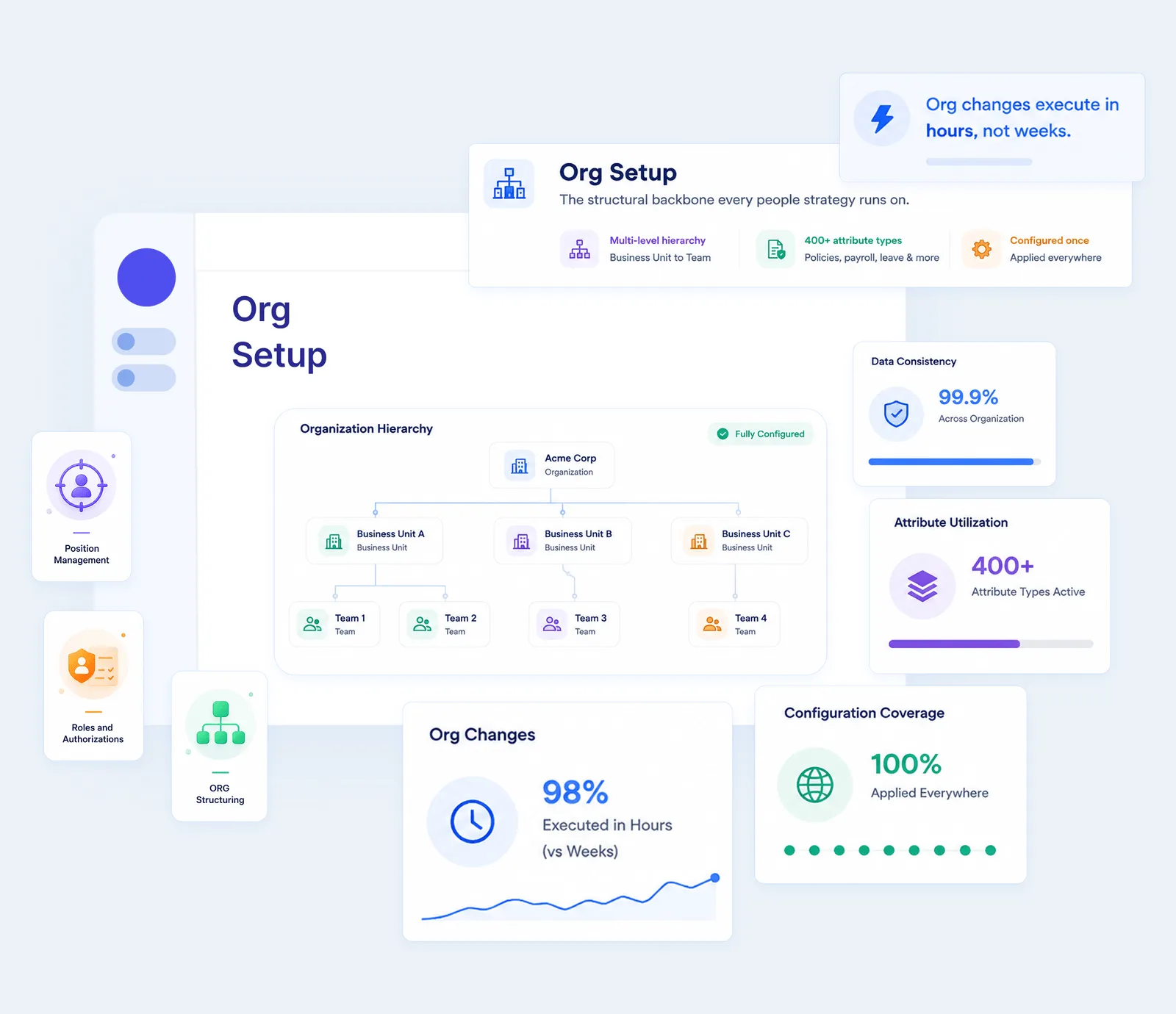
HR Launchpad holds the foundational employee dossier, with 400+ configurable fields covering personal, professional and financial data. Everything downstream, from payroll to performance, reads from the same record.
The unified architecture removes the reconciliation headaches that fragment most HR tech stacks. HR, Finance and Operations stop running separate systems that produce contradictory numbers.
2. Ghrowth.ai for Agentic Intelligence
Ghrowth.ai carries the agentic intelligence layer inside the platform. It answers HR queries on WhatsApp and Microsoft Teams, grounded in the organisation's own policies via Retrieval-Augmented Generation (RAG).
It goes further than a chatbot. Ghrowth.ai raises routine transactions like leave and claims, and it surfaces payroll anomalies before pay runs. The agentic layer closes the loop between insight and action inside the same interface HR teams already use.
3. Zero-Touch Payroll With Live Analytics
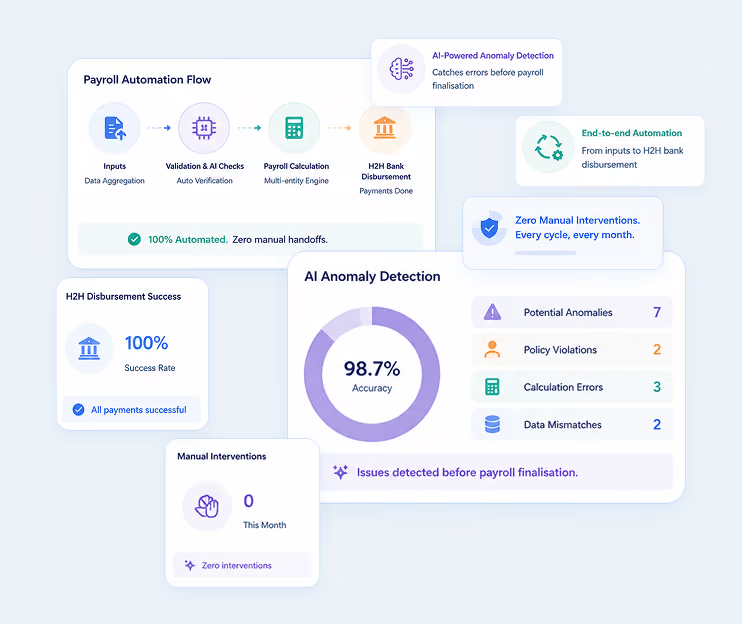
ZingZeroTAP handles zero-touch payroll across every legal entity. It aggregates attendance, leave, salary revisions and full-and-final inputs into one automated pass. Statutory filings for PF, ESIC, PT and TDS apply automatically as government notifications land.
The Zing Intelligence Hub layers 19 live Power BI dashboards on top, tuned per persona with row-level security. Boards see workforce cost across every entity. HRBPs see their business unit. Managers see their team.
Key capabilities across the ZingHR stack for HR leaders in India:
- Native Indian payroll processing with automated PF, ESIC, PT, TDS and Form 16 issuance.
- Blockchain-backed document security for employee records through ZingID.
- 100+ integrations covering ERP, finance and biometric devices.
Building an HR Tech Stack That Gets Used
HR technology pays back through the hours it returns to HR teams and managers, and through workforce numbers leaders can rely on in a review.
Start with the workflow that costs your team the most time each month, often payroll inputs or leave approvals, and judge every vendor on how it handles that workflow with your own data.
Book a demo to see ZingHR run your payroll and approval workflows on your own data.
Frequently asked questions (FAQs)
Pricing usually runs per employee per month, with separate one-time fees for implementation and data migration. Costs rise with the number of modules, legal entities and integrations. Ask vendors whether statutory compliance updates and support sit inside the subscription.
Timelines depend on the modules, the number of legal entities and the state of existing employee data. Core HR and payroll go live first, usually after at least one parallel payroll run. Talent and analytics modules follow once core records are clean.
It can be, if the vendor supports consent records, purpose-limited access and breach reporting under the Digital Personal Data Protection Act, 2023 (DPDP Act). Check where data is hosted, who can view salary fields and how audit logs are kept.
No. A 200-person company can start with core HR, payroll and attendance, then add performance and learning modules as headcount grows. ZingHR lets organisations switch on modules in stages on the same employee record, so early data carries forward.
ERP HR modules focus on employee records and cost data for finance. A dedicated HRMS adds Indian statutory payroll, leave policies, self-service and talent workflows. ZingHR connects to ERP and finance systems through 100+ integrations, so finance keeps its ledger while HR runs daily operations.
What to do next?
See ZingHR in Action
Join the 1,200+ enterprises that have replaced fragmented HR with one intelligent, future-ready platform. See ZingHR in 30 minutes.
Build the Organization You Want
Great HR drives retention, capability, and culture. ZingHR takes care of the operational layer so your people team owns the strategy.
Dr. Rohit Goswami
Head — Centre of Excellence
Dr. Rohit Goswami is Head — Centre of Excellence at ZingHR, where he leads Product Management and the AI Centre of Excellence. A surgeon-turned-product leader, he drives AI strategy across product lines and the entire employee lifecycle. Recognized as a thought leader in Agentic AI and HR technology, Rohit focuses on bridging emerging technology and real business outcomes — building intelligent, user-centric solutions that help organizations unlock productivity and prepare for the future of work.

Elevating Impact.
Defining Destiny
See how ZingHR's AI-powered Hire-to-ReHire platform frees your CPO to lead with purpose and deliver the outcomes your Board is watching for


ZingHR is the AI-powered Hire-to-ReHire platform built for one purpose to remove every transactional layer of HR from your organisation, permanently.