6 Best HRIS Software for Indian Businesses in 2026
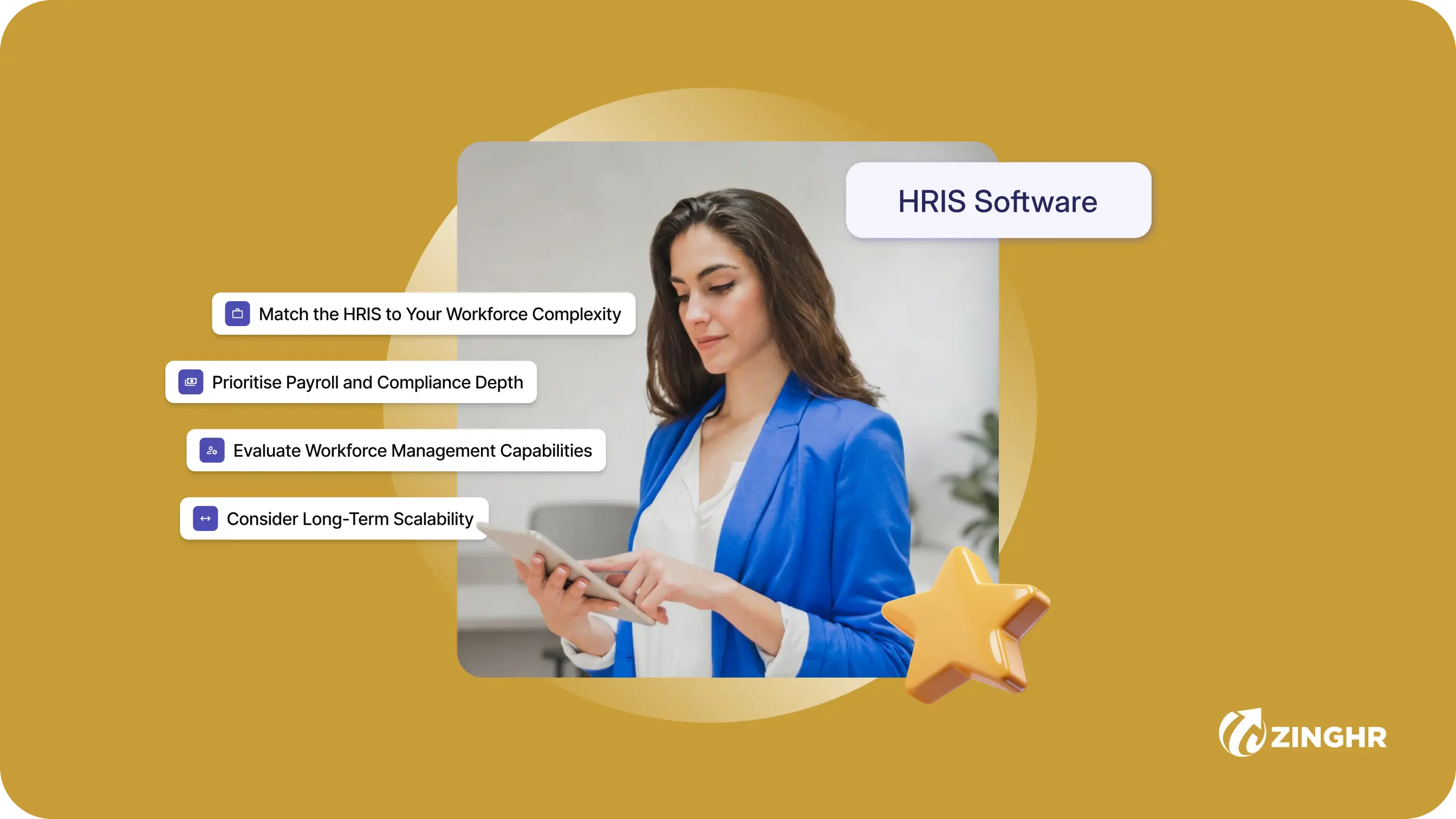
Table of contents
One unstitched HR platform to manage your entire workforce, from Hire to Re-Hire.
Talent Management solutions built for growing and exceptional people
Built-in compliance tools that update with changing regulations
Automated payroll, attendance, and leave management
Insights that help HR leaders make faster, better decisions

Key Takeaways
- ZingHR is the strongest fit for enterprises managing complex payroll, compliance, and workforce operations across multiple states or countries. Automated EPF, ESI, PT, and LWF filings run from a single platform, while AI-driven compliance intelligence flags payroll and statutory risks before they trigger penalties.
- We evaluated six HRIS platforms across core HR depth, payroll integration, international coverage, and pricing transparency. Ease of implementation and scalability by company size also shaped the rankings.
- HR teams today manage far more than employee records. Payroll reconciliation, onboarding, tax filings, leave management, and multi-country compliance create operational overhead that fragmented HR tools fail to solve cleanly.
- The right HRIS depends heavily on company size and geography. SMBs prioritise usability and cost efficiency, while enterprises need payroll-native architecture and workforce analytics that scale across jurisdictions.
Why Choosing an HRIS Is Harder Than It Looks
HR teams in 2026 are not short of options. The challenge is that every platform in the HRIS category claims to do everything, and the gap between what a vendor demo shows and what the software actually handles at your headcount, geography, and compliance complexity becomes clear only after you have signed.
The category also has a terminology problem. HRIS, HRMS, and HCM get used interchangeably in vendor marketing. For the purposes of this guide: HRIS covers core employee data, onboarding, time-off tracking, and basic compliance. HRMS adds payroll and learning. HCM extends further into workforce planning, advanced analytics, and finance integrations.
Most buyers searching for the best HRIS software need something in the HRMS range, and that distinction matters when comparing pricing and feature depth. Our comparison of the best HRMS software in India covers exactly that tier
This guide covers six platforms for 2026, matched to company size, workforce geography, and payroll complexity.
How We Evaluated These 6 Platforms
Our review drew on G2 and Capterra user ratings, verified pricing data from official websites, and five criteria applied consistently across every platform.
1. Core HR Feature Depth
A qualifying HRIS handles employee records, onboarding workflows, time-off management, org charts, and document storage.
Platforms that covered performance management and engagement tooling within the base subscription scored higher than those locking those features behind add-on tiers.
2. Skills Intelligence and Internal Mobility
Skills taxonomies and internal mobility programs drive measurable performance gains, according to Deloitte's 2026 research. Organizations redesigning work around skills outperform those locked into static job architectures.
Gap analysis and career pathing should connect directly to your workforce planning process.
3. Payroll Integration and Coverage
Payroll-native platforms, where pay calculations and statutory deductions share a data layer with employee records, scored above platforms requiring third-party integrations for payroll.
US-only payroll coverage was flagged as a limitation for companies with international headcount. Multi-country payroll depth received additional weight for globally distributed teams.
4. Compliance Handling
Automated tax filing, statutory reporting, and compliance change tracking reduce the manual burden on HR teams managing multi-state or multi-country obligations.
Platforms with built-in compliance monitoring scored higher than those requiring manual configuration or external consultants for regulatory updates.
5. Analytics and Workforce Planning
Headcount forecasting and attrition prediction are table stakes for enterprises at this scale. Cost modelling and board-level dashboards complete the picture.
The real test: can your CFO pull a headcount-vs-attrition figure in one step?
Quick Comparison: 6 Best HRIS Software Platforms
The table below compares six leading HRIS platforms based on their ideal business fit, core HRIS capabilities, and trial availability.
Six HRIS software platforms compared by company size, strengths, and pricing 2026
1. ZingHR
Verdict: The strongest HRIS choice for enterprises with 1,000+ employees that need employee lifecycle management, payroll, workforce operations, and compliance unified on a single platform. ZingHR stands out for combining core HRIS functionality with AI-driven automation across hiring, onboarding, attendance, payroll, performance, and workforce analytics, reducing the operational fragmentation common in enterprise HR teams.
ZingHR Key Features
ZingHR positions itself as an AI-powered Hire-to-ReHire HCM platform, covering the full employee lifecycle from recruitment through payroll, performance, learning, and rehire workflows within one unified architecture.
- AI-driven recruitment and onboarding: Recruiters access AI-ranked candidate shortlists, cognitive assessments, and structured hiring workflows inside the same HRIS. Remote onboarding automates document collection, offer letters, and pre-joining tasks before day one.
- Unified workforce management: Attendance, leave, shift rostering, geo-fenced punch-ins, and workforce scheduling operate from one dashboard. The platform supports field, gig, blue-collar, and distributed workforces through mobile-first workforce management tools.
- Zero-touch payroll automation: ZingHR’s ZingZeroTAP engine automates payroll reconciliation across locations, pay structures, and currencies with minimal manual intervention. Payroll workflows integrate directly with attendance and leave data, reducing reconciliation errors between systems.
- Employee self-service and mobile HR: Employees manage leave requests, attendance, pay slips, tax documents, and HR approvals through self-service portals and mobile apps. GPS-based attendance tracking and facial recognition support field-heavy operations.
- Performance and productivity management: Continuous KPI tracking, OKRs, 360° feedback, mentorship programmes, and productivity analytics sit within the same platform. HR teams monitor workforce performance without relying on disconnected tools.
- Learning and employee growth: ZingHR includes personalised learning pathways, multilingual micro-learning, succession planning, and career development workflows to support long-term workforce planning.
- Compliance and HR analytics: Payroll compliance, audit trails, workforce dashboards, and real-time reporting are built directly into the HRIS layer. CHROs and HR operations teams gain centralised visibility into workforce operations and compliance posture.
ZingHR Pros
- Unified HRIS architecture connecting recruitment, onboarding, payroll, workforce management, performance, learning, and compliance on a single data layer, eliminating fragmentation across separate HR tools.
- Strong workforce management depth for enterprises managing distributed, shift-based, gig, or multi-location teams, supported by geo-fencing, facial recognition, and mobile-first attendance systems.
- AI-driven automation reduces repetitive HR operations across payroll, hiring, compliance, and employee lifecycle workflows, allowing teams to focus on strategic workforce planning.
ZingHR Cons
- Built primarily for mid-market and enterprise organisations, meaning smaller businesses may find the platform’s breadth and configuration depth excessive for straightforward HR operations.
- Implementation requires process mapping and workflow setup upfront, particularly for enterprises managing multiple business units, locations, or workforce categories.
ZingHR is Best For
Enterprises with 1,000 or more employees operating across multiple Indian states or international locations, particularly those in BFSI, Manufacturing, Pharma, Retail and QSR, Healthcare, and Microfinance where statutory compliance complexity is high and manual filing processes carry meaningful penalty risk.
ZingHR Pricing
Quote-based, scaled to headcount and module selection. Book a demo for a pricing walkthrough based on your state footprint and compliance scope.
2. Darwinbox
Verdict: A strong contender for large enterprises across India and Southeast Asia that prioritise modern employee experience and mobile-first UX over deep payroll-native architecture. Darwinbox covers the core HCM stack well, but enterprises with heavy multi-state Indian compliance loads or shift-driven workforce operations often find the workforce management and statutory automation in payroll-native platforms a closer fit at scale.
Darwinbox Key Features
- Cloud-native HCM suite: Recruitment, onboarding, core HR, performance, learning, and analytics sit on a unified cloud platform with consistent UI across modules.
- Mobile-first employee experience: A mobile app supports attendance, leave, expense submission, and approvals, designed for distributed and field workforces.
- Onboarding workflows: Pre-joining task management, document collection, and offer letter generation are configurable without heavy IT involvement.
- Performance and engagement: Continuous feedback, OKR tracking, 360-degree reviews, and employee sentiment surveys are bundled within the platform.
- Payroll and compliance: India payroll with statutory deductions is supported, alongside multi-country payroll coverage for Southeast Asian markets. Compliance depth varies by regional module configuration.
Darwinbox Pros
- Modern UI and strong mobile experience reduce adoption friction across knowledge-worker and customer-facing teams.
- Configurable workflows across hiring, onboarding, and performance reduce reliance on external consultants for routine HR changes.
Darwinbox Cons
- Workforce management depth for shift-based, blue-collar, and field operations is less mature than payroll-native enterprise platforms, often requiring custom configuration for complex attendance models.
- Implementation timelines extend meaningfully for enterprises with multi-state Indian payroll, multiple legal entities, or industry-specific statutory variations.
Darwinbox is Best For
Mid-market and enterprise organisations between 500 and 5,000 employees across India and Southeast Asia, particularly knowledge-worker-heavy businesses in IT services, fintech, and modern retail where employee experience is a hiring differentiator.
Darwinbox Pricing
Quote-based, scaled to modules selected and headcount.
3. Keka HR
Verdict: A strong fit for Indian SMEs and mid-sized companies (50-500 employees) that prioritise straightforward payroll and core HR over enterprise-grade workforce management. Keka HR is well-regarded for usability and quick rollout, but organisations approaching multi-state operations or complex workforce categories typically need to migrate to a platform with deeper compliance and workforce management infrastructure.
Keka HR Key Features
- Payroll processing: Automated salary calculations, statutory deductions (EPF, ESI, PT, TDS), and payslip generation are bundled into the base offering for Indian businesses.
- Leave and attendance management: Configurable leave policies, attendance tracking, holiday calendars, and timesheet workflows handle standard mid-market HR operations.
- Performance management: Goal setting, continuous feedback, 1-on-1s, and review cycles are integrated, with templates suited to smaller HR teams.
- Hiring and onboarding: A built-in applicant tracking system and onboarding checklists support recruitment-heavy SMEs without separate ATS spend.
- Expense management: Reimbursement workflows, policy enforcement, and approval chains are available within the HRIS platform.
Keka HR Pros
- Clean, modern interface that reduces training overhead for HR teams and employees in growing companies.
- Bundled payroll, performance, ATS, and expense modules give SMEs reasonable feature coverage without stitching together separate tools.
Keka HR Cons
- Workforce management depth is limited for shift-heavy operations, geo-fencing, or large blue-collar workforces that need facial recognition attendance and complex rostering.
- Compliance automation across multi-state and multi-entity setups requires more manual configuration than enterprise-grade alternatives, increasing operational risk as headcount scales.
- Analytics and workforce planning capabilities are sized for mid-market use, with limited support for board-level dashboards and CHRO-grade forecasting.
Keka HR is Best For
Indian SMEs and mid-sized organisations between 50 and 500 employees, particularly knowledge-worker businesses with single-location or low-complexity payroll where ease of use outweighs deep workforce management requirements.
Keka HR Pricing
Customized HR and payroll solutions with quote-based pricing tailored to each organization’s size, requirements, and feature needs.
4. Ramco
Verdict: Ramco HCM is built for large organisations managing complex workforce structures, multiple legal entities, and multi-country payroll operations. Its strength lies in combining HR, payroll, workforce management, and compliance into a unified platform. While the system offers deeper operational capabilities than SMB-focused HRIS tools, implementation complexity and enterprise-oriented workflows can make it excessive for smaller businesses with straightforward HR needs.
Ramco Key Features
- Workforce management: Attendance tracking, shift scheduling, rostering, overtime management, geo-fencing, and time capture support operationally intensive industries.
- Employee self-service: Employees can access payslips, leave balances, attendance records, tax information, reimbursement requests, and profile updates through web and mobile portals.
- Core HR management: Centralised employee records, onboarding workflows, document management, organisational structures, and employee lifecycle tracking.
- AI and automation capabilities: Chatbots, workflow automation, analytics, and configurable business rules help reduce manual HR and payroll administration.
- Performance and talent management: It supports goal setting, appraisals, competency tracking, learning, and workforce development processes for enterprise HR teams.
Ramco Pros
- Strong payroll and workforce management capabilities make it well-suited for organisations with shift-based, distributed, or operational workforces.
- Multi-country payroll expertise and compliance support help enterprises standardise HR and payroll operations across regions.
Ramco Cons
- Implementation and configuration can be complex compared to SMB-focused HR software, often requiring dedicated internal resources.
- User interface feels less modern than newer cloud-native HR platforms, particularly in employee-facing workflows.
- Best value is realised at enterprise scale, making it difficult for smaller organisations to justify the investment and deployment effort.
Ramco is Best For
Large enterprises, multinational organisations, and workforce-intensive industries such as manufacturing, aviation, logistics, retail, healthcare, and services that require advanced payroll, workforce management, and compliance capabilities across multiple locations and countries.
Ramco Pricing
Pricing is available through custom enterprise quotes based on employee count, deployment scope, modules selected, and geographic requirements.
5. PeopleStrong
Verdict: A capable choice for large Indian enterprises managing attendance-led payroll, shift operations, and blue-collar workforces. PeopleStrong covers the core HCM stack with strong workforce management, though enterprises evaluating multi-country payroll, agentic AI automation, and unified compliance intelligence often prefer a more in-depth tool.
PeopleStrong Key Features
- Workforce and attendance management: Shift rostering, geo-fenced attendance, biometric integrations, and overtime tracking are central to the platform's enterprise positioning.
- Payroll processing: India payroll with multi-state statutory handling, alongside selected international payroll coverage, is bundled within the HCM layer.
- Performance and learning: OKRs, continuous feedback, and learning paths are included, with content libraries available through partner integrations.
- AI-led automation: Conversational HR bots, candidate screening, and workflow nudges are positioned as productivity tools for large HR operations.
PeopleStrong Pros
- Workforce management depth suits enterprises with shift-based operations, blue-collar workforces, and multi-location attendance requirements.
- Bundled HCM coverage across hiring, payroll, performance, and learning reduces the need for separate point solutions in large organisations.
PeopleStrong Cons
- Module integration depth varies, with some workflows requiring additional configuration to align payroll, attendance, and performance data on a single layer.
- Mid-market organisations may find the platform's enterprise positioning heavier than required, with implementation timelines and configuration overhead that exceed simpler deployments.
PeopleStrong is Best For
Large Indian enterprises with 1,000+ employees in Manufacturing, Retail, BFSI, and Services where workforce management complexity, shift operations, and attendance-led payroll are operationally significant.
PeopleStrong Pricing
Quote-based, scaled to modules selected and headcount.
6. SAP SuccessFactors
Verdict: One of the most comprehensive HCM platforms available for large enterprises managing complex global workforces. SAP SuccessFactors extends well beyond core HRIS functionality into talent management, workforce planning, learning, recruiting, and analytics. The breadth of functionality comes with implementation complexity and higher costs, making it most suitable for mid-market and enterprise organisations.
SAP SuccessFactors Key Features
- Core HR and leave management: Centralised employee records, organisational management, employee lifecycle tracking, benefits administration, and global workforce data management.
- Talent management suite: Recruiting, onboarding, performance management, succession planning, compensation management, and career development are integrated into a single platform.
- Learning management: Learning and development tools support employee training, compliance certification, skills development, and personalised learning paths.
- Workforce analytics and planning: Advanced workforce analytics, headcount forecasting, skills intelligence, and strategic workforce planning help HR leaders make data-driven decisions.
SAP SuccessFactors Pros
- Strong global capabilities support multinational organisations with complex compliance, localisation, and workforce management requirements.
- Deep reporting and workforce analytics provide valuable insights for strategic HR planning and talent development.
SAP SuccessFactors Cons
- Implementation, configuration, and ongoing administration often require significant internal resources or external consulting support.
- Licensing and deployment costs can be difficult to justify for smaller organisations with straightforward HR requirements.
SAP SuccessFactors is Best For
Mid-market and enterprise organisations with 500+ employees, particularly multinational companies that require advanced talent management, workforce planning, global HR operations, and extensive compliance support.
SAP SuccessFactors Pricing
SAP SuccessFactors uses custom enterprise pricing based on modules selected, employee count, deployment scope, and geographic requirements.
How To Choose The Right HRIS Software For Your Business
Your choice here will shape HR operations for the next three to five years. Here's how to narrow the field based on what matters for your enterprise.
1. Match the HRIS to Your Workforce Complexity
Entity count and worker classification shape every HRIS decision. A 200-person IT services firm and a 12,000-employee manufacturing group operate in entirely different ways.
If you run three shifts across eight plants, shift rostering and attendance-led payroll must be built-in capabilities. Office-based workforces, on the other hand, put more weight on employee experience and performance management.
2. Prioritise Payroll and Compliance Depth
Native PF and ESIC processing is mandatory for any HRIS serving Indian enterprises. PT and LWF must be equally embedded. TDS calculations, including dual income-tax regime support, should be built in, with automatic statutory updates when rates change.
Ask vendors specifically about multi-state PT calculations and how quickly they push rule changes. Platforms built outside India tend to bolt on compliance through local partners, which introduces delays and error risk.
3. Evaluate Workforce Management Capabilities
Geo-fenced attendance and biometric integration top the list when workforce scheduling drives your payroll accuracy. Overtime calculations and real-time attendance dashboards belong in the core platform as well.
4. Consider Long-Term Scalability
Headcount growth and entity expansion will test your HRIS architecture within three years of deployment.
If you're at 2,000 employees and growing 20% annually, your HRIS must handle 5,000 on the same architecture. Multi-entity support and configurable policy engines separate scalable platforms from ones that become bottlenecks. The ability to add modules through configuration alone matters equally.
Why ZingHR Stands Out Among HRIS Platforms In India
Here’s what makes ZingHR the best HRIS software in India.
1. Built Specifically for Indian HR Operations
ZingHR was purpose-built in India for the regulatory complexity and workforce structures your enterprise actually operates in. CTC breakups and reimbursement policies are native to the architecture. State-level compliance variations and multi-entity payroll are built the same way.
2. Combines HR, Payroll, Compliance and Workforce Operations
Connecting payroll and compliance to workforce scheduling usually means stitching together separate tools. ZingHR runs these functions on a single unified platform.
3. AI-Driven HR Operations and Workforce Intelligence
ZingHR's agentic intelligence layer executes multi-step workflows that go well beyond task automation. It resolves employee queries and flags attrition risk autonomously and optimises shift schedules and delivers board-level workforce insights in real time.
The Right HRIS Depends On Your Workforce And Operational Complexity
If you're under 200 employees with a single entity and straightforward compliance, platforms like Ramco or SAP SuccessFactors cover the basics affordably. Keka HR adds a cleaner interface and solid payroll for SMEs scaling toward 500 employees.
Once you cross 500 employees or operate across multiple entities, your requirements expand well beyond payroll. Darwinbox and PeopleStrong compete well in this range, with strengths in employee experience and blue-collar workforce management respectively.
At 1,000+ employees, multi-entity payroll and state-level statutory compliance become baseline requirements. Indian enterprises that need deep India compliance and unified workforce operations will find ZingHR the strongest fit on this list.
Book a demo to see how ZingHR's agentic intelligence HCM platform serves your enterprise.
Frequently asked questions (FAQs)
ZingHR offers the deepest India payroll and statutory compliance coverage for enterprises with 1,000+ employees, paired with unified workforce management and agentic intelligence. However, the best choice depends on your workforce structure and compliance complexity.
Keka HR and Ramco are strong options for Indian SMEs. Keka suits companies with 50 to 500 employees that want clean payroll and leave management. Ramco works well for smaller businesses under 200 employees focused on affordable payroll compliance.
India-built platforms like ZingHR and Keka handle PF and ESIC natively, with automatic statutory updates. Ramco offers comparable coverage for smaller businesses. PT and LWF are processed natively across all these platforms. TDS calculations, including dual regime support, follow the same built-in approach.
Enterprise-grade platforms like ZingHR and PeopleStrong include native shift rostering and geo-fenced attendance. Biometric integration and overtime calculations round out the multi-shift, multi-location toolkit. Mid-market platforms offer basic attendance tracking, which suits office-based teams. Shift-heavy industries like manufacturing and QSR require deeper capabilities.
Multi-location enterprises need a platform that handles entity-level payroll and state-specific compliance from a single system. Location-based workforce policies must be configurable at the same level. ZingHR is purpose-built for this, with multi-entity payroll and location-level shift configuration. Geo-fenced attendance works across all distributed operations.
What to do next?
See ZingHR in Action
Join the 1,200+ enterprises that have replaced fragmented HR with one intelligent, future-ready platform. See ZingHR in 30 minutes.
Build the Organization You Want
Great HR drives retention, capability, and culture. ZingHR takes care of the operational layer so your people team owns the strategy.

Elevating Impact.
Defining Destiny
See how ZingHR's AI-powered Hire-to-ReHire platform frees your CPO to lead with purpose and deliver the outcomes your Board is watching for


ZingHR is the AI-powered Hire-to-ReHire platform built for one purpose to remove every transactional layer of HR from your organisation, permanently.