6 Best Enterprise HR Software Platforms in India Compared
Top enterprise HR software solutions in India for 2026 compared.

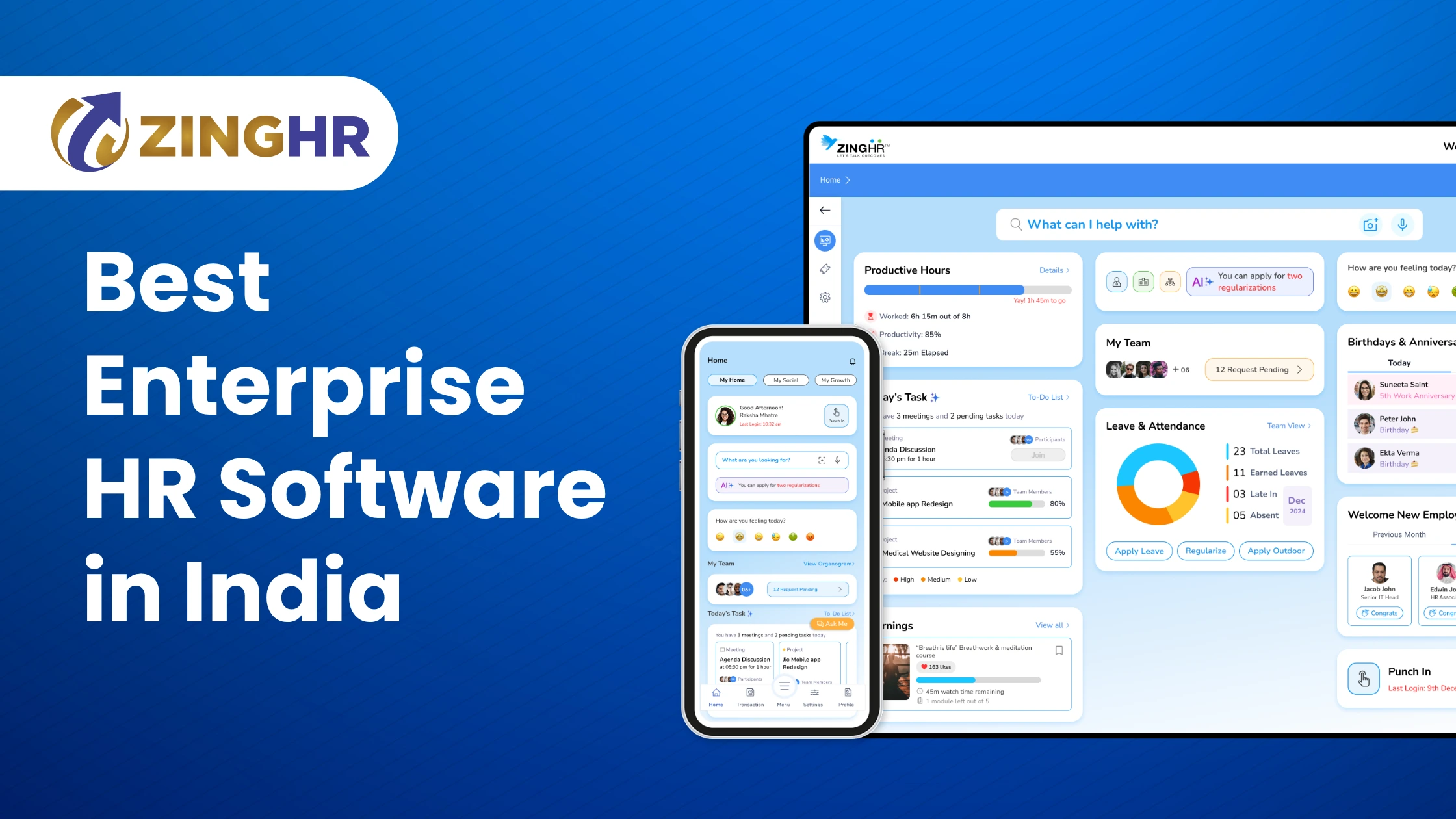
Table of contents
One unstitched HR platform to manage your entire workforce, from hire to rehire.
Talent Management solutions built for growing and exceptional people
Built-in compliance tools that update with changing regulations
Automated payroll, attendance, and leave management
Insights that help HR leaders make faster, better decisions

Key Takeaways
- Enterprise HR software built for 1,000+ employee organisations must unify payroll, compliance, talent management, and board-level analytics into a single architecture, fragmented point solutions introduce compliance risk and decision lag at scale.
- Regulated industries, BFSI, Manufacturing, Pharma, Retail, IT/ITes, and Healthcare, demand platforms with multi-geography compliance automation, not just localisation checkboxes.
- The shift from process automation to agentic intelligence is redefining what enterprise HCM delivers: proactive attrition signals, compliance risk flags, and workforce gap alerts at the CXO level, before the board asks the question.
- Global enterprises evaluating HCM platforms should prioritise five criteria: global payroll coverage, compliance automation depth, integration breadth with ERP/CRM/finance systems, real-time analytics, and scalability across legal entities.
- ZingHR is the only platform in this list purpose-built as a strategic command centre for Boards and CXOs, combining agentic intelligence with hire-to-rehire lifecycle coverage across Asia, EMEA, and SEA.
Managing a workforce of thousands across departments, geographies, and regulatory environments demands more than spreadsheets or fragmented point solutions.
Enterprise HR software consolidates recruitment, onboarding, payroll, performance management, compliance, and analytics into a single platform engineered for scale.
According to ISG's 2025 HR Technology survey, enterprises increasingly prioritise unified platforms that reduce tool sprawl and deliver board-level analytics.
In this article, we evaluate six enterprise-grade HCM platforms best suited for large organisations with 1,000+ employees operating in regulated industries. If your shortlist also spans the mid-market tier, start with the wider roundup of the best HR software in India.
6 Best Enterprise HR Software Platforms
The following table provides a side-by-side overview of the six platforms evaluated in this guide. Each is rated on G2, assessed for its primary differentiator, and matched to the enterprise use case it serves best.
How did we compile this list?
We conducted the evaluation using verified user reviews on G2 and Capterra, vendor-published feature documentation, and independent analyst reports from sources such as TechnologyAdvice and ISG.
Each platform was assessed against enterprise-specific criteria: global payroll coverage, compliance automation, integration breadth, analytics depth, and scalability for 1,000+ employee organisations.
The goal is to provide you with a balanced, data-backed view that helps CXOs and HR leaders align platform selection with strategic workforce objectives.
1. ZingHR
Best for: Large enterprises with 1,000+ employees in BFSI, manufacturing, pharma and healthcare, retail and IT/ITes requiring unified HCM with board-level intelligence.
ZingHR is an agentic intelligence HCM platform engineered for Boards, CXOs, and HR leaders. Recognised among the top HCM suites by Gartner in Asia, ZingHR spans the full hire-to-rehire lifecycle, from talent acquisition, onboarding, performance, payroll, compliance, to e-Separation.
The platform provides CHROs, CFOs, CIOs, and CEOs with real-time workforce intelligence to support strategic decisions. Its global presence extends across SEA and EMEA, with an active user base exceeding 2 million.
By integrating every HR function with AI/ML-powered decision support, enterprises move from reactive administration to proactive workforce strategy. It is critical in regulated industries where multi-geography compliance carries significant operational risk.
ZingHR's Key Features
- ZingHR's AI layer, powered by Ghrowth.ai, shifts leadership focus from historical reporting to forward-looking risk detection. The platform flags compliance exposures, attrition signals, and workforce gaps before they escalate to board-level conversations.
Ghrowth.ai functions as a Strategic Command Center for Boards and CXOs. It consolidates signals across HR, Finance, Sales, and Operations into role-specific views built for the CEO, CFO, CHRO, and Board. Each view surfaces the metrics and risks most relevant to that role, without requiring manual data aggregation.
Leadership receives actionable intelligence automatically. Compliance risks appear in context. Attrition patterns are visible early enough to act on.
- Workforce Management with Zero-Touch Payroll: Attendance, shifts, and payroll calculations are fully automated across all entities and jurisdictions. For enterprises running payroll across multiple states or countries with different tax structures, this means no manual reconciliation, no missed statutory deadlines, and no compliance gaps between one payroll cycle and the next.
- Talent Acquisition with AI/ML Screening: ZingHR replaces the manual top-of-funnel entirely. Requisitions flow into multi-mode sourcing channels, and resumes are matched and ranked by AI. Shortlisted candidates move into robotic video interviews, all before a recruiter makes a single call.
ZingHR's Pros
- Comprehensive unification of HR processes from hire-to-rehire reduces data silos effectively.
- Strong compliance features purpose-built for regulated industries like BFSI and manufacturing.
- Real-time board-level analytics support strategic decisions for CXOs.
- Mobile accessibility and self-service capabilities improve employee engagement.
ZingHR's Cons
- Implementation timelines can extend for complex, multi-entity setups.
- Advanced customization may require specialist support during initial configuration.
2. SAP SuccessFactors HXM
Best for: Global enterprises requiring deep ERP integration, AI-enhanced talent management, and localised compliance across 100+ countries.
SAP SuccessFactors HXM is a cloud-based HCM suite for large enterprises that need to align workforce strategy with broader business operations.
SuccessFactors connects workforce data with financial, supply chain, and customer data. It reduces the reconciliation overhead that disconnected systems create. It also has localisation capabilities with pre-configured compliance rules, tax regulations, and reporting standards.
SAP SuccessFactors HXM's Key Features
- AI-Enhanced Talent Management: AI across recruitment, learning, and performance delivers intelligent candidate matching, personalised development recommendations, and sentiment analysis that surfaces engagement risks early.
- Global Payroll & Localisation: Payroll with automatic tax and statutory updates. Eliminates the need for region-specific payroll vendors across EMEA, APAC, and the Americas.
- Succession Planning & Workforce Analytics: Succession tools map talent pipelines and identify readiness gaps. Analytics dashboards track headcount trends, pay equity, and turnover risk.
- Employee Experience Management (HXM): Continuous feedback loops, pulse surveys, and experience scores shift the platform from a system-of-record to a system-of-engagement.
SAP SuccessFactors HXM's Pros
- Broad AI add-ons for analytics, personalization, and sentiment analysis.
- Strong global payroll coverage with automatic localization updates.
- Seamless integration within the SAP ecosystem for unified business operations.
SAP SuccessFactors HXM's Cons
- Steep learning curve for organizations without prior SAP experience.
- High implementation costs and extended deployment timelines.
- Can be overly complex for mid-sized teams with simpler requirements.
.webp)
3. Workday HCM
Best for: Enterprises prioritising real-time analytics, workforce modelling, and unified HR-finance operations for data-driven decision-making.
Workday HCM is a cloud-native platform for HR, finance, and planning, serving enterprises like Target and other Fortune 500 organisations.
Its defining advantage is connecting HR and financial data within a single architecture, enabling CXOs to correlate headcount decisions with financial projections and model reorganisation scenarios in real time.
Workday HCM's Key Features
- Real-Time Analytics & Customizable Reporting: Workday surfaces insights the moment data changes, covering attrition risk, headcount trends, pay equity, and diversity metrics with highly customizable reporting for HR and finance teams.
- Unified HR-Finance Platform: Payroll costs, headcount planning, and revenue forecasts share a common data source, eliminating reconciliation errors and providing a single version of truth for cross-functional planning.
- Workforce Planning & Modelling: Scenario-modelling tools forecast the impact of hiring plans, reorganisations, and attrition on financial outcomes with budget alignment built in.
- Performance & Learning Management: Goal-setting, continuous feedback, performance reviews, and learning pathways integrate directly with succession planning for always-current pipeline visibility.
Workday HCM's Pros
- Excellent report customization and real-time analytics depth.
- Unified HR-finance integration eliminates data reconciliation overhead.
- Intuitive interface consistently praised by end-users across roles.
Workday HCM's Cons
- Pricing places it out of reach for smaller enterprise segments.
- Limited out-of-box payroll coverage in certain regions requires third-party partners.
- Occasional performance lags reported when processing very large datasets.
4. Oracle Fusion Cloud HCM
Best for: Enterprises requiring highly configurable AI-powered workflows, deep ERP-CRM-SCM integration, and comprehensive compensation management across complex organizational structures.
Oracle Fusion Cloud HCM integrates HCM with ERP, CRM, and SCM for large, complex enterprises, serving clients like FujiFilm and Wendy's. Oracle lets enterprises model complex compensation structures, build custom approval chains, and configure workflows without developer intervention.
For enterprises already on Oracle infrastructure, HCM data flows directly into financial reporting, customer ops, and supply chain planning, no middleware required.
Oracle Fusion Cloud HCM's Key Features
- AI-Powered Workflows & Personalization Personalized career recommendations, intelligent task routing, and adaptive learning suggestions reduce administrative friction and surface actionable insights for managers.
- Configurable Modules Without Custom Code Talent, payroll, compensation, and learning modules adapt to organization-specific policies, union requirements, and region-specific approval chains without writing code.
- Compensation Management Advanced modelling for merit cycles, bonus plans, equity awards, and total rewards statements. Scenario analysis ensures pay equity compliance before finalizing decisions.
Oracle Fusion Cloud HCM's Pros
- Advanced AI analytics and workforce modelling capabilities.
- Highly configurable workflows adapt to complex enterprise requirements without custom code.
- Strong compensation management tools supporting global pay equity analysis.
Oracle Fusion Cloud HCM's Cons
- Complex setup typically requires specialized implementation partners.
- Full deployment costs are among the highest in the market.
- Innovation pace for new features can lag behind cloud-native competitors.
5. ADP Vantage HCM
Best for: Enterprises requiring proven multi-country payroll processing, extensive third-party integrations, and regulatory compliance at scale across 140+ countries.
ADP Vantage HCM is a comprehensive human capital management platform built for large enterprises that need reliable, compliant payroll processing across complex regulatory environments.
Organizations typically select ADP Vantage HCM when payroll accuracy and compliance are the primary selection criteria. The platform's tax engine handles federal, state, and local tax calculations, garnishment processing, and benefits administration with the precision that large enterprises require when managing tens of thousands of pay events per cycle.
ADP Vantage HCM's Key Features
- Open API Marketplace Pre-built integrations with hundreds of third-party applications, from ERP systems to benefits providers, extend platform functionality without custom development.
- Multi-Country Payroll Processing Payroll in 140+ countries with pre-configured compliance rules, local tax codes, statutory deductions, and currency conversions.
- Tax Filing & Compliance Automation: Automated federal, state, and local tax filings, including year-end reporting, W-2 generation, and garnishment processing with automatic regulatory updates.
- Benefits Administration: Health insurance, retirement plans, FSA/HSA, and PTO managed through employee self-service portals, reducing HR administrative overhead.
ADP Vantage HCM's Pros
- Vast integration options via the open API marketplace suit complex tech stacks.
- Reliable payroll compliance with automatic regulatory updates.
- Proven scalability for large workforces with complex payroll requirements.
ADP Vantage HCM's Cons
- User interface feels dated against other cloud-native competitors.
- Customer support response times vary depending on issue complexity.
- Pricing transparency is limited, with add-on costs that are difficult to forecast.
6. Rippling Enterprise HCM
Best for: Enterprises requiring true HR-IT convergence with unified employee records, global payroll across 185+ countries, and automated identity/access management.
Rippling unifies HR, payroll, compliance, identity management, and analytics into a single platform, a fundamentally different architectural approach from competitors that bolt together separate modules.
The platform's defining differentiator is its HR-IT convergence. When a new employee is onboarded, Rippling automatically provisions their payroll, benefits, laptop, security credentials, and application access from a single workflow. When an employee departs, the same unified record revokes everything instantly.
Rippling Enterprise HCM's Key Features
- Unified HR-IT Platform: Each employee is a single record that syncs across HR, IT, and finance. Role or location changes propagate instantly to payroll, benefits, device management, and application access.
- Global Payroll Across 185+ Countries: Full-time employees and gig workers across 185+ countries, handling currency conversions, local tax compliance, and statutory reporting.
- Identity & Access Management: Device provisioning, software access, and security policies run alongside HR workflows. Role changes trigger automatic access updates, critical in regulated industries under audit scrutiny.
- Compliance Automation: Automated monitoring across jurisdictions tracks changes in labour law, tax regulation, and reporting requirements. This reduces the manual compliance burden as organizations expand geographically.
Rippling Enterprise HCM's Pros
- True unification across HR, IT, and finance eliminates tool sprawl.
- Global payroll automation covering 185+ countries simplifies international expansion .
- Fast onboarding with automated provisioning of devices, apps, and benefits
Rippling Enterprise HCM's Cons
- Less mature for very large, complex enterprise deployments compared to SAP or Oracle.
- Pricing scales quickly as headcount and module count increase.
- Advanced analytics capabilities are less developed than Workday's dedicated planning tools.
Benefits of Enterprise HR Software
The right enterprise HR platform becomes the operational backbone of your workforce strategy. Here is what that looks like in practice.
- Unified command centre for all HR operations: A single platform brings recruitment, payroll, performance, compliance, and analytics into one place. HR teams get a clearer view of workforce operations without reconciling data across disconnected tools.
- Compliance automation across jurisdictions: Multinational teams can manage region-specific labour laws, tax rules, statutory reports, and audit requirements with less manual effort. Automated workflows reduce missed updates, reporting gaps, and documentation risks.
- Measurable efficiency gains through automation: Routine workflows such as payroll calculations, attendance tracking, leave approvals, and benefits administration become faster and more accurate. HR teams can spend more time on workforce planning, employee experience, and business support.
- Better employee experience through self-service: Employees can access payslips, apply for leave, update details, complete training, and track requests without raising HR tickets. Faster access reduces dependency on HR for everyday queries.
- Board-level workforce intelligence: Advanced analytics help leaders track attrition risk, pay equity gaps, succession readiness, productivity trends, and hiring needs in real time. CXOs get workforce data they can use for business decisions, not just HR reporting.
Key Features of Modern Enterprise HR Software
The best enterprise HR platforms combine automation, analytics, and employee experience into one system. Here are the key features to look for:
- Scalable multi-entity architecture: Supports multiple legal entities, business units, countries, and locations from one platform. HR teams can configure policies, approval flows, reporting structures, and compliance rules by entity or region.
- Global compliance management: Keeps HR teams audit-ready with country-specific rules, statutory reports, policy updates, and document trails. The feature is especially important for BFSI, pharma, and healthcare, where compliance gaps can carry serious risk.
- AI-powered workforce analytics: Helps leaders spot attrition risk, skills gaps, hiring bottlenecks, and compensation gaps early. The goal is to support better workforce decisions, not just report what happened last quarter.
- Integrated payroll and benefits: Connects payroll with attendance, leave, tax, reimbursements, bonuses, and benefits data. The setup reduces manual checks, improves payroll accuracy, and gives employees clearer visibility into pay and deductions.
- End-to-end talent management: Covers hiring, onboarding, goals, performance reviews, learning, internal mobility, and succession planning. HR teams can manage the full employee lifecycle without switching across disconnected tools.
- ERP, CRM, and third-party integrations: HR data connects with finance, IT, ERP, CRM, and collaboration systems through APIs and pre-built integrations.
- Ghrowth.ai — Strategic Command Center: Built on ZingHR's data layer, Ghrowth.ai unifies HR, Finance, Sales, and Operations into a single intelligence platform. Boards and CXOs receive real-time alerts, succession visibility, and cross-functional insights in one command view.
Recommended reading: How HCM Software Works to Supercharge Your HR Efficiency
Why Choose ZingHR Enterprise HR Software?
ZingHR operates as a strategic command centre for GHROWTH, purpose-built for Boards, CXOs, and HR leaders managing large, complex workforces. Unlike traditional HR platforms that stop at process automation, ZingHR delivers agentic intelligence that drives governance, compliance, and measurable business outcomes from a single platform.
Recognised among the top HCM suites in Asia by Gartner, it is trusted across BFSI, Manufacturing, Pharma, Retail, IT/ITes, and Healthcare.
What separates ZingHR from legacy platforms is the combination of board-level analytics, mobile-first employee experience, and AI/ML-powered decision support, on a cloud-native architecture that scales across geographies.
The hire-to-rehire lifecycle coverage means CHROs, CFOs, CIOs, and CEOs get unified workforce intelligence without stitching together multiple point solutions.
Request a demo to explore why enterprises across Asia, EMEA, and SEA choose ZingHR as their HR tech systems partner, and see how the platform works in practice.
Frequently asked questions (FAQs)
The answer depends on your priority. Workday leads on analytics and HR-finance integration; SAP leads on global localisation within ERP ecosystems. For enterprises in Asia, EMEA, and SEA that need agentic intelligence alongside compliance automation, ZingHR is the stronger alternative to both, purpose-built for Boards and CXOs managing large, complex workforces.
For enterprises scaling across Asia, EMEA, and SEA, ZingHR delivers compliance automation with board-level payroll visibility. Rippling covers 185+ countries; ADP covers 140+.
ZingHR, SAP SuccessFactors, Workday, Oracle, ADP Vantage, and Rippling - all rated 4.1/5+ on G2, each built for a different enterprise priority.
Rippling is the strongest choice for HR-IT convergence and fast international scaling, though less mature than SAP or Oracle for complex legacy deployments.
Oracle's native ERP-CRM-SCM integration means workforce, financial, and operational data live in one architecture with configurable modules requiring no custom code.
ADP is the go-to for payroll reliability and statutory compliance across 140+ countries, while Workday offers stronger analytics and Rippling delivers a more intuitive user experience.
What to do next?
See ZingHR in Action
Join the 1,200+ enterprises that have replaced fragmented HR with one intelligent, future-ready platform. See ZingHR in 30 minutes.
Build the Organization You Want
Great HR drives retention, capability, and culture. ZingHR takes care of the operational layer so your people team owns the strategy.
Prasad Rajappan
Founder & Managing Director
Prasad Rajappan is the Founder and Managing Director of ZingHR, a leading HR technology platform focused on transforming workforce experiences through innovation, intelligence, and outcomes-driven solutions. With over three decades of experience across ERP, business process transformation, and HR technology, he has been at the forefront of workforce change and digital transformation. A recognized HRTech thought leader, Prasad writes and speaks on the future of work, AI-powered workforce solutions, and building agile, people-centric organizations.

Elevating Impact.
Defining Destiny
See how ZingHR's AI-powered Hire-to-ReHire platform frees your CPO to lead with purpose and deliver the outcomes your Board is watching for


ZingHR is the AI-powered Hire-to-ReHire platform built for one purpose to remove every transactional layer of HR from your organisation, permanently.