Best 8 Remote Workforce Management Software for Modern Indian Employers
Which remote workforce management software fits your entities, compliance map, and board-level reporting needs? Here's how the leading platforms stack up.

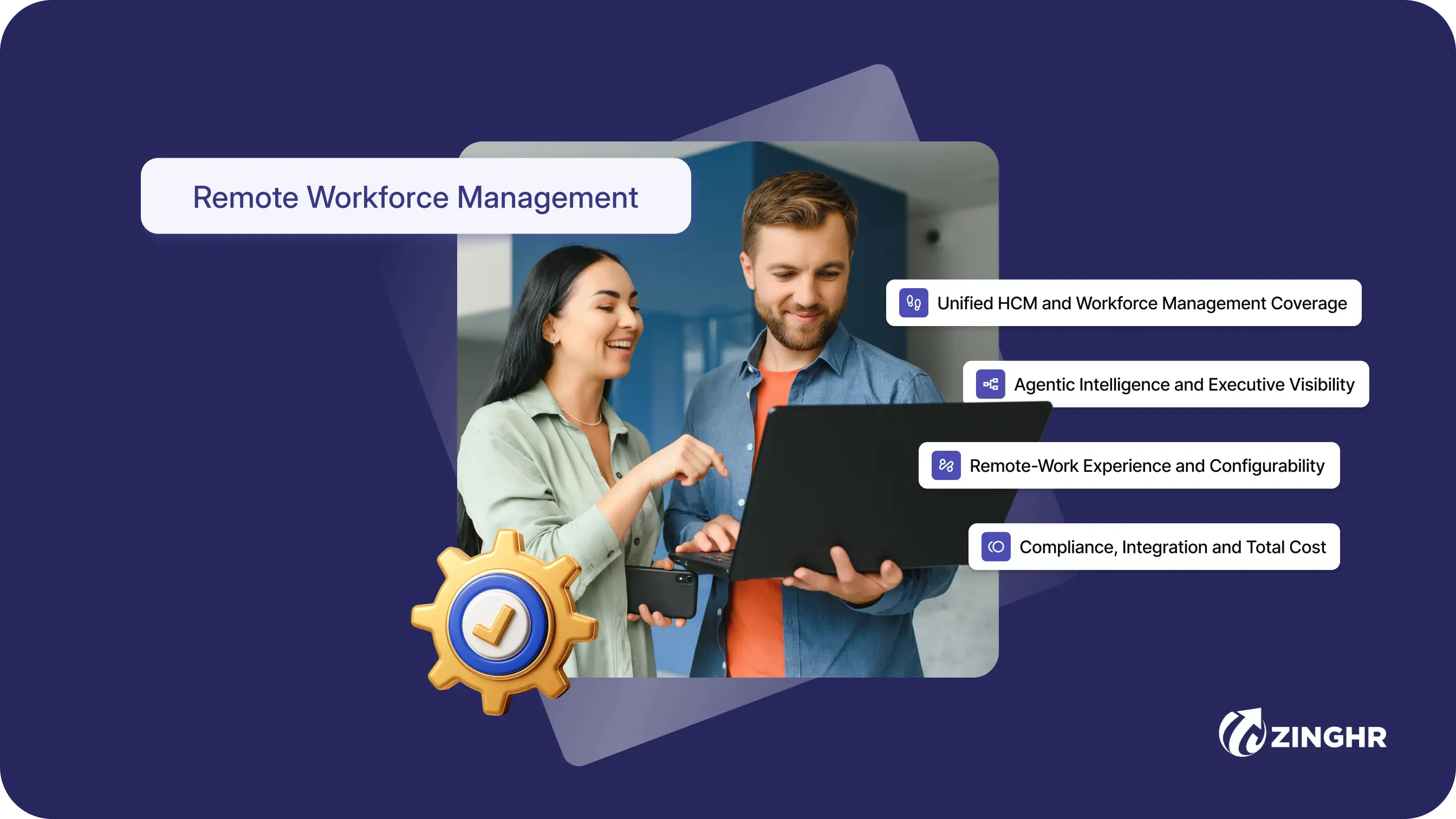
Table of contents
One unstitched HR platform to manage your entire workforce, from hire to rehire.
Talent Management solutions built for growing and exceptional people
Built-in compliance tools that update with changing regulations
Automated payroll, attendance, and leave management
Insights that help HR leaders make faster, better decisions

Key Takeaways
- Remote workforce management platforms now promise similar core features around attendance, payroll, and analytics. Your differentiator is how well a platform matches your entities and compliance map.
- Global mega-suites deliver strong scale and a single system of record. They also carry higher implementation cost and longer timelines that lean on system integrators.
- Regionally strong platforms tend to win on mobile experience and local payroll depth. Their no-code configurability helps when hybrid policies shift often.
- ZingHR pairs a unified Hire-to-ReHire HCM with an Agentic Intelligence core. It works as a strategic command centre for boards and CXOs, beyond a system of record.
- For under 1,000 employees in one country, a lighter, lower-cost tool often works. Multi-entity and multi-country operations are where enterprise suites earn their keep.
When you are comparing remote workforce management software for a 1,000+ employee enterprise, the shortlist matters more than the category. Every HRMS software for remote workforce management promises attendance, payroll, and analytics for distributed teams. The real question is which one fits your entities and compliance map, and matches your board's appetite for real-time visibility.
The guide below ranks eight platforms that enterprise buyers across BFSI, manufacturing, pharma, retail, and IT/ITeS actually evaluate, from global mega-suites to APAC-strong challengers. We cover what makes each the best workforce management software remote teams can rely on, and where each strains.
How We Evaluated the Platforms
We judged each platform against what matters when you run a distributed, multi-entity workforce, looking past marketing claims. Four criteria carried the most weight.
1. Unified HCM and Workforce Management Coverage
Can the platform run core HR, time and attendance, scheduling, payroll, and compliance for distributed staff in one place? We looked hardest at multi-entity and multi-country depth, since that is where fragmented stacks break down.
2. Agentic Intelligence and Executive Visibility
Embedded AI and analytics should surface real decisions: attrition risk, productivity trends, and labour cost. Board-level dashboards should give CXOs a live read on the workforce, above a month-old report that arrives too late to act on.
3. Remote-Work Experience and Configurability
Distributed teams work through apps and self-service chatbots. We weighed employee experience alongside no-code workflow engines that let HR update leave and approval rules independently of IT or a system integrator.
4. Compliance, Integration and Total Cost
We reviewed multi-country statutory coverage and security controls. We also weighed the integration ecosystem across ERP and identity, plus realistic total cost of ownership over licences and implementation.
Why ZingHR Wins for Remote Workforce Management
- ZingZeroTAP's zero-touch multi-entity payroll engine gives distributed organisations centralised control with local compliance across India, APAC, and the Middle East, removing the fragmentation that breaks most stitched-together stacks at exactly the point they are tested most.
- Ghrowth.ai's Agentic Intelligence, through the Zing Intelligence Hub, turns workforce data into real-time board-grade decisions on attrition risk, labour cost, and productivity, well before a month-end report arrives.
- The no-code Workflow Engine lets HR update leave, approval, and rostering policies independently of IT, a decisive advantage when hybrid and remote-work rules shift faster than a change-request queue can keep pace with.
- ZingSocial keeps distributed and frontline employees engaged through always-on AI chatbot support and a connected social feed, lifting adoption across geographies where HR cannot be physically present.
Remote Workforce Management Software Platforms at a Glance
The best remote workforce management software 2026 spans the full range of remote workforce management needs, from Indian SMB payroll specialists to global HCM command centres. The table below maps each to its strongest use case and verified ratings so you can orient your shortlist before reading the full profiles.
A high-level comparison of the best remote workforce management software 2026 platforms, covering best-fit, core capabilities, pricing model and verified G2 ratings as of August 2026.
1. ZingHR: Unified HCM and Agentic Intelligence Command Centre
ZingHR Is Best For
ZingHR suits mid-market and enterprise organisations, roughly 1,000 to 20,000+ employees, that want one unified HCM with AI and analytics at the core. It replaces a patchwork of stitched-together point tools and fits multi-entity, multi-location businesses across BFSI, retail, manufacturing, and IT/ITeS. If your CHRO and CFO want a single command centre for the Hire-to-ReHire lifecycle, with board-level visibility built in, ZingHR fits that profile.
ZingHR Key Features
- Zing Workforce Management: Centralises remote and distributed workforce operations with geo-fenced punch in/out, multi-mode attendance, leave management and shift rostering across locations.
- Geo-Fenced Attendance: Enables employees to punch in and out from approved locations using GPS, with Zing Workforce Management supporting location-verified attendance for field and distributed teams.
- AI-Driven Shift Scheduling: Uses demand forecasting and automated shift allocation to schedule employees across different locations and workforce requirements.
- Zing Intelligence Hub: Provides real-time workforce analytics through ZingIntel dashboards, giving managers visibility into absenteeism, overtime, shift performance and workforce costs.
- Productivity App: Helps managers monitor distributed teams through OKR and goal alignment, team output heatmaps and workload insights, including burnout-risk detection.
- ZingZeroTAP: Connects attendance, leave, overtime and loss-of-pay data directly to payroll, with AI anomaly detection identifying discrepancies before payroll is finalised.
ZingHR Pros
- Unified Hire-to-ReHire HCM on a single data backbone with embedded Agentic Intelligence, cutting the need for multiple point solutions
- ZingZeroTAP and multi-entity payroll are a strong fit for distributed, multi-location workforces needing centralised control with local compliance
- Deep AI across recruitment (ZingHire), performance (ZingGrow), and engagement supports real-time, data-driven decisioning
- No-code workflow engine and executive dashboards let HR move fast and give boards a live view of the workforce
ZingHR Cons
- Less well-known in North America and Western Europe than Workday, SAP, or ADP, which can affect internal stakeholder comfort
- Breadth of modules means you need strong implementation governance to reach full utilisation and clean configuration
Gartner Peer Insights: 4.6/5 (362 ratings)
ZingHR Pricing
ZingHR runs on subscription SaaS, with modules priced per employee per month and implementation scoped by complexity, entities, and geographies. Book a demo to get a scoped quote.
Verdict
ZingHR is a strong contender for any distributed, multi-entity organisation that wants a single AI-first command centre: unified HCM, zero-touch multi-entity payroll, and board-level analytics built in across India, APAC and the Middle East. SBI, Mahindra Finance, HDB Financial Services, and Burger King have made that call. Budget for disciplined implementation governance to get full value from its breadth.
2. Darwinbox: Cloud-Native HCM for APAC and Middle East Workforces
Darwinbox Is Best For
Darwinbox suits mid-market and enterprise organisations, roughly 500 to 10,000+ employees, that want a cloud-native HCM tuned to emerging markets. It fits CHROs across Asia, the Middle East and adjacent regions modernising legacy HCM in IT/ITeS, manufacturing, services, and retail. Distributed and frontline staff who live on their phones benefit most from its self-service experience.
Darwinbox Key Features
- End-to-end HCM covering core HR, leave, attendance, payroll, recruitment, performance, and engagement in one platform.
- Employee self-service and approvals built for remote and frontline workers, with strong app adoption across distributed populations.
- Deep configurability and localisation for policies, compliance, and languages across APAC and the Middle East.
- AI-driven talent and analytics features, including sentiment analysis and recommendations.
- Built-in workflows and automation to digitise HR processes end to end.
- Marketplace and integrations spanning collaboration, payroll, and identity tools, with an API framework for ERP and finance systems.
Darwinbox Pros
- Strong app experience for employees and managers, which helps distributed and frontline workforces adopt quickly
- Deep regional compliance and localisation for APAC and emerging markets, often ahead of global incumbents in those regions
- Broad HCM coverage replaces multiple point tools, with highly configurable workflows and org structures
Darwinbox Cons
- Workday and SAP maintain wider footprints and partner ecosystems across North America and Europe
- Customers report configuration complexity and change-management effort on large deployments
- Analytics and AI are capable, though top-tier global suites offer deeper advanced analytics
Gartner Peer Insights: 4.7/5 (600 ratings)
Darwinbox Pricing
Darwinbox runs on licence-based SaaS with quote-based pricing shared on request. Implementation and module scope depend on employee count and chosen features.
Verdict
When your remote and frontline population sits mainly in APAC or the Middle East, Darwinbox is a serious contender. Prioritise it where app experience and regional compliance depth matter.
3. Workday: Global HCM and Finance Integration
Workday Is Best For
Workday suits upper mid-market to large enterprises, from 1,000 to 100,000+ employees, that want a single strategic system of record spanning HR and finance. It fits CIOs and CHROs running complex global operations across tech, financial services, higher education, healthcare, professional services, and the public sector.
Workday Key Features
- Strong global HR capabilities across multi-country, multi-entity, and compliance scenarios.
- Embedded machine learning for skills, recommendations, and anomaly detection.
- Powerful people analytics and dashboards for leaders and HR.
- Extensive ecosystem and integrations across ERP, collaboration, identity, and payroll outsourcers.
- Highly structured security and role-based access, important for large regulated organisations.
Workday Pros
- Very strong capacity and reliability for complex, global organisations
- Unified data model across HR and finance supports strong analytics and workforce planning
- Broad functionality with frequent AI and automation innovations, backed by a large partner ecosystem
Workday Cons
- High implementation cost and complexity, often requiring SI partners and long timelines
- Smaller organisations with simpler needs may find it more than they require
- Configuration is powerful, though it can feel rigid next to newer no-code-heavy platforms
Gartner Peer Insights: 4.4/5 (828 ratings)
Workday Pricing
Workday runs on subscription SaaS with quote-only pricing shared on request. Total cost of ownership is driven by modules, headcount, and geography, and typically includes an implementation partner.
Verdict
For a large, complex, global organisation that wants HR and finance on one system of record, Workday is a benchmark choice. Budget for the implementation investment and timeline, and be honest about whether business units with simpler needs justify the spend.
4. SAP SuccessFactors: HCM for SAP-Centric Enterprises
SAP SuccessFactors Is Best For
SAP SuccessFactors suits large enterprises, from 5,000 to 100,000+ employees, that already run SAP ERP and want tight links between people and finance processes. It fits manufacturing, energy, retail, the public sector, and other regulated verticals standardising on SAP for integrated HR and finance operations.
SAP SuccessFactors Key Features
- End-to-end human experience management (HXM) spanning Employee Central, time, payroll, recruiting, onboarding, learning, performance, and compensation.
- Strong global time and attendance with localisation across many countries.
- Deep integration with SAP S/4HANA and other SAP line-of-business apps.
- Embedded people analytics and workforce planning tools.
SAP SuccessFactors Pros
- Best fit for SAP-centric enterprises needing tight HR and ERP integration
- Comprehensive functionality covering core HR alongside talent and learning
- Strong global coverage and compliance, especially for complex multinationals
SAP SuccessFactors Cons
- User experience keeps improving, though newer platforms have felt more intuitive historically
- Implementations can be long and consultant-heavy
- For shops outside the SAP stack, Workday and other suites deliver stronger integration value
Gartner Peer Insights: 4.4/5 (1,023 ratings)
SAP SuccessFactors Pricing
SAP SuccessFactors is modular and subscription-based, with pricing shared on request. It often forms part of a broader SAP modernisation programme.
Verdict
If you are standardising on SAP and want HR living close to your ERP, SuccessFactors is the logical choice for global, regulated operations. For companies outside the SAP stack, weigh the integration advantage against more modern, agile alternatives.
5. ADP: Payroll Accuracy and Multi-Country Compliance
ADP Is Best For
ADP suits organisations of all sizes that put payroll and compliance first, with particular strength in multi-country and compliance-heavy operations. HR and finance leaders across retail, manufacturing, healthcare, services, logistics, and franchise networks turn to ADP to offload payroll and compliance with integrated time and attendance.
ADP Key Features
- Market-leading payroll across the US and globally, with tax filing and compliance services.
- Time and attendance and scheduling for both on-site and remote staff.
- Benefits administration and HRIS, alongside talent modules covering recruiting, performance, learning, and onboarding.
- Deep regulatory compliance expertise and employer services, including HR advisory.
ADP Pros
- Extremely strong payroll accuracy and compliance track record
- Works across company sizes from SMB to enterprise across multiple product lines
- Wide integration ecosystem connecting accounting and ERP systems with HR tools
ADP Cons
- The product range can feel fragmented, with capabilities varying by ADP product
- Newer cloud-native HCMs sometimes rate higher on UI and reporting
- Service quality reviews can be inconsistent across regions and segments
G2: 4.4/5 (149 reviews, Comprehensive Services)
Gartner Peer Insights: 4.2/5 (75 ratings, Enterprise HR)
ADP Pricing
ADP uses tiered subscription models by product and headcount. Exact pricing stays private beyond entry-level SMB ranges.
Verdict
When payroll accuracy and multi-country compliance are the top priority, ADP is hard to beat and works across SMB to enterprise. Map precisely which ADP product you are buying, since capability and experience vary across the portfolio.
6. PeopleStrong: Hire-to-Retire HCM for India and Southeast Asia
PeopleStrong Is Best For
PeopleStrong suits mid-market and large enterprises based in India and Southeast Asia that want a regional platform with strong talent modules and flexible deployment. It fits CHROs across IT/ITeS, BFSI, manufacturing, retail and services who value local payroll depth and modern employee-experience tooling.
PeopleStrong Key Features
- Unified platform spanning core HR, payroll, attendance, recruitment, performance, and learning.
- AI-powered HR chatbots and employee-experience tools for self-service and helpdesk resolution.
- Strong India and APAC localisation for payroll and time management.
- Configurable workflows and process automation across HR operations.
- Talent and productivity focus with performance and collaboration features.
PeopleStrong Pros
- Strong grasp of APAC HR and payroll requirements, especially in India
- Good coverage of both core HR and talent in one unified platform
- AI and automation support employee self-service and the HR helpdesk
PeopleStrong Cons
- Limited brand recognition and implementation ecosystem outside APAC
- Integrations and analytics stay less mature than global mega-suites
- Niche or global scenarios may require additional customisation
Gartner Peer Insights: 4.7/5 (608 ratings)
PeopleStrong Pricing
PeopleStrong runs on subscription SaaS with quote-based pricing shared on request. Scope depends on your chosen modules and overall deployment complexity.
Verdict
If you need remote workforce management software India or Southeast Asia teams rely on, PeopleStrong is a credible regional contender with solid talent modules. Confirm integration depth and analytics against your reporting needs, and factor in its lighter presence beyond APAC.
7. Keka: Easy-to-Use HRIS and Payroll for SMBs and Mid-Market
Keka Is Best For
Keka suits small and mid-sized businesses of roughly 50 to 2,000 employees that want a modern, easy-to-use HRIS and payroll. It builds on a strong India base with growing APAC presence. It fits HR and finance leaders in tech, services, agencies, startups and manufacturing SMEs digitising HR for the first time.
Keka Key Features
- Core HR, payroll, leave, and attendance with strong India compliance.
- Performance management and OKRs alongside basic engagement features.
- Employee self-service and app for leave, attendance, and payslips.
- UX-led design and quick implementation tuned to smaller teams.
- Integrations with accounting and collaboration tools.
Keka Pros
- Very user-friendly for HR and employees, ideal for first-time HR digitisation
- Strong India payroll and compliance support
- Quick to implement and configure compared with enterprise suites
Keka Cons
- Primarily tuned to India and nearby markets, with limited global payroll support
- Feature depth for complex talent and analytics trails enterprise HCMs
- Best suited to simpler operations; highly complex, multi-entity global structures may need more
Gartner Peer Insights: Not available
Keka Pricing
Keka is priced per employee each month, with detailed tiers shared on request beyond published marketing ranges.
Verdict
For a growing team under 2,000 employees in India, Keka delivers modern usability and quick implementation at an SMB-friendly price. Once you move toward multi-entity, multi-country complexity, plan to reassess against a full enterprise HCM.
8. greytHR: Reliable Payroll and Core HR for Indian SMBs
greytHR Is Best For
greytHR suits small and lower mid-market companies of roughly 20 to 1,000 employees in India that need dependable payroll and core HR, kept simple. It fits HR and admin teams in services, manufacturing SMEs, agencies and local businesses running mostly single-country operations on a lean budget.
greytHR Key Features
- Core HR database with payroll, leave, and attendance management.
- Compliance and statutory reporting for Indian regulations.
- Employee self-service portal for payslips, leave requests, and basic workflows.
- Templates and automation that cut manual HR tasks for small teams.
greytHR Pros
- Cost-effective solution for SMB payroll and HR basics
- Strong focus on Indian payroll compliance and statutory outputs
- Simple UI that small HR teams can run without IT support
greytHR Cons
- Limited global capabilities; best kept to single-country operations
- Talent management, analytics, and integrations stay more basic than mid-market or enterprise suites
- Growth into complex multi-entity operations may force a migration
Gartner Peer Insights: 4.4/5 (283 ratings)
greytHR Pricing
The Essential plan starts at ₹2,495 per month, with pricing scaling according to your employee count. Enterprise and multi-entity organisations can opt for custom pricing tailored to their requirements.
Verdict
greytHR is a practical, affordable remote workforce management software India SMBs choose for reliable payroll and core HR without the overhead. For 1,000+ employee, multi-country operations, you will quickly outgrow its talent and analytics depth.
Pick the Right Platform for Your Remote Workforce
Operating footprint, implementation appetite, and board expectations narrow the field faster than a feature matrix. These four questions get you to a shortlist worth defending to your CFO and CIO.
1. Your Geographic and Entity Footprint
Where your people sit should drive the decision. Single-country operations under 1,000 employees usually manage well without a global mega-suite. Multi-entity, multi-country structures need centralised control with genuine local payroll and statutory depth. That requirement narrows the field to platforms proven in your regions.
2. Your Appetite for Implementation and Governance
Be honest about your budget and internal capacity for a rollout. Global suites reward organisations that can staff a long, SI-led implementation.
Regionally strong and AI-first platforms move faster, though breadth still demands governance so modules get adopted instead of sitting dormant.
3. How Much You Need Board-Level Intelligence
If your board wants a live read on attrition risk, labour cost, and productivity across geographies, prioritise embedded analytics and agentic AI. A static system of record delivers less here. Fresh data matters when workforce decisions move weekly.
4. How Often Your Policies Change
Hybrid and remote-work rules shift constantly. When HR must adjust leave, approval, and rostering logic on its own, a no-code workflow engine becomes a decisive advantage over platforms that queue every change through IT or an SI.
Quick Shortlist for Remote Companies
- Choose ZingHR if you want a unified HCM + Agentic Intelligence command centre for a distributed, multi-entity workforce across India, APAC, and the Middle East, with board-level analytics and zero-touch payroll built in.
- Choose Darwinbox if your remote and frontline population sits mainly in APAC or the Middle East and app experience is your top priority.
- Choose Workday if you are a large global enterprise that wants HR and finance on one system of record and can fund the implementation.
- Choose SAP SuccessFactors if you already run SAP ERP and want HR living close to your finance and operations stack.
- Choose ADP if payroll accuracy and multi-country compliance outweigh everything else on your list.
- Choose PeopleStrong if you want a regional India and Southeast Asia platform with solid talent modules.
- Choose Keka or greytHR if you are an India-focused SMB or mid-market team wanting easy, affordable HR and payroll.
Recommended Platforms by Industry
Indicative platform fit by industry for enterprise buyers in India, APAC, and the Middle East. ZingHR fits across all segments.
Remote Workforce Management With ZingHR
ZingHR is built to be a strategic command centre. The difference matters when your board wants outcomes and when your HR team needs to move faster than a change-request queue allows.
Global HRMS software for remote workforce management optimises for scale. Regional players optimise for local payroll. ZingHR combines unified HCM with an Agentic Intelligence core, so intelligence sits inside the workflow instead of a separate reporting layer that arrives after the moment to act has passed.
That combination shows up in three ways for enterprise buyers:
- Zing Intelligence Hub turns workforce data into real-time, board-ready decisioning instead of retrospective dashboards. Boards see attrition risk, labour cost, and productivity as it happens.
- ZingZeroTAP's zero-touch, multi-entity payroll engine gives distributed organisations centralised control with local compliance. Fragmented stacks fail at exactly that point: compliant, multi-entity payroll across entities and geographies.
- The no-code workflow engine lets HR adjust policies as fast as remote-work rules change, with no wait on IT.
When Workforce Management Becomes a Leadership System
The right remote workforce management software changes how your leadership team sees and steers the workforce, well beyond administration. That choice shapes whether CXOs get a live view of attrition, cost, and productivity or a lagging report that arrives after the moment to act has passed.
The organisations that win here choose the best workforce management software remote teams trust and treat it as a governance and execution layer. They invest in implementation discipline to realise its full value across every region they operate in. That discipline is what converts a strong platform choice into a measurable business outcome with faster decisions, tighter compliance and a workforce your board can see and steer.
ZingHR was engineered for exactly that ambition. It features a unified HCM with Agentic Intelligence, built as a strategic command centre for boards and CXOs running remote, hybrid and multi-entity workforces.
Request a demo to see how ZingHR's agentic intelligence HCM platform serves your business.
What to do next?
See ZingHR in Action
Join the 1,200+ enterprises that have replaced fragmented HR with one intelligent, future-ready platform. See ZingHR in 30 minutes.
Build the Organization You Want
Great HR drives retention, capability, and culture. ZingHR takes care of the operational layer so your people team owns the strategy.
Ravi Bajaj
Co-Founder
Ravi Bajaj is Co-Founder of ZingHR and a technologist with more than three decades in enterprise solutions, product innovation, and business transformation. He has built and scaled platforms designed to solve complex business challenges while improving operational efficiency and customer experience. At ZingHR, Ravi leads customer success, onboarding, and partner-ecosystem development, and is involved in the company's growth across the Middle East and Africa. His focus is on helping organizations turn technology into stronger workforce productivity and employee experience.

Elevating Impact.
Defining Destiny
See how ZingHR's AI-powered Hire-to-ReHire platform frees your CPO to lead with purpose and deliver the outcomes your Board is watching for


ZingHR is the AI-powered Hire-to-ReHire platform built for one purpose to remove every transactional layer of HR from your organisation, permanently.