HR Strategy Framework: Meaning, Examples & How to Build One
An effective HR strategy framework connects people priorities with business goals, technology and compliance. Explore its key components, examples, and a five-layer approach to developing an agile, AI-ready HR strategy.

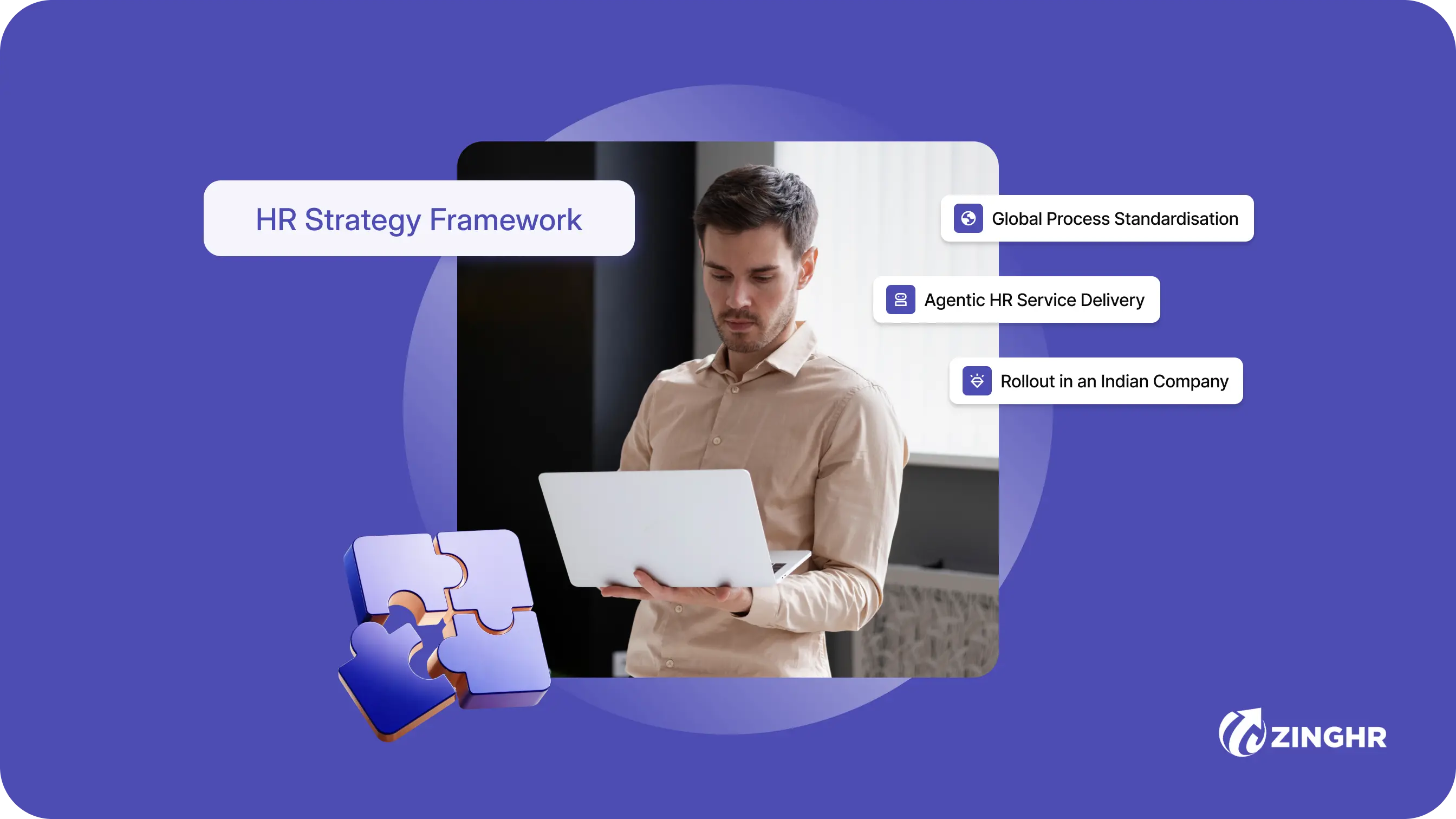
Table of contents
One unstitched HR platform to manage your entire workforce, from Hire to Re-Hire.
Talent Management solutions built for growing and exceptional people
Built-in compliance tools that update with changing regulations
Automated payroll, attendance, and leave management
Insights that help HR leaders make faster, better decisions

Key Takeaways
- An HR strategy framework turns business strategy into workforce priorities and outcomes you can measure against turnover, hiring and employee engagement.
- It runs all year as an execution discipline, with governed AI adoption designed in from the start.
- Business alignment, segmented investment and governance over data and AI are the three components that carry the weight.
- ZingHR runs the framework from a single command centre, pairing board-level workforce intelligence with agentic execution and compliance-by-design.
HR is being asked to produce more this year on a budget that stays where it was. The Hackett Group’s 2026 HR Key Issues Study records workloads climbing 9% while headcount holds flat and operating budgets rise 1%. Across the same respondents, 83% of organisations expect more from the function.
That pressure is what separates an HR strategy from an HR strategy framework. The study also found 84% of HR leaders naming skills fluidity as a priority, while 61% still lack an implemented plan to redesign work models. Intent sits well ahead of the operating structure that would carry it.
At 1,000+ employees, that distance shows up in specific rooms. Your CFO asks for the headcount-versus-attrition number mid-meeting. The board wants AI deployed with governance that survives an audit. A deck refreshed once at an offsite answers neither question.
We wrote this guide around the five layers that hold up under both questions. Here we define what an HR strategy framework is, break down each of the five layers with examples of how teams at your scale run them, and close with a build sequence you can start this quarter. By the end, you will know which layers you already have in place and which two or three need work.
What is an HR Strategy Framework?
An HR strategy framework is the blueprint linking your people priorities to specific business outcomes across capability and compliance. It sits on top of your core human capital management (HCM) systems and aligns HR practices with organisational goals.
It answers one question with many moving parts. How does the way you manage people help the company hit its targets? The HR strategy meaning centres on direction and trade-offs, well beyond an activity list. A framework worth the name gives you outcomes you can measure, tied to turnover, hiring speed and engagement.
1. HR Strategy vs Strategic Planning
Your HR strategy is the roadmap of choices linking people to business outcomes. Strategic planning is the process that produces and refreshes that roadmap. The table below sets them side by side.
How HR strategy differs from strategic planning
2. Human Resource Strategy at Scale
So what is human resource strategy when you run 1,000+ employees across geographies? It gets far harder than the textbook version. You manage permanent and contract workers, each with different statutory treatment. You operate across states and countries with clashing compliance regimes. Your board rewards outcomes over effort.
HR leaders are moving toward business-aligned, skills-based strategies, with AI augmentation replacing administrative work. Developing HR strategies at scale means building a people strategy flexible enough to absorb a restructuring one quarter and a skills-shift the next.
Every data point still has to hold up in an audit. Strategic HR practices exist precisely so organisations can adapt as business conditions change.
3 Pressures Driving HR Strategy in 2026
Two shifts now push HR strategy to the top of the board agenda, agentic AI and India's compliance reset. The cost of fragmented planning compounds both. Each force alone would justify a rethink, and together they make a static approach risky.
1. Agentic AI in HR
Agentic AI has crossed from pilots into core HR functions. The agentic AI in HCM market is projected to grow from USD 2.47 billion in 2025 to USD 13.48 billion by 2031, a 24.21% CAGR.
Agentic systems interpret intent and chain actions across modules, which moves the conversation past the chatbot entirely. Your framework has to be AI-aware by design, deciding where agents act and where humans stay in the loop.
2. India's Labour Codes and DPDPA
India's compliance reset landed in two moves, the Labour Codes and the DPDP regime. On 21 November 2025, India's four Labour Codes came into force, replacing 29 central statutes. The codes rewrite wage and retrenchment rules. They also extend social security to gig workers and tighten workplace safety.
In parallel, the Digital Personal Data Protection Act (DPDPA) 2023 and the DPDP Rules 2025 established the country's first comprehensive data-protection regime. Its obligations phase in through roughly May 2027. Here is the gap to watch.
The Labour Codes leave AI-driven workplace management unregulated, so that governance burden sits with your internal framework and your labour law compliance checklist.
3. Fragmented HR Costs
Fragmented strategy shows up as scattered data and slow service, with stalled execution close behind. Data sits across four HR systems, so board reporting becomes a manual stitch-up. HR service runs slow because ownership of the end-to-end workflow stays unclear. Execution stalls between the offsite and the operating rhythm.
At scale, that fragmentation carries a hard cost. It stops you responding to the board in the moment, and it leaves your numbers open to challenge.
Key Components of an HR Strategy Framework
Three components carry the weight in any framework. Business alignment runs on scenarios. Segmented HR customers get prioritised spend. Governance covers data and AI. Underneath them sit the operational building blocks every framework names, from talent acquisition to performance management and employee engagement.
1. Business Alignment
Corporate strategy rarely moves in a straight line, so your workforce plan needs the same flexibility. Translate the business plan into scenarios you can flex against. A growth scenario means aggressive hiring and a capability build that turns into competitive advantage.
A restructuring scenario pulls the Industrial Relations Code into play, reshaping how you handle redeployment. A skills-shift scenario reallocates budget from headcount to reskilling. When your CEO changes direction mid-year, you switch scenarios instead of rebuilding the plan.
Also read: AI in Recruitment: From Hiring Automation to Workforce Intelligence
2. Workforce Segmentation
Treating your whole workforce as one undifferentiated group wastes money and attention. Effective HR strategies segment their customers the way marketing segments a market. Leaders and people managers want different support from individual contributors.
Your contingent workforce and unions add two more distinct sets of needs. Rank those segments, fund investment by expected value and strategic weight, and target retention strategies where the risk to the business runs highest.
3. Data and AI Governance
Governance is the component most legacy frameworks bolt on as an afterthought, and that is the mistake. Consent capture and DPIAs belong in the design from day one, with human review and audit trails alongside.
Under the DPDP regime, employee-data processing needs a lawful basis and purpose-based consent. Any AI touching pay or promotion decisions needs documented human review. Data-driven decision making pays off only when the data underneath it is governed, so investments deliver returns you can defend.
Treat governance as a first-class component, and you deploy agentic AI with confidence.
How to Develop an HR Strategy: 5-Layer Framework
Developing HR strategies at scale works best as five layers that build on each other. Each layer stays live and gets revisited as conditions shift. Work through them in order, and you connect business strategy to governed AI and defensible compliance.
1. Business and Workforce Alignment
Start by mapping corporate strategy to the workforce scenarios above, then run a quick SWOT against each. A useful lens here is the five rights of workforce planning:
- Right shape, meaning the roles and structure the strategy calls for.
- Right skills, meaning the capabilities each role demands next.
- Right size, meaning headcount matched to demand.
- Right site, meaning the locations and entities that carry the work.
- Right spend, meaning the budget behind each of the above.
Job analysis underpins the right-shape and right-skills calls, mapping tasks to the roles that carry them. Redesigned wage structures affect your cost models. Social-security coverage for gig workers changes your contingent strategy. Effective human resource planning uses data to forecast future labour needs and identify skills gaps before they bite.
Also read: Strategic Workforce Planning: Build a Future-Ready Workforce
2. Process and Experience
Map your core workflows end to end. Think recruit-to-hire and pay-to-payslip, drawn as complete flows. Standardise processes globally on a common data model, then allow local variation for compliance and employee experience.
Standardisation gives you clean, comparable data. Local flexibility keeps you compliant across states and countries. Talent acquisition sits inside this layer as a full flow of screening and onboarding candidates who fit the culture, well beyond a bolt-on requisition tool.
You need both consistency and flexibility, and the architecture is where you set the balance.
3. Data and Agentic AI
Define your HR data model first, because agentic AI is only as good as the data underneath it. Then decide where agents orchestrate work, starting with low-stakes, high-volume domains like helpdesk and benefits queries. Embed governance in the same layer, so DPIAs, inline consent and audit trails ship with every AI-assisted decision.
Your HR metrics and workforce dashboards then report people and compliance KPIs from one source. The same analytics help you predict trends in attrition and capacity before they reach the board.
4. People and Operating Model
Choose your delivery model first, whether shared services, centres of excellence or a mix. Then define how AI augments each role instead of replacing people. A shared-services agent handles tier-one queries so your HRBPs work on strategy.
Capability makes this land, so upskill your HR team in AI literacy and data ethics, and secure management buy-in early. Internal mobility and succession planning keep institutional knowledge inside the business and reduce reactive hiring.
Performance management belongs here too, built on clear expectations, goals tracked through the year and regular feedback.
5. Compliance and Improvement
Bake Labour Code and DPDPA duties into your policies and standard operating procedures. Extend the same rules into system configuration and global data-protection obligations. Compliance-by-design means the data model captures consent status and statutory eligibility automatically, with audit trails on AI decisions.
Then close the loop. Monitor execution through KPIs, including compliance ones, and track DPIAs completed and data-rights requests handled on time. When regulations change, you update configuration and retrain models. Updating config instead of rebuilding keeps the framework alive between planning cycles.
HR Strategy Framework Examples
Three examples make the layers concrete. One shows process architecture at global scale. One shows agentic service delivery with hard numbers. An Indian rollout shows how to sequence AI adoption under the 2025 compliance regime.
1. Global Process Standardisation
Large global employers show the process layer done well. The core principle reads simply. Build standardised, consistent HR processes at global scale, then let local units flex for compliance. In practice that means a common core HR data model with unified time and payroll interfaces.
Talent and learning modules fold into the same analytics stack. Clean, comparable data across every geography is exactly what the board's numbers depend on. Skip it, and every cross-country figure turns into a manual reconciliation.
2. Agentic HR Service Delivery
Agentic service delivery is the data layer with receipts. Once an assistant moves from task automation to genuinely agentic HR, the outcomes reach the CFO's dashboard.
A high containment rate means most queries resolve without human intervention. Service-centre costs fall sharply. Agentic routing spans benefits and payroll workflows, interpreting employee intent and chaining actions like record updates and approval triggers.
The gap between a chatbot that answers and an agent that acts is exactly this, and it proves governed agentic AI pays for itself.
3. Rollout in an Indian Company
Now put the two together under Indian conditions. A 1,000+ employee firm rolls out agentic AI in stages, sequencing by risk.
Agents start in safe domains like the HR helpdesk and shift scheduling, both high-volume and low-stakes. A wrong answer there is easy to correct and easy to audit. Prove containment and accuracy first. Only then extend agents toward higher-stakes areas like performance and promotions, where sign-off by a person stays firmly in place.
Throughout, the Labour Codes and DPDPA set the guardrails, with consent captured inline and every AI-assisted decision leaving a trail.
Also read: Employee Attrition Rate: Calculation, Strategies and Benchmarks
Common HR Strategy Mistakes
Large-scale HR strategies tend to fail in three predictable ways. They freeze into a document. They add AI without governance. They optimise silos instead of workflows. Each failure is avoidable once you can name it.
1. A Static Annual Strategy
The offsite deck that gets filed and forgotten is the most common failure. A strategy refreshed once a year struggles to absorb a mid-year restructuring or a fresh compliance obligation. By the time the next planning cycle arrives, the plan describes a company that has already changed.
The fix is scenario planning with ongoing portfolio oversight. Review scenarios quarterly, reprioritise investments as conditions shift, and treat the strategy as something you run.
2. AI Without Governance
The second failure is the expensive one. Enthusiasm for agentic AI runs ahead of the guardrails. Agents go live before DPIAs and consent management are in place, and vendor and bias audits get skipped. That is direct compliance exposure under DPDP, and it also becomes a reputational risk the moment an AI-assisted hiring or pay decision gets challenged and the human-review trail is missing.
Governed AI runs at the same speed, and it is the only kind you can stand behind in front of your board or a regulator.
3. Siloed Optimisation
Teams optimise recruitment here and payroll there, each system tuned in isolation. The end-to-end workflow, from recruit-to-hire to grievance-to-resolution, stays slow everywhere.
Fragmented systems also block the board's view, because the data joins up poorly. You end up with locally efficient silos and a globally slow organisation. Map and own the whole workflow, and the silos stop fighting each other.
How ZingHR Runs the HR Strategy Framework
A framework is only as good as the platform that runs it. ZingHR operationalises all five layers from a single command centre. Three capabilities carry the weight and map to the layers above, from board-level intelligence to agentic execution and compliance-by-design.
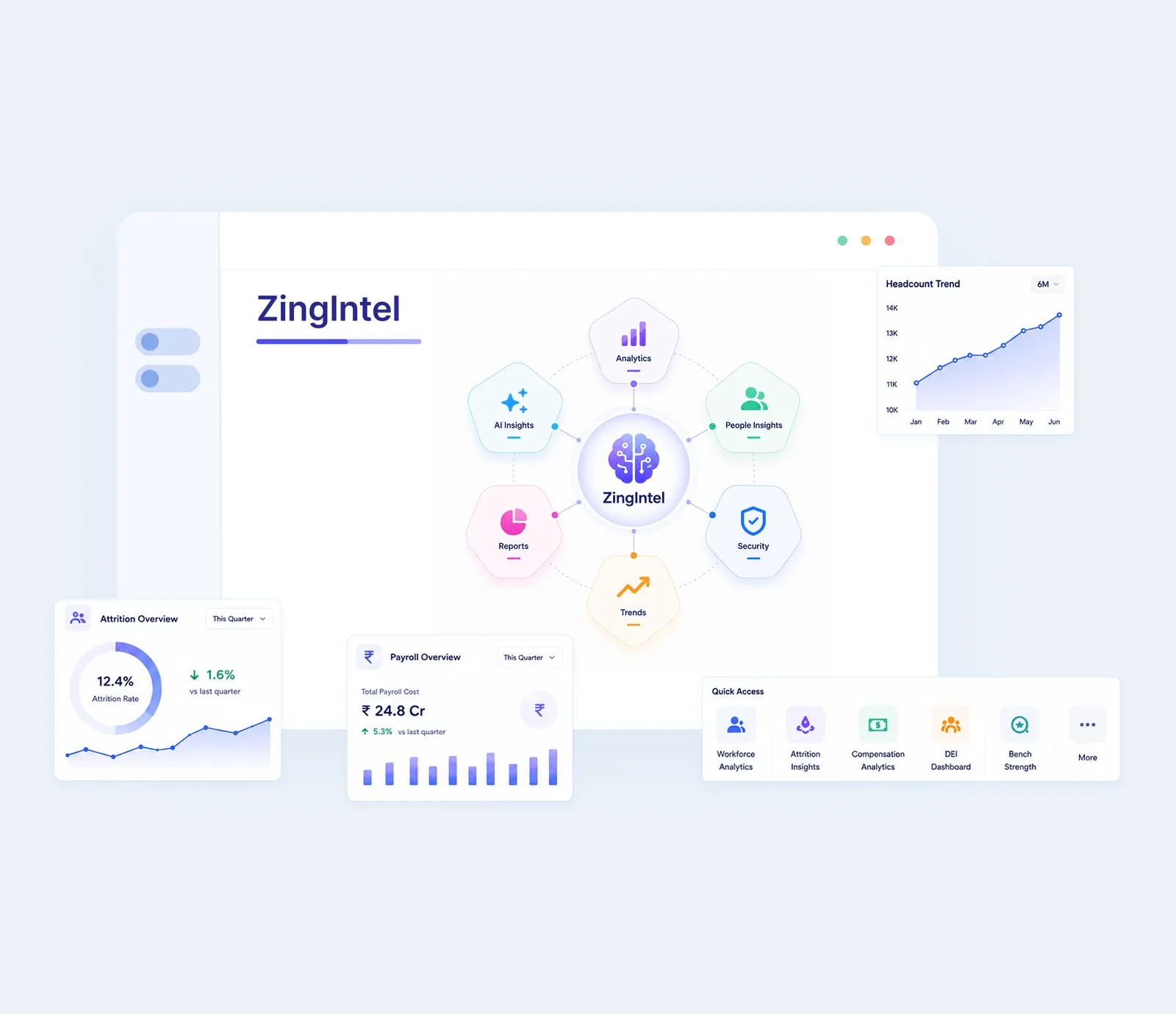
1. Board-Level Workforce Intelligence
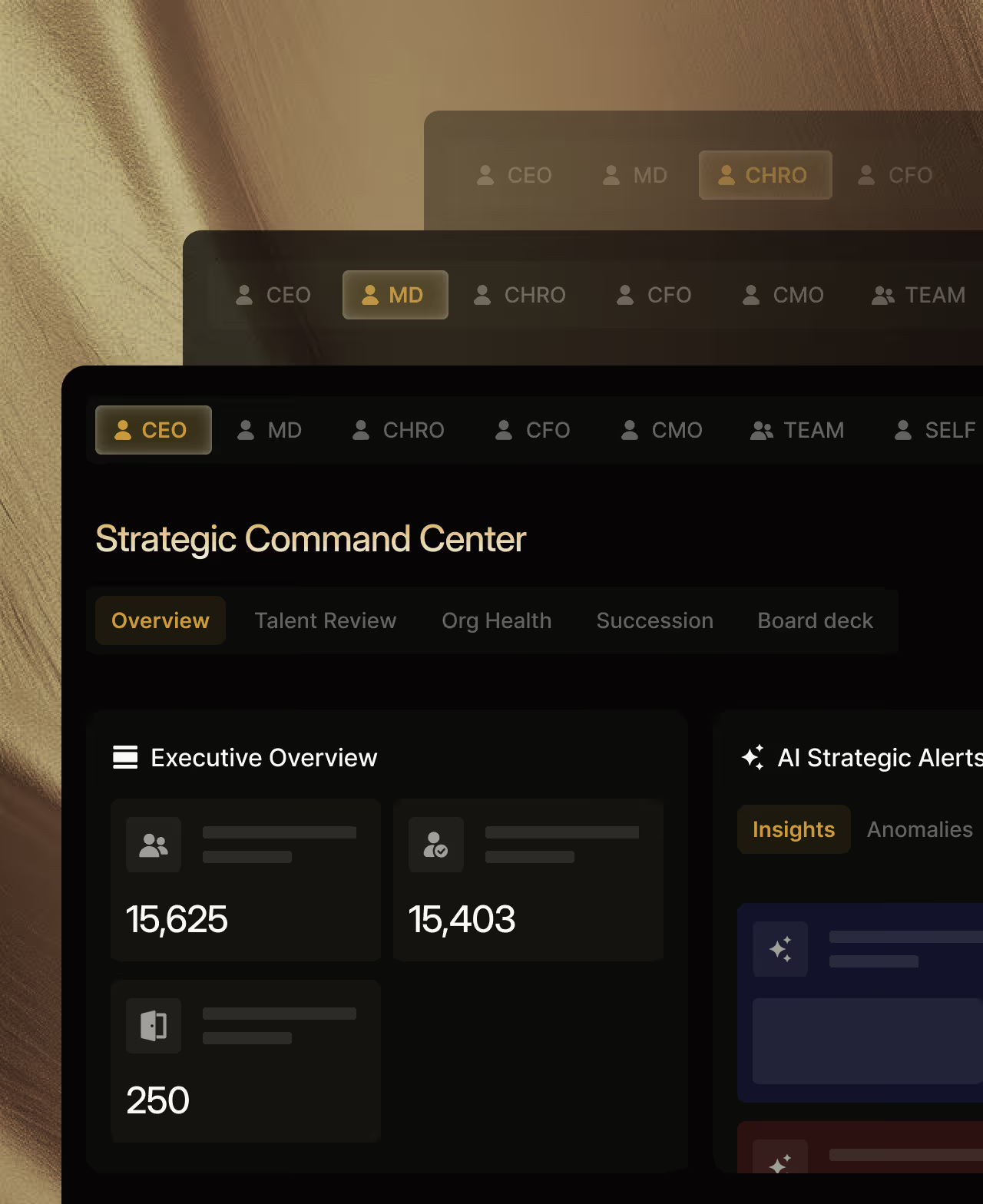
The data layer becomes visible to the people who decide. ZingHR's live dashboards tie people metrics to business and HR outcomes in one view. Headcount and attrition sit next to cost and productivity, with compliance KPIs like DPIAs completed alongside them.
Your CHRO and CFO read the same source of truth. A question from the board gets settled in the meeting, and the numbers hold up afterward. HR analytics becomes a standing view instead of a monthly MIS request.
2. Agentic Intelligence Across the Workflow
The process and operating-model layers move into action here. Anchored on Ghrowth.ai, ZingHR's agentic HCM deploys AI agents that orchestrate multi-step workflows instead of single tasks.
Service delivery and scheduling run through agents that interpret intent and chain actions across modules, targeting the high-containment, lower-cost outcome the best deployments report. A person stays in the loop on consequential decisions, so agents handle tier-one volume while your HRBPs focus on strategy.
The same connected lifecycle links talent management to compensation, so rewards align with performance, retention and business outcomes.
3. Compliance-by-Design
The alignment and compliance layers sit hard-wired into the system. ZingHR's configuration ships Labour Code and DPDPA-ready from the outset. Consent gets captured at the point of collection, and statutory eligibility for wages and social security gets tracked automatically. Every AI-assisted decision leaves an audit trail across states and countries.
When regulations shift, you update configuration instead of rebuilding, so the governance the Labour Codes hand to your internal framework gets absorbed by the platform. The same discipline runs through day-to-day statutory compliance in HR and payroll.
HR Strategy Implementation Checklist for CXOs
The framework only matters when it maps to who owns what. Here is the checklist split by CXO, so accountability is clear from the first meeting.
CXO ownership map for the HR strategy framework
The pilot then runs in three governed stages over 90 days:
- Days 1 to 30, align on scenarios and define the HR data model, then complete DPIAs for your first AI use case.
- Days 31 to 60, pilot agents in a safe domain like the helpdesk, with governance switched on from day one.
- Days 61 to 90, measure containment and cost, then report people and compliance KPIs to the board.
Keep each phase small and governed, so evidence earns the next one and the board sees measurable impact at every step.
Turn Your HR Strategy Into a Working Discipline
A modern HR strategy framework connects three things that used to live apart. Business strategy meets governed agentic AI, with compliance holding both together across five live layers. The shift runs from a document you file to a discipline you run on shared ownership across the C-suite.
For HR professionals, it delivers measurable results and defensible AI adoption, backed by governance your board can stand behind. The organisations pulling ahead are the ones executing the framework as one live system, under audit. ZingHR turns the five layers into exactly that.
Book a demo to see how ZingHR's agentic intelligence HCM platform runs your HR strategy framework at scale.
Frequently asked questions (FAQs)
The core components are business alignment through workforce scenarios, HR customer segmentation with prioritised investment, and governance over data and AI. Operationally, that means talent acquisition, performance management and employee engagement, tied together by continuous improvement so the strategy adapts as conditions change.
Work through five layers in order. Start with business and workforce alignment, then process and experience. Move to data and agentic AI, then people and operating model. Finish with compliance and improvement. Each layer stays live and gets revisited instead of completed once.
HR strategy is the roadmap, the set of choices linking people to business outcomes. Strategic HRM is the ongoing discipline of aligning people management with business strategy over time. One names the destination and route. The other keeps them aligned as the business shifts.
The four Labour Codes, in force since 21 November 2025, rework wages and retrenchment, extend social security to gig workers and tighten safety. DPDPA 2023 and the DPDP Rules 2025 govern employee-data handling, phasing in through roughly May 2027. Both call for compliance-by-design and governed AI.
Yes, with the right guardrails. Run DPIAs before deployment and manage consent inline. Keep human review for consequential decisions, and audit vendors and models for bias. Start in low-risk domains like the helpdesk, prove containment and accuracy, then extend to performance and promotions.
What to do next?
See ZingHR in Action
Join the 1,200+ enterprises that have replaced fragmented HR with one intelligent, future-ready platform. See ZingHR in 30 minutes.
Build the Organization You Want
Great HR drives retention, capability, and culture. ZingHR takes care of the operational layer so your people team owns the strategy.
Dr. Anupama Iyer
Director — HR
Dr. Anupama Iyer is Director — HR at ZingHR and an accomplished HR leader, consultant, facilitator, and academic with over two decades of experience in people practices and talent development. Her work spans HR consulting, training design, leadership development, and academia. Bringing both a practitioner's and an educator's perspective, she is passionate about building people-centric workplaces and helping organizations create cultures that enable growth, employee development, and long-term success.

Elevating Impact.
Defining Destiny
See how ZingHR's AI-powered Hire-to-ReHire platform frees your CPO to lead with purpose and deliver the outcomes your Board is watching for


ZingHR is the AI-powered Hire-to-ReHire platform built for one purpose to remove every transactional layer of HR from your organisation, permanently.