How to Create an Effective HR Compliance Checklist
HR compliance at scale is threshold-aware. Obligations like POSH, EEO-1, and centralized frameworks trigger at specific headcount levels and multiply across jurisdictions. This guide breaks the checklist into seven domains and a five-step operating framework that replaces the annual audit scramble. It closes with how agentic HCM platforms turn compliance into continuous, real-time assurance flagging misclassifications and documentation gaps before they become violations.
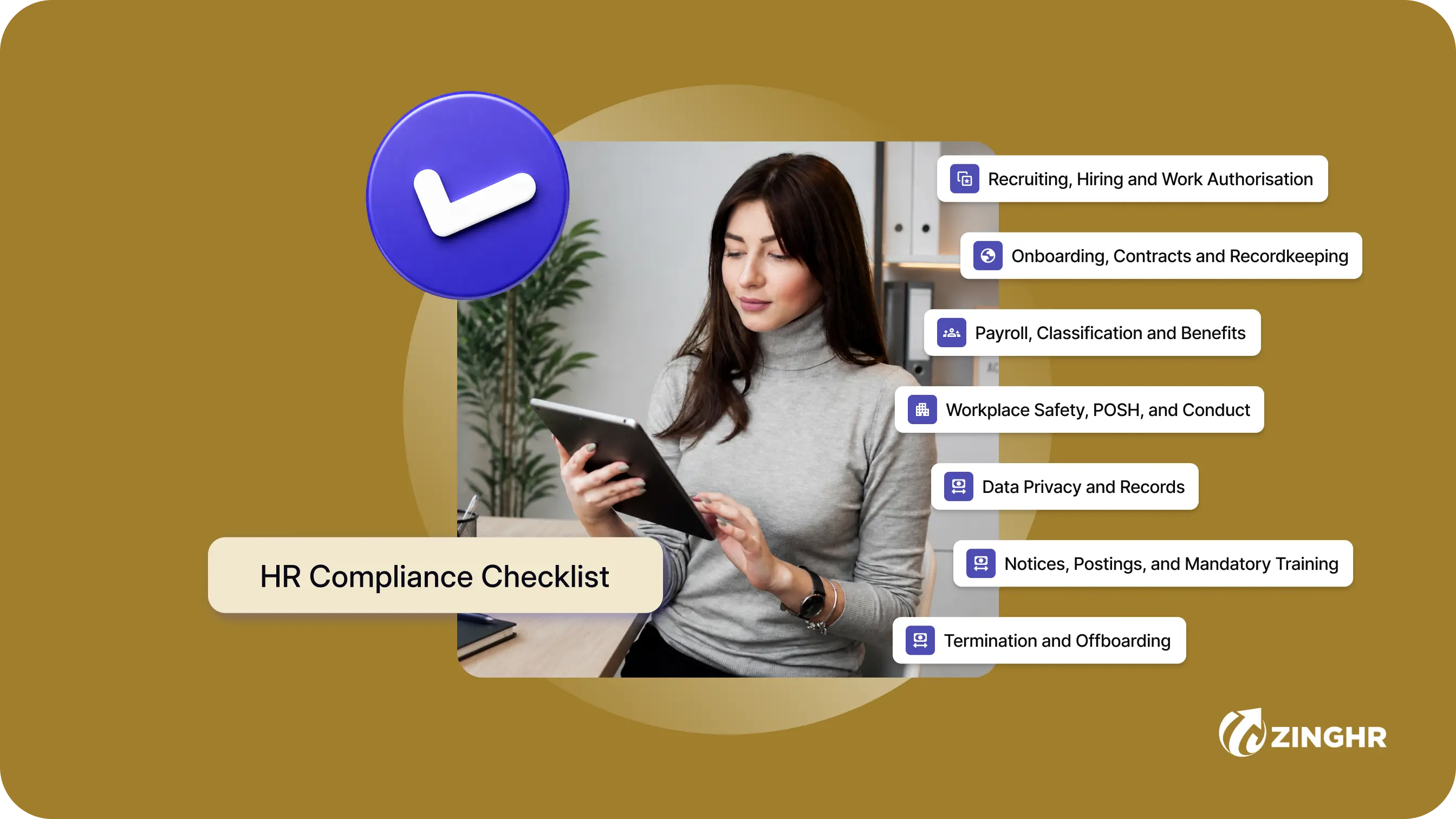
Table of contents
One unstitched HR platform to manage your entire workforce, from Hire to Re-Hire.
Talent Management solutions built for growing and exceptional people
Built-in compliance tools that update with changing regulations
Automated payroll, attendance, and leave management
Insights that help HR leaders make faster, better decisions

Key Takeaways
- For organisations with 1,000+ employees, HR compliance is a board-level risk. It spans employment law, payroll, Prevention of Sexual Harassment (POSH) and data privacy across multiple jurisdictions.
- A static, spreadsheet-based HR compliance checklist falls behind fast. Build compliance into recruiting, payroll, and offboarding workflows instead of auditing it later.
- Run a five-step operating framework: map obligations, design policies and controls, embed checks in your HCM, train your teams, then monitor and audit.
- Employee thresholds change your obligations. POSH triggers at 10+, EEO-1 at 100+, and centralized frameworks at 1,000+. India's Labour Codes and DPDP Act add more, so your checklist must stay threshold-aware.
- Agentic HCM platforms like ZingHR flag misclassifications and policy gaps in real time. Compliance shifts from an annual scramble to continuous assurance.
According to HR.com, only 32% of organisations operate with proactive compliance monitoring and legal risk assessment practices. Governance risk has moved firmly onto the audit committee's agenda.
The timing sharpens the stakes. India's four Labour Codes and the Digital Personal Data Protection (DPDP) Act are both active and expanding in scope, and tightening global data regimes are adding further obligations. Large employers operating across multiple states and countries face compliance requirements across a growing number of national, state, and city-level regulatory frameworks.
The guide covers three things:
- A threshold-aware HR compliance checklist covering the seven domains that matter.
- A five-step operating framework to run it.
- How to embed all of it in your HCM so compliance runs continuously.
Why HR Compliance Is a Board-Level Issue for Large Organisations
The financial exposure is the fastest way to reframe this for your CFO and CEO.
In FY 2024, the U.S. Equal Employment Opportunity Commission (EEOC) secured nearly USD 700 million in monetary relief for over 21,000 victims of employment discrimination in the US alone.
The Fair Labor Standards Act (FLSA) wage-and-hour violations routinely cost large employers millions more, which is why pay-equity and overtime audits are now standard in compliance programmes. In India, POSH gaps carry penalties and reputational damage, and DPDP breach exposure adds a fresh line of data-privacy risk to the ledger.
Leaders underestimate that risk scales non-linearly with headcount and jurisdictions. Add a state and you inherit its Shops and Establishments rules and leave provisions. Add a country and you inherit a data-protection regime and works-council triggers. Ad-hoc controls like shared drives, email reminders, and one overloaded compliance manager degrade badly at scale.
Framed correctly, a well-run compliance checklist for the HR department becomes workforce intelligence and governance. It gives your board real-time visibility into your risk posture, which is the framing that gets compliance budget approved at the CXO level.
Why Generic HR Compliance Checklists Fall Short
A generic downloadable checklist is written for a 50-person company with one office. Drop it into a 5,000-person, multi-state operation and three failure points show up fast.
1. Static Checklists and Threshold-Based Triggers
Obligations switch on at specific headcount thresholds:
- POSH Internal Committees at 10+ employees.
- US federal-contractor rules at 50+.
- EEO-1 reporting at 100+.
- Centralised frameworks at 1,000+.
A one-size list has no way of knowing which rules apply to which entity or worker type. Companies that apply the same checklist everywhere carry unnecessary compliance cost in some locations and undetected risk in others.
2. Disconnected Systems and Audit Exposure
When payroll, onboarding, and training records live in separate systems, the gaps between them stay invisible. A missing contract, an unsigned work-authorisation form, or a misclassified contractor stays hidden until an auditor or a claimant goes looking.
Your HR legal compliance checklist is only as good as the data it can see.
3. Annual Audits vs. Continuous Risk
Your compliance posture shifts every single day through new hires, transfers, promotions, and terminations. A point-in-time annual audit shows where you stood on one Tuesday in March.
Everything before and after that date stays a blind spot. Continuous, agentic monitoring closes that window and catches gaps as they form instead of months later.
The 5-Step HR Compliance Operating Framework
Run your HR compliance checklist as a live operating model, active every quarter of the year. The five-step cycle below turns scattered obligations into a repeatable system your board can trust.
Step 1: Assess and Map Obligations
You cannot track an obligation you have not identified. Step 1 produces a single map of every compliance requirement your organisation carries, by entity and by location.
The map determines which thresholds apply where, which regulations govern which workforce, and which obligations are already active vs. approaching. Without it, Steps 2 through 5 are guesswork.
To build the map, gather three inputs per entity:
- Headcount per location, including contractors, to determine which thresholds you cross at each site.
- The applicable thresholds: POSH Internal Committee at 10+, federal-contractor rules at 50+, EEO-1 reporting at 100+, and centralised frameworks at 1,000+.
- Every regulation governing each entity, from India's Labour Codes and state Shops and Establishments rules to GDPR, DPDP, and any applicable US state privacy statutes.
The map becomes the spine everything else hangs off. Revisit it every time you add a location, change entity structure, or cross a headcount threshold.
Step 2: Design Policies and Controls
A policy states your position. A control enforces it. Organisations that have policies without controls discover the gap during an audit, when it is too late to close.
For each compliance domain, you need written documentation of your position and a named individual responsible for it. Work through the following across every domain:
- Review your employee handbook annually against new regulations and update any section affected by legislative or regulatory changes.
- Document your position on anti-discrimination, wage-and-hour rules, leave entitlements, POSH, data protection, and lawful termination in language that is specific enough to use in a dispute.
- Assign ownership to a named individual for each control: HR owns the handbook, legal owns policy interpretation, IT owns data access controls, and safety owns incident logs and investigation records.
- Set a review cadence for each policy, quarterly for high-change areas like data privacy, annually for stable ones, so no document quietly goes stale between refresh cycles.
Step 3: Embed Compliance into HCM Workflows
A checklist that stops at policy leaves the actual risk in place. Compliance gaps are created at workflow moments: at hire, at onboarding, at the point of data collection, and at offboarding. The checks need to live at those same moments rather than in a separate review layer that runs weeks later.
Build the following into your HCM so they fire automatically:
- Work-authorisation verification and deadline tracking during employee onboarding, before the employee's first working day.
- Worker classification checks at hire, flagging any role that meets contractor thresholds for a compliance review before payroll is set up.
- Consent capture and purpose logging at the point of data collection, with a retention schedule attached so deletion deadlines are tracked in the same record.
- Automated training assignment on day one, with completion tracked in the same system rather than chased manually across email and spreadsheets.
Compliance woven into the workflow is harder to bypass and easier to audit than compliance bolted on after the fact.
Step 4: Train and Communicate
Training compliance splits into three audiences, each with different content requirements and the same documentation requirement: a dated, topic-level completion record per employee. An auditor credits training that appears in a log.
Cover the following across your workforce:
- All managers, annually: harassment, retaliation, lawful termination, and bias prevention. Managers are the highest-exposure group for employment claims, and annual documented training is a standard defence in litigation.
- Payroll teams and line managers, role-specifically: wage-and-hour rules, worker classification criteria, and local statutory requirements relevant to the locations they manage.
- All employees, at onboarding and annually thereafter. POSH awareness, data-privacy obligations, and grievance channel procedures. POSH annual training is a statutory requirement in India at 10+ employees.
- Track every session by employee name, date, topic, and delivery format. Keep the records for at least three years or the applicable statutory retention period, whichever is longer.
Step 5: Monitor, Audit, and Improve
Compliance posture shifts daily through new hires, exits, promotions, and regulatory changes. A single annual audit cannot keep pace with a workforce that is always in motion.
Effective monitoring runs at two speeds: automated, continuous flagging of live gaps, and scheduled human review of the full picture. Build both into your operating calendar:
- Continuous: Automated alerts for missing contracts, unsigned documents, classification anomalies, and threshold breaches, surfaced in your HCM as they occur rather than discovered in a quarterly sweep.
- Quarterly: Internal checks across all seven compliance domains to catch anything the automated flags missed and to verify that remediation items from the previous quarter are closed.
- Annual: A full compliance audit and pay-equity review, benchmarked against the prior year's findings to show direction of travel to your board and audit committee.
- After every finding: Assign a named remediation owner, set a deadline, and feed the gap back into Step 2 so the policy or control is updated rather than patched.
The Core HR Compliance Checklist: Domains and Items
Seven domains cover the employee lifecycle end to end. Use this as your master HR statutory compliance checklist and localise each item per jurisdiction.
Core HR compliance checklist for organisations
1. Recruiting, Hiring and Work Authorisation
- Post roles with fair, inclusive language free of age, gender, or disability bias.
- Verify right-to-work eligibility through Form I-9 in the US or the applicable Indian documentation.
- Keep background checks within fair-credit and ban-the-box limits for the relevant jurisdiction.
2. Onboarding, Contracts and Recordkeeping
- Provide every employee with a written contract and job description before their start date.
- Keep personnel files complete and segregated, with tax forms and signed handbook acknowledgements on record.
- Store work-authorisation forms and health data apart from general HR files.
3. Payroll, Classification and Benefits
- Classify each worker correctly as exempt, non-exempt, or contractor before payroll runs.
- Get overtime calculations right and reconcile benefits enrolment each cycle.
- In India, ensure clean PF (EPFO) and ESI handling and accurate Professional Tax deductions.
- Use HR compliance software to automatically calculate all of this rather than relying on manual spreadsheets.
4. Workplace Safety, POSH, and Conduct
- Maintain safety logs and run inspections where Occupational Safety and Health Administration (OSHA) or equivalent rules apply.
- Constitute a POSH-compliant Internal Committee and run annual training with documented records.
- Set up clear grievance and whistleblower channels under a documented code of conduct.
- Keep POSH compliance and training records audit-ready at all times.
5. Data Privacy and Records
- Align data handling with GDPR and HIPAA, and add DPDP rules for Indian employee data.
- Define retention and deletion rules per data category and jurisdiction.
- Control cross-border data transfers and enforce role-based access.
- Keep a documented breach-response plan that has been tested.
6. Notices, Postings, and Mandatory Training
- Post current, jurisdiction-specific rights notices in all physical locations.
- Provide digital versions for remote staff on the same update cycle.
- Schedule anti-harassment and safety training on a documented annual calendar.
- Track every certification and keep completion records by employee, date, and topic.
7. Termination and Offboarding
- Follow lawful termination steps with documented rationale for each decision.
- Settle final pay with all accrued leave on the statutory deadline.
- Issue benefit-continuation notices and remove data access on the last working day.
- Keep exit documentation and retain records per the applicable statutory retention period.
India-Specific and Global Compliance Triggers to Track
An HR compliance checklist in India carries triggers that reach well past a generic global list. The table below maps the key thresholds before the domain detail that follows.
Key obligations across India, the USA and global markets
1. India's Four Labour Codes and Revised Wage Definitions
The four Labour Codes change how organisations handle wages and PF liability:
- A new definition of "wages" redefines PF and ESI thresholds and reworks CTC structuring.
- Allowance-heavy pay structures may face higher PF liability under the revised definition.
- Documentation expectations rise with the change, requiring more rigorous payroll records.
- Implementation timelines still vary by state, so your checklist has to flex per location.
2. The POSH Act and the DPDP Act
The POSH Act, 2013 applies at 10+ employees. Key requirements:
- A properly constituted Internal Committee with at least one external member.
- Annual training for all employees, with dated completion records.
- Annual report to the District Officer.
The DPDP Act adds consent and retention duties, and cross-border rules for every piece of HR data your organisation holds. Consent must be obtained at collection, purposes must be specified, and data must be deleted when the purpose is fulfilled.
See the full labour law compliance checklist for how these interact.
3. Global Thresholds and Multi-State Complexity
For organisations operating internationally:
- EEO-1 reporting kicks in at 100+ US employees, with 2026 data due by 31 March 2027.
- Federal-contractor obligations start at 50+.
- Works-council and union consultation triggers vary significantly by country and must be mapped per entity.
- Remote staff still need lawful access to mandatory postings, which means digital equivalents are required.
How ZingHR Approaches HR Compliance
Large organisations typically have compliance documentation spread across several systems. What they lack is a single place where policy, payroll, training, and employee records live together and stay current. ZingHR connects all of it in one platform.
1. Core Platform Capabilities
ZingHR centralises multi-country policy and localised handbooks so a CHRO sees the same governance picture across every entity. PF and ESI calculate automatically on the payroll engine.
Professional Tax runs on the same engine. Statutory notices and training assignments fire on schedule, with completion tracked in the same system rather than chased separately.
For more on how a unified system handles these functions end to end, see ZingHR's guide to HCM software.
2. Continuous Assurance
Ghrowth.ai, ZingHR's agentic intelligence layer, monitors compliance continuously rather than waiting for a quarterly review. Specific actions it takes:
- Flags misclassifications and wage anomalies before payroll runs, so corrections happen before the bank transfer.
- Detects missing documentation, such as an unsigned contract or an incomplete work-authorisation form, the moment the gap appears in the record.
- Ingests regulatory changes and routes proposed policy updates to HR and legal for review, so teams see amendments before they take effect.
- Shows real-time dashboards at board level. For example, POSH training coverage by entity, open remediation items, jurisdiction-by-jurisdiction compliance status.
In practice: a roughly 1,500-employee Indian IT services firm used ZingHR to centralise POSH records and multi-state Shops and Establishments compliance in one portal. Audit prep shrank from a month-long reconciliation project to days.
A 10,000-employee multinational used the same system to maintain region-specific policies and automated consent logs, keeping DPDP-style obligations and cross-border controls defensible across every entity.
Who Benefits: CHRO, CFO, and CIO
The same compliance programme reads differently depending on which chair you sit in. The table below maps the value for each stakeholder.
How agentic HCM addresses workforce, financial and data governance risks
Compliance as a Continuous Operating Model
HR compliance works as a continuous, threshold-aware operating model. It spans everything from employment law to data privacy, and it shifts every day you hire or exit someone. The organisations that get this right run compliance as a live system, replacing the annual audit scramble.
When you embed your HR statutory compliance checklist into your HCM, your risk posture shifts from a March reconstruction to a dashboard you trust any Tuesday of the year. Your audit trail exists before an auditor asks for it.
Book a demo to see what continuous, embedded compliance looks like across the jurisdictions you operate in.
Frequently asked questions (FAQs)
A checklist for large organisations covers seven core domains: 1. Recruiting, work authorisation, and onboarding. 2. Payroll classification and benefits. 3. Workplace safety and POSH. 4. Data privacy and records. 5. Statutory notices and mandatory training. 6. Termination and offboarding. At scale, layer threshold-based triggers on top, since obligations change as you cross 10, 50, 100, and 1,000 employees across different jurisdictions.
An HR statutory compliance checklist in India tracks the mandatory obligations Indian employers meet monthly and annually: 1. PF, ESI and Professional Tax contributions. 2. POSH Internal Committee governance and annual training. 3. Gratuity and statutory bonus obligations. 4. State-specific Shops and Establishments requirements. 5. New obligations under the four Labour Codes and the DPDP Act.
Audit continuously rather than relying on a single point-in-time review: 1. Run internal checks quarterly. 2. Conduct a full audit and pay-equity review annually. 3. Re-audit before any major policy change or new-jurisdiction expansion. Continuous, agentic monitoring inside your HCM catches gaps as they form, months before a manual review would.
An HR monthly compliance checklist captures the recurring items that need attention every month: 1. Statutory contribution filings for PF, ESI, and PT. Payroll reconciliation. 2. New-hire documentation and work-authorisation completion. 3. Training tracking and completion updates. 4. Automating these inside your HCM keeps them on schedule every cycle without manual chasing.
Several thresholds switch on new obligations: 10+: POSH Internal Committee becomes mandatory in India. 50+: US federal-contractor rules apply. 100+: EEO-1 reporting kicks in. 1,000+: Centralised frameworks with automated recordkeeping and systematic audits become essential. A threshold-aware checklist maps which rules apply to which entity and worker type, replacing one generic list applied everywhere.
An agentic HCM embeds compliance checks directly into recruiting, payroll, and offboarding workflows. Specifically, it: 1. Automates statutory calculations like PF and ESI, reducing manual error. 2. Maintains audit-ready records with full traceability. 3. Flags misclassifications and missing documentation before they become violations. 4. Ingests regulatory changes and routes proposed policy updates for review. 5. Shows real-time compliance dashboards for CHROs and the board.
What to do next?
See ZingHR in Action
Join the 1,200+ enterprises that have replaced fragmented HR with one intelligent, future-ready platform. See ZingHR in 30 minutes.
Build the Organization You Want
Great HR drives retention, capability, and culture. ZingHR takes care of the operational layer so your people team owns the strategy.

Elevating Impact.
Defining Destiny
See how ZingHR's AI-powered Hire-to-ReHire platform frees your CPO to lead with purpose and deliver the outcomes your Board is watching for


ZingHR is the AI-powered Hire-to-ReHire platform built for one purpose to remove every transactional layer of HR from your organisation, permanently.