UAE Payroll Regulations 2026: WPS Rules, Deadlines and Compliance Explained
UAE payroll regulations 2026 introduce stricter WPS deadlines, faster enforcement and new Emiratisation requirements. Learn what changed and how to stay compliant.
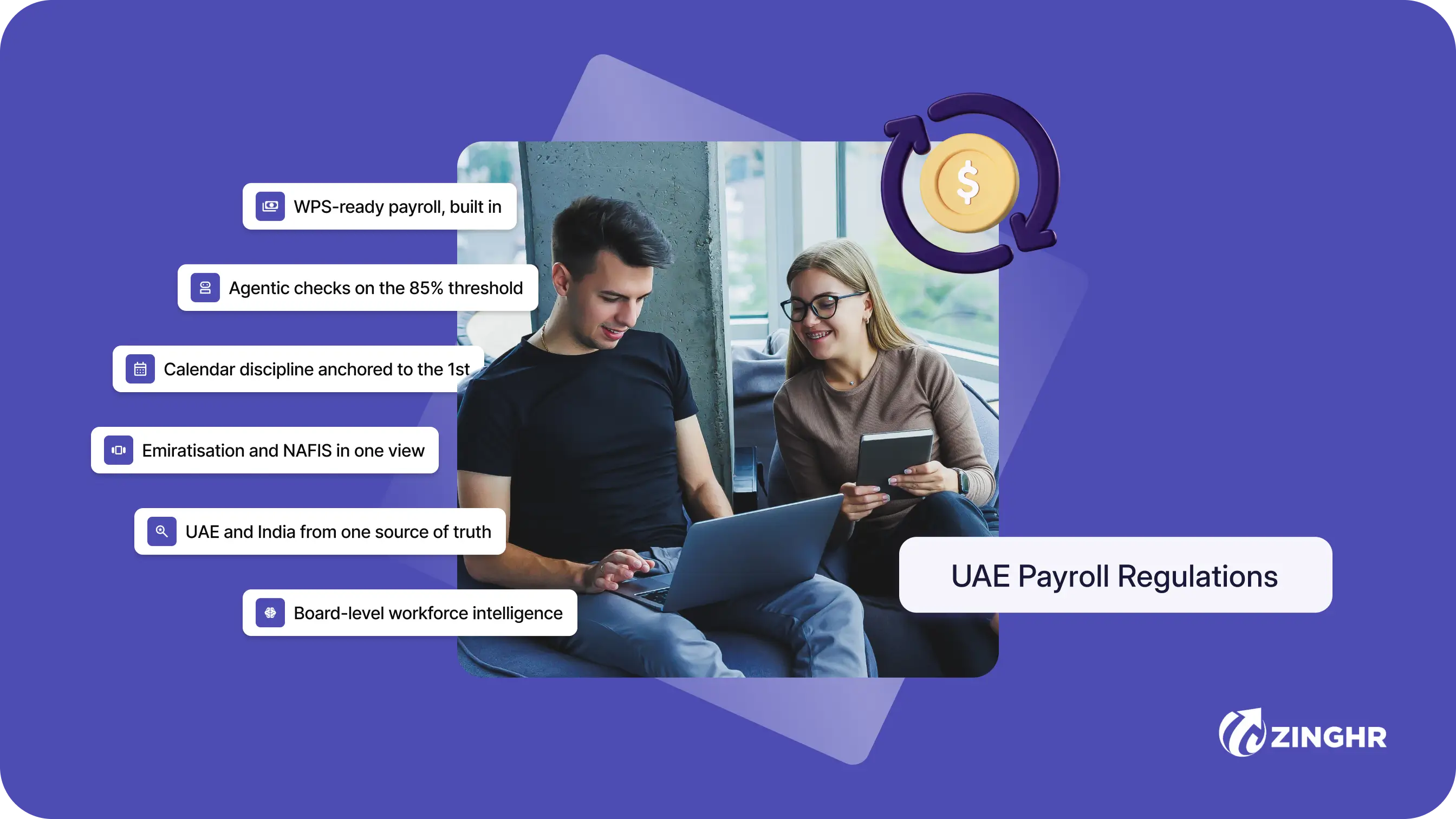
Table of contents
One unstitched HR platform to manage your entire workforce, from hire to rehire.
Talent Management solutions built for growing and exceptional people
Built-in compliance tools that update with changing regulations
Automated payroll, attendance, and leave management
Insights that help HR leaders make faster, better decisions

- Ministerial Resolution No. 340 of 2026 resets the rules for the UAE Wage Protection System 2026, effective 1 June 2026. Wages for the previous month must land by the first day of each Gregorian month.
- You're compliant only if you transfer at least 85% of total wages due through WPS-registered channels by that deadline. Miss it, and enforcement escalates fast.
- Penalties now bite from day one for repeat offenders. Electronic warnings arrive on day 2 and work-permit suspensions by day 5. Fines and classification downgrades follow by day 11, with travel bans and asset seizure for larger firms by day 21.
- Add the AED 6,000 Emirati minimum wage from January 2026 and NAFIS quota tracking. Payroll becomes a board-level governance question, well beyond a back-office task.
- For enterprises running UAE and India together, a unified HCM platform with agentic intelligence is the difference between real-time compliance and month-end panic.
Here's the scenario your CFO quietly dreads. It’s the 2nd of the month. Salaries for one UAE entity failed to clear because a bank cut-off slipped, and MOHRE's system already flagged the delay. By the 5th, new work permits are frozen. By the 11th, you face fines and a downgrade in your MOHRE classification. All of this now moves within days.
That's the shift UAE payroll regulations 2026 introduce. Under Ministerial Resolution No. 340 of 2026, the UAE Wage Protection System 2026 runs on a single, unforgiving clock, and enforcement is largely automated.
For an enterprise with 1,000+ employees across BFSI and manufacturing, a missed payroll cycle carries real weight. It reaches your work permits and your regulator standing. In serious cases, it restricts the travel freedom of your named executives.
If you operate across the GCC and India, the complexity multiplies. UAE demands real-time wage policing through WPS; India runs on filings and staggered labour codes. Managing both from disconnected systems is exactly how deadlines slip. This guide walks you through what changed and how to build payroll compliance that holds up to scrutiny.
What Changed in UAE Payroll for 2026
Three changes matter most, and they compound each other. Therse's a unified payment deadline and a firm 85% compliance threshold. A tightly defined list of exclusions completes the picture. Get these right and most of your risk disappears.
1. A Single Salary Deadline: The First of Every Month
Every private-sector establishment must now pay the previous month's wages by the first day of each Gregorian month. Any transfer after that date counts as delayed inside WPS. The clock allows zero grace and stays strictly literal.
It replaces the earlier practice, where employers effectively had a 10-15-day window. In practice, your payroll calculation and bank confirmation must be completed before the 1st. Build in contingencies for public holidays and bank cut-offs that can quietly push your transfer past the line.
2. 85% Wage Transfer Threshold
An establishment counts as compliant when it transfers at least 85% of total wages due, after lawful deductions, by the deadline.
Payments must run through WPS-registered banks or channels authorised by MOHRE. Salary Information Files (SIF) must be generated in the prescribed format.
WPS applies to any establishment with five or more employees. A shortfall can trigger work-permit bans from the very first offence. For large enterprises, hitting that 85% mark is the floor. You want visibility that predicts a shortfall before the cycle closes, well ahead of any report confirming it afterward.
3. Article 4 Exemptions
Several worker categories sit outside your WPS calculation. Each exclusion still needs proper documentation and notification to MOHRE.
Article 4 covers cases from pending labour claims to approved unpaid leave. Exempt categories include:
- Workers with wage-related labour claims pending before the courts.
- Workers with absconding reports filed against them.
- Workers whose liberty is restricted through detention or court orders that stop them working.
- Workers on approved unpaid leave.
- Seafarers, on request and approval.
- Foreign workers employed by foreign establishments or branches in the UAE and paid outside the UAE, where the worker consents.
- Workers holding mission work permits of up to three months.
These stay safe only when your records prove them. An undocumented exemption looks identical to a missed payment in MOHRE's eyes.
How Enforcement Escalates, Day by Day
The 2026 shift goes beyond the deadline itself. Consequences stack up fast once you cross it.
Under Resolution 340/2026 and the penalty framework of Cabinet Resolution No. 21 of 2020, enforcement runs on a staged, largely automatic timeline. Knowing each trigger point shows exactly how much room for error you have. The honest answer is almost none.
1. The Escalation Timeline at a Glance
2. Enterprise Compliance Risks
Scale changes everything here. For a company with a handful of staff, a delayed payroll means a fine and a warning.
An enterprise running 3,000 employees across multiple UAE entities faces something heavier. The same delay can freeze work permits during a growth push. It registers dozens of labour disputes automatically.
Past day 21, it puts travel bans on the very people responsible for fixing the problem. Enforcement scales with your size, and it moves automatically, with or without a MOHRE officer involved. That's the real message of 2026.
Payroll compliance has become a real-time governance discipline. The cost of getting it wrong now shows up in operational continuity and executive liability, well beyond penalty fees.
Also read:
Beyond WPS: The Wider Compliance Load on Your Payroll Team
Three 2026 changes stack onto WPS at once, and each carries its own cost line: the Emirati minimum wage, plus fixed-term contract and end-of-service reforms. The deadline and the 85% threshold grab the headlines. These changes land on your payroll team at the same time. Your CFO should see them together, in one view.
1. The AED 6,000 Emirati Minimum Wage and NAFIS Quotas
From 1st January 2026, Emirati nationals in the private sector must earn a minimum salary of AED 6,000 per month. A transition window runs until 30 June 2026 before strict enforcement.
After 1st July 2026, firms that miss the threshold feel it through quota recognition and work-permit controls. They may also pay AED 6,000 per unfilled Emirati slot, every month. Companies with 50 or more employees report Emirati headcount quarterly on the NAFIS platform.
A BFSI back-office hub or an IT/ITes centre scaling in the UAE now treats Emiratisation as a live budget item. Every unfilled slot is a recurring cost, and every Emirati salary below the threshold is a compliance breach waiting to be found.
2. Contracts and End-of-Service: The Structural Changes
Unlimited contracts are gone. All contracts must now be fixed-term, capped at three years and renewable, with legacy unlimited contracts treated as fixed-term by law. Contracts must be registered with MOHRE within 60 days of hire.
End-of-service gratuity is calculated on basic salary only, excluding allowances. That single rule is why your salary structure design matters more than ever. A sloppy basic-vs-allowance split throws your EOS provisioning off and breaks reconciliation between WPS values and contracts. Both problems show up at the worst possible moment.
Funded EOS schemes are also emerging through financial institutions, so your CFO should model these liabilities now, well before settlement.
3. Running UAE and India Together
Here's where multinationals feel the real strain.
The UAE polices wages in real time through WPS. India runs on PF, ESI, professional tax, TDS and state-specific minimum wages.
Enforcement comes through inspections and filings. India's labour codes are still rolling out state by state through 2026, so the rules keep shifting underneath you. Managing both jurisdictions from separate systems is how deadlines slip and reconciliations break.
The UAE needs real-time wage policing; India needs multi-jurisdiction rule orchestration. A unified platform like ZingHR handles both at once, from the same source of truth.
A Compliance Operating Model That Holds Up
A compliance operating model holds up when ownership is clear and the rules live inside your HCM. Enterprises that stay clean run payroll compliance as a structured model with named owners. Think of it in four layers, each answering a different governance question.
1. The 4 Layers
- Regulation mapping: Keep a living rules library inside your HCM. Cover WPS (Resolution 340/2026), fixed-term and EOS rules, Emirati wage and quota rules, and the Cabinet Resolution 21/2020 penalty schedule. Update it quarterly, because the ground keeps moving.
- Process and calendar: Anchor a global payroll calendar to the first-of-month deadline. Lock your attendance cut-off, then set hard SLAs. Calculation done by the 25th, approvals by the 28th or 29th, WPS file submitted and bank transfer confirmed before the 1st.
- Technology and agentic intelligence: Auto-generate SIF files and reconcile them against contracts. Run agentic checks that predict whether you'll clear 85% for the cycle. Flag late approvals early, and catch gaps between contracted salary and posted WPS values.
- Governance and audit: Monthly WPS dashboards track on-time percentage and exceptions. Quarterly reviews check Emirati headcount against NAFIS quotas and EOS provisioning against real obligations. Digital audit trails cover every submission and every MOHRE notice.
2. 7-Step Checklist for 2026
Work through these in order for a practical starting point. Each step closes a specific failure mode.
- Confirm entity and MOHRE setup: Every UAE entity registered, every employee contract uploaded.
- Standardise contracts and salary structures: Convert residual unlimited contracts to fixed-term, and define basic versus allowances cleanly for EOS and WPS.
- Configure the calendar to the 1st: Lock run dates so bank confirmation lands before the deadline, with holiday and cut-off contingencies built in.
- Automate WPS processing: Compliant SIF generation, one WPS record per employee, documented handling of exemptions.
- Build Emiratisation controls: Track every Emirati salary against the AED 6,000 floor, integrate NAFIS reporting, and show the cost of unfilled slots.
- Run AI-based compliance checks: Alert when predicted transfer falls below 85%, flag any file dated past the 1st, and highlight contract-vs-WPS mismatches.
- Prepare for inspections and disputes: Keep documentary evidence for every exemption and a full log of MOHRE communications and resolutions.
Done well, this model shifts your payroll team from fighting month-end fires to preventing them. That's the whole point of treating compliance as a discipline.
Also read: How to Set Up a Performance Management System
What This Looks Like in Reality
Frameworks help, but the pressure shows up in daily operations. Two enterprise scenarios make the stakes concrete, and both reflect patterns we see repeatedly across GCC operations.
1. Global Logistics Group With 3,000 UAE Employees
Consider a logistics operation running multiple UAE entities and several payroll cycles that never quite aligned. Inconsistent WPS files kept tripping the system.
The result was predictable: day 5 work-permit suspensions during a period when the business was mobilising new hires. Every frozen permit meant a delayed contract and an unhappy client.
The fix relied on a unified HCM software and payroll setup with a single monthly run tuned to the 1st-of-month deadline, plus agentic checks that confirmed the 85% transfer threshold would clear before the cycle closed.
The outcome: a clean WPS record across the following 12 months, and faster MOHRE inspections because the data stayed traceable. When a regulator can verify your compliance in minutes, you stop being a target.
2. BFSI Back-Office Hub Across UAE and India
Now take a BFSI hub straddling both countries. The Emirati minimum wage of AED 6,000 landed in January 2026, and NAFIS reporting was due quarterly. The threat of AED 6,000 per non-compliant slot, every month, sat as a live line on the budget. The team linked Emirati positions and salaries inside one analytics layer, with NAFIS reporting on the same view.
Agentic alerts fired whenever an Emirati salary drifted below the threshold or a quota gap opened. The result was a measurable drop in Emiratisation penalty exposure. Just as important, the business gained a compliance narrative it could show regulators. Instead of finding a breach at quarter-end, the team saw it coming and fixed it while the cost stayed low.
Both stories share a spine. The risk was real-time, so the control had to be real-time too. Batch reporting after the fact tells you what went wrong. It arrives too late to stop a work-permit freeze that has already hit.
Also read: UAE Employment Law: Key Rules and Regulations
How ZingHR Approaches UAE Payroll Regulations 2026
ZingHR treats UAE payroll regulations in 2026 as a governance problem and that shapes how the platform is built. The difference between generic automation and agentic intelligence is exactly this.
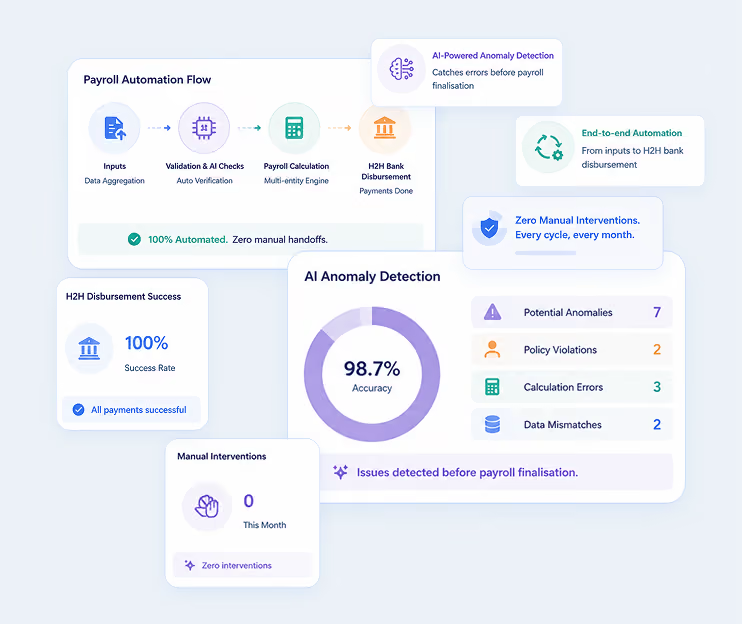
Automation runs the payroll. Agentic intelligence watches the cycle and predicts the shortfall, then tells your team where to act before the deadline passes. That's what a single command centre for GHROWTH is meant to do.
Here's how that plays out against the rules covered in this guide:
- WPS-ready payroll, built in: The platform auto-generates compliant SIF files and maps one WPS record to every employee. It reconciles posted values against contracts, so a mismatch stays clear of MOHRE.
- Agentic checks on the 85% threshold: Instead of confirming a shortfall after the fact, ZingHR predicts whether your transfer will clear 85% for the cycle and flags the gap while there's still time to close it.
- Calendar discipline anchored to the 1st: Payroll services run dates and approval SLAs are enforced through workflow, with bank cut-offs mapped in. Holiday contingencies keep a bank delay from pushing you past the deadline.
- Emiratisation and NAFIS in one view: Track every Emirati salary against the AED 6,000 floor and model the cost of unfilled slots. Quarterly NAFIS reporting stays on the rails.
- UAE and India from one source of truth: Real-time wage policing covers the UAE. Multi-jurisdiction rule orchestration handles India's statutory filings, from PF and ESI to shifting labour codes, all inside one unified HCM.
- Board-level workforce intelligence: Monthly WPS dashboards pair with digital audit trails for every submission and MOHRE notice. Your CFO and CHRO get a compliance narrative they can put in front of a regulator calmly.
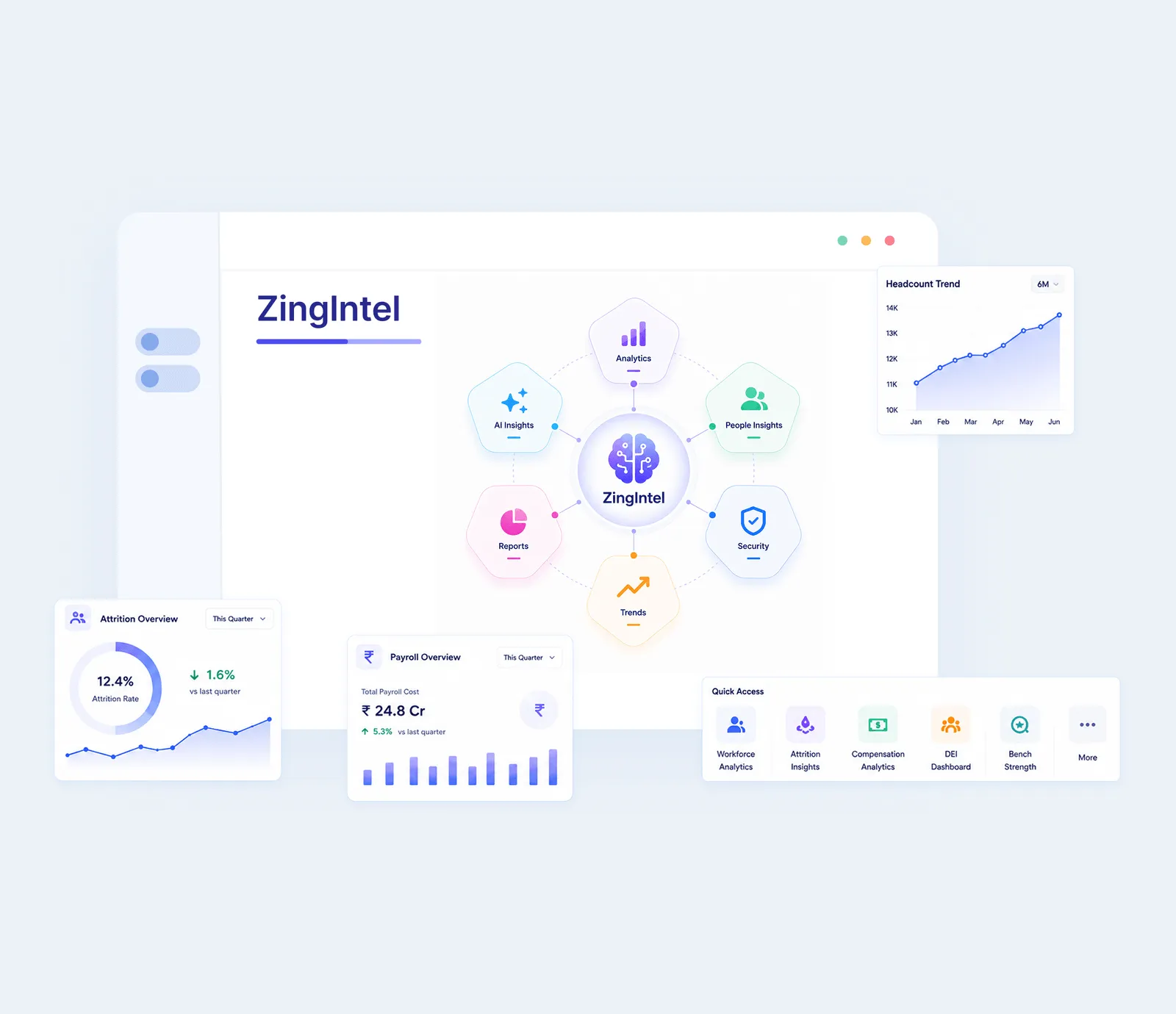
For enterprises with 1,000+ employees, especially Indian groups expanding across the GCC, that pairing matters. Unified HCM + embedded regulatory intelligence turns payroll from a monthly risk into a controlled, auditable discipline.
Building UAE Payroll Compliance for 2026 and Beyond
The 2026 rules close the gap you used to rely on. The 10-day cushion has gone, and the quiet grace period with it. Enforcement now runs automatically from a missed transfer to a frozen work permit.
The UAE Wage Protection System 2026 runs on a single clock and an 85% threshold. Its enforcement timeline escalates to travel bans and asset seizure within three weeks. Add the Emirati minimum wage and NAFIS quotas on top, and payroll clearly sits at board level now.
The enterprises that stay clean will win on discipline. They treat compliance as a real-time governance discipline, backed by a platform that predicts problems instead of reporting them. Build the operating model and anchor the calendar to the 1st.
Let agentic intelligence watch the threshold for you. Do that, and the 2nd of the month stops being the day your CFO dreads. Book a demo to see how ZingHR's HCM platform serves your enterprise.
Frequently asked questions (FAQs)
Missing the 1st-of-month salary deadline triggers rapid enforcement. Electronic warnings begin on day 2, work permit suspensions by day 5, and fines with MOHRE classification downgrades by day 11. Larger employers may face labour disputes, travel bans and precautionary asset seizure, making non-compliance a serious operational and reputational risk.
Article 4 exempts workers with pending labour claims, approved unpaid leave, detention or court restrictions, absconding reports, certain seafarers, eligible foreign workers paid outside the UAE, and mission work permit holders. Every exemption must be properly documented and notified to MOHRE to avoid being treated as non-compliance.
From 1 January 2026, eligible Emirati employees must earn at least AED 6,000 monthly. Non-compliance can trigger monthly penalties, quota issues and work permit restrictions. Companies with 50+ employees must also report Emirati headcount through NAFIS, making workforce planning and payroll budgeting increasingly important.
Yes, a unified HCM platform can manage UAE WPS compliance alongside India’s statutory payroll requirements from a single system. It automates compliance checks, simplifies multi-country payroll and improves visibility across both jurisdictions. ZingHR provides these capabilities through a single, unified platform.
No, WPS applies to MOHRE-registered private-sector establishments with five or more employees. Salaries must be paid through WPS-approved banks or authorised channels. Failing to comply can trigger work permit restrictions and other enforcement actions, making WPS compliance essential for eligible employers.
What to do next?
See ZingHR in Action
Join the 1,200+ enterprises that have replaced fragmented HR with one intelligent, future-ready platform. See ZingHR in 30 minutes.
Build the Organization You Want
Great HR drives retention, capability, and culture. ZingHR takes care of the operational layer so your people team owns the strategy.
<script type="application/ld+json">
{
"@context": "https://schema.org",
"@type": "FAQPage",
"mainEntity": [
{
"@type": "Question",
"name": "What happens if we miss the 1st-of-month salary deadline?",
"acceptedAnswer": {
"@type": "Answer",
"text": "Missing the 1st-of-month salary deadline triggers rapid enforcement. Electronic warnings begin on day 2, work permit suspensions by day 5, and fines with MOHRE classification downgrades by day 11. Larger employers may face labour disputes, travel bans and precautionary asset seizure, making non-compliance a serious operational and reputational risk."
}
},
{
"@type": "Question",
"name": "Who is exempt from WPS calculations under the 2026 rules?",
"acceptedAnswer": {
"@type": "Answer",
"text": "Article 4 exempts workers with pending labour claims, approved unpaid leave, detention or court restrictions, absconding reports, certain seafarers, eligible foreign workers paid outside the UAE, and mission work permit holders. Every exemption must be properly documented and notified to MOHRE to avoid being treated as non-compliance."
}
},
{
"@type": "Question",
"name": "How does the Emirati minimum wage affect our payroll budget?",
"acceptedAnswer": {
"@type": "Answer",
"text": "From 1 January 2026, eligible Emirati employees must earn at least AED 6,000 monthly. Non-compliance can trigger monthly penalties, quota issues and work permit restrictions. Companies with 50+ employees must also report Emirati headcount through NAFIS, making workforce planning and payroll budgeting increasingly important."
}
},
{
"@type": "Question",
"name": "Can a single HCM platform manage India and UAE payroll together?",
"acceptedAnswer": {
"@type": "Answer",
"text": "Yes, a unified HCM platform can manage UAE WPS compliance alongside India's statutory payroll requirements from a single system. It automates compliance checks, simplifies multi-country payroll and improves visibility across both jurisdictions. ZingHR provides these capabilities through a single, unified platform."
}
},
{
"@type": "Question",
"name": "Does WPS apply to every company in the UAE?",
"acceptedAnswer": {
"@type": "Answer",
"text": "No, WPS applies to MOHRE-registered private-sector establishments with five or more employees. Salaries must be paid through WPS-approved banks or authorised channels. Failing to comply can trigger work permit restrictions and other enforcement actions, making WPS compliance essential for eligible employers."
}
}
]
}
</script>

Elevating Impact.
Defining Destiny
See how ZingHR's AI-powered Hire-to-ReHire platform frees your CPO to lead with purpose and deliver the outcomes your Board is watching for


ZingHR is the AI-powered Hire-to-ReHire platform built for one purpose to remove every transactional layer of HR from your organisation, permanently.