The Complete Guide to HR Software Implementation
A clean HRMS rollout across multi-location, multi-country operations requires seven structured phases, a tested rollback plan, and executive sponsorship that goes well beyond signing the budget.

Table of contents
One unstitched HR platform to manage your entire workforce, from hire to rehire.
Talent Management solutions built for growing and exceptional people
Built-in compliance tools that update with changing regulations
Automated payroll, attendance, and leave management
Insights that help HR leaders make faster, better decisions

Key Takeaways
- HR software implementation is a multi-phase process spanning requirements analysis, vendor selection, data migration, configuration, testing, training, and post-go-live optimisation, typically 3–12 months depending on organisational size.
- Enterprise leaders (CHRO, CFO, CIO) in regulated industries such as BFSI, Pharma, Healthcare, and Manufacturing benefit most from a structured, phased rollout safeguarding compliance and minimising operational disruption.
- Data readiness is the single biggest risk factor: poor data quality causes the majority of implementation delays, making early audit and cleanup essential.
- Change management and training are non-negotiable, and without executive sponsorship and role-specific adoption programmes, even the best HRMS will underperform.
- ZingHR's unified HCM platform, powered by Ghrowth.ai, its agentic intelligence engine, provides board-level reporting, compliance-first design, and phased implementation support engineered for multi-location enterprises across the globe.
- In 2026, 91% of HR leaders expressed interest in a unified HCM platform, making consolidation from fragmented point solutions the dominant implementation pattern.
A clean HRMS rollout can still go sideways if the groundwork is weak. Payroll teams find duplicate employee records, managers struggle with approval flows, and employees return to email because self-service feels confusing.
For enterprise HR, Finance, and IT leaders, HRMS implementation is less about switching tools and more about protecting payroll accuracy, compliance, workforce data, and user trust during change. Success starts before vendor demos, with clear requirements, data cleanup, workflow mapping, system testing, and training tied to real roles.
The guide walks through seven phases of HR software implementation in 2026, from objectives and vendor selection to migration, configuration, go-live, and post-launch measurement across multi-location enterprises.
7 Steps to a Successful HR Software Implementation
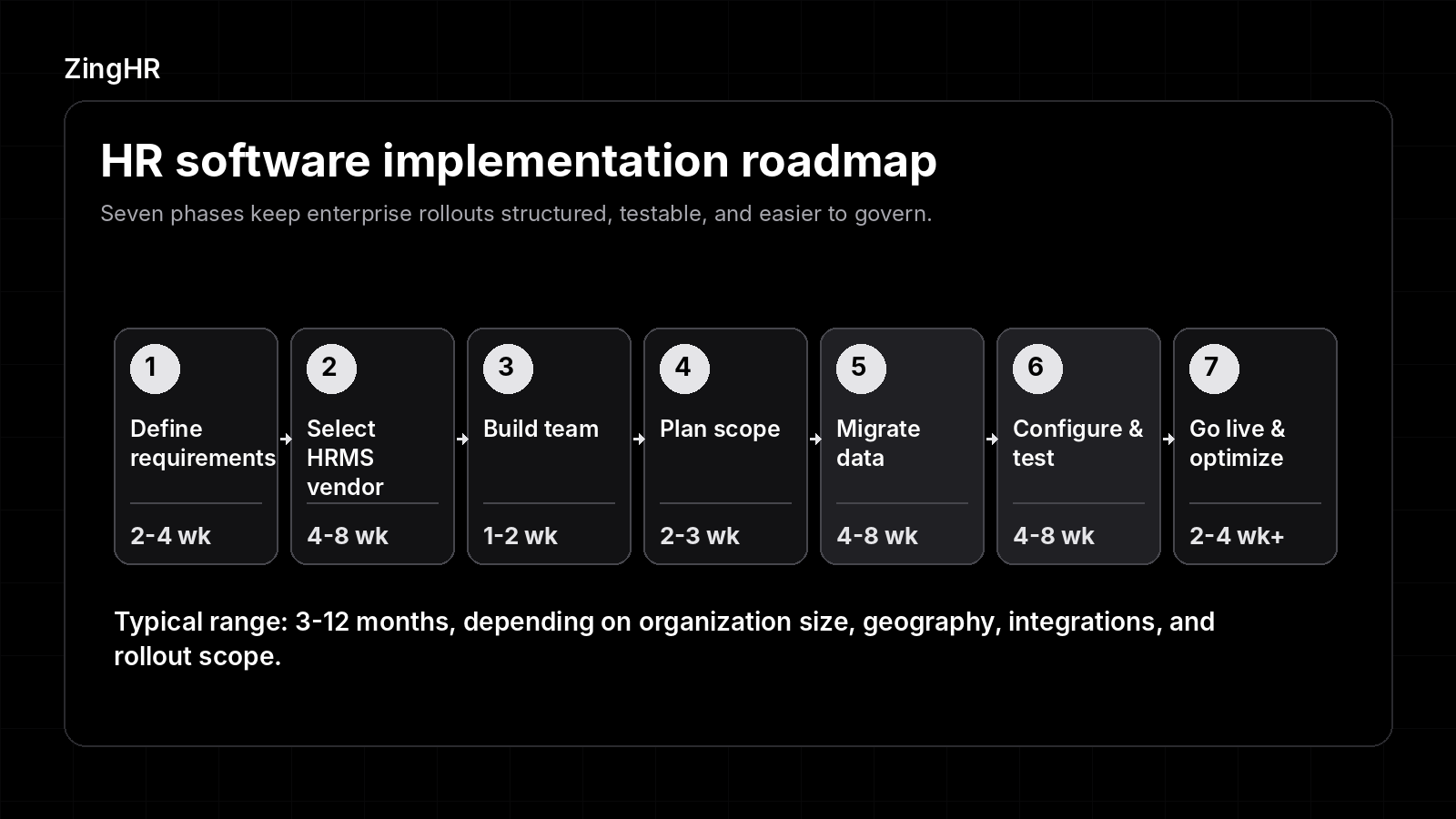
A structured approach prevents the budget overruns, data loss, and adoption failures plaguing unplanned rollouts. The table below maps each implementation phase to its core activities, typical timeline, and the stakeholders who must be involved.
Seven-phase HR software implementation roadmap showing core activities, typical timelines, and key stakeholders per phase.
How Did We Compile This Guide?
The implementation framework draws on industry research from the 2025–2026 HR Systems Survey (9,886 HR professionals across 4,670 organisations), best-practice guidance from HRMS implementation consultancies, and real-world deployment patterns observed across enterprise HCM rollouts in regulated sectors.
Our goal is to provide a balanced, vendor-informed but methodology-driven guide that operations and IT leaders can apply regardless of platform choice.
Phase-by-Phase HR Software Implementation Guide
Frequently asked questions (FAQs)
HR software implementation follows a structured seven-phase roadmap: define strategic objectives and requirements, evaluate and select your HRMS vendor, assemble the cross-functional implementation team, plan budget and timeline with scope controls, execute data migration with rigorous testing, configure the system and run user acceptance testing, and go live with role-based training and ongoing optimisation.
Implementation timelines vary significantly based on organisational size, geographic complexity, and scope. Small businesses deploying a single-country HRMS (e.g., core HR and payroll) can expect 3–4 months. Mid-market organisations with multi-module requirements typically require 4–6 months. Large enterprises with multi-country statutory payroll, complex integrations, and thousands of employees should plan for 6–12 months.
The three most frequent challenges are poor data quality (responsible for the majority of delays and rework), organisational resistance to change, and integration failures with existing systems. Mitigate data risk by starting the audit and cleanup process three months before migration. Address resistance through executive sponsorship, transparent communication, and role-specific training delivered close to go-live.
Score vendors using a weighted scorecard across five dimensions. Evaluate functional fit without heavy customisation, and look for structured implementation methodologies. Calculate the three-year total cost of ownership, including migration and support. Verify security certifications (SOC 2, ISO 27001, GDPR) and confirm proven vertical expertise at a comparable scale.
Start data audits at least three months before migration. Inventory all sources, then standardise, deduplicate, and reconcile records. Choose between a full historical or cutover migration. Run test migrations using a 10% data sample. Require two successful test cycles before the full import. Never migrate directly to production without validation. Keep legacy systems read-only during cutover and document a tested rollback procedure.
Establish pre-implementation baselines for payroll errors, admin hours, time-to-hire, compliance incidents, and self-service usage. Track progress weekly during Q1, then monthly. Target 99.5%+ payroll accuracy, a 20–50% reduction in admin hours, and 80%+ self-service adoption within six months. Calculate financial ROI as (annual automation savings + cost avoidance) / total investment. Optimising against these metrics quarterly typically delivers a 2–3x first-year ROI for executive stakeholders.
What to do next?
See ZingHR in Action
Join the 1,200+ enterprises that have replaced fragmented HR with one intelligent, future-ready platform. See ZingHR in 30 minutes.
Build the Organization You Want
Great HR drives retention, capability, and culture. ZingHR takes care of the operational layer so your people team owns the strategy.

Elevating Impact.
Defining Destiny
See how ZingHR's AI-powered Hire-to-Retire platform frees your CPO to lead with purpose and deliver the outcomes your Board is watching for


ZingHR is the AI-powered Hire-to-ReHire platform built for one purpose to remove every transactional layer of HR from your organisation, permanently.