15 Best HR Software in India (2026): Top Solutions Analyzed and Reviewed
2026 shortlist of 15 best HR software solutions for businesses in India.

Table of contents
One unstitched HR platform to manage your entire workforce, from hire to rehire.
Talent Management solutions built for growing and exceptional people
Built-in compliance tools that update with changing regulations
Automated payroll, attendance, and leave management
Insights that help HR leaders make faster, better decisions

Key Takeaways
- The India HRMS market is projected to grow from USD 0.87 billion in 2025 to USD 2.27 billion by 2031. Choosing the right platform now prevents a costly migration as your workforce scales.
- Indian statutory compliance: PF, ESIC, PT, and TDS, is non-negotiable; the right HR software automates these calculations state by state, reducing manual errors by up to 95% and keeping organisations audit-ready at all times.
- Workforce size determines the right tier: free tools suit bootstrapped startups, mid-market platforms serve growing firms between 200–500 employees, and purpose-built enterprise HCM is essential for organisations crossing the 1,000-employee threshold.
- Attendance-to-payroll integration is the single highest-ROI feature for Indian businesses. It eliminates duplicate data entry, removes the most common source of payroll disputes, and saves SMEs 15–20 hours of administrative work every month.
- ZingHR is the only platform in this list built to permanently remove transactional HR from enterprise operations, with 35+ modules on one codebase and one database, Ghrowth.ai agentic intelligence, ZingZeroTAP zero-touch payroll, and multi-geography compliance across 30+ countries, recognised by Gartner as a Customers' Choice in 2024.
For a 500-person workforce, paper attendance records, manual payroll files, and spreadsheet-based performance tracking break down anytime. HR teams have to spend hours chasing approvals, correcting missed punches, and reconciling salary inputs across departments.
On the other hand, employees feel the impact when payroll errors turn into disputes. Finance sees it when audits expose missing records or weak compliance trails. Finally, leadership feels it when headcount, attrition, attendance, and performance data sit across five spreadsheets, each owned by a different person.
The India HRMS market is projected to grow from USD 0.87 billion in 2025 to USD 2.27 billion by 2031, and the number of platforms competing for that spend has grown with it. Not all of them handle Indian statutory compliance at the same depth. Not all of them scale past 500 employees. And pricing structures vary enough that the wrong choice at 200 employees becomes an expensive migration at 800.
We evaluated 15 HR software platforms on Indian statutory compliance depth (PF, ESIC, PT, TDS), verified G2 ratings, pricing, scalability, and target segment fit. Each review gives you what you need to compare shortlisted options without going back to vendor websites.
ZingHR is purpose-built for enterprises managing 1,000+ employees across geographies; the guide covers the full range from free startup tools to board-level HCM platforms.
15 HR Software in India to Streamline Workforce Management
Let’s compare these 15 top cloud HRMS software options in India across workforce size, pricing model, and compliance coverage before reading the detailed reviews.
Top HR software in India at a glance
How Did We Compile This List?
This list was assembled through a multi-source evaluation that combined verified G2 and Capterra user ratings, published vendor documentation, hands-on interface analysis, and publicly available pricing data. Each solution was assessed on Indian statutory compliance depth (PF, ESIC, PT, TDS), scalability for the stated target segment, mobile accessibility, and integration capabilities. Our goal is to present a balanced, data-backed view that helps HR leaders, CXOs, and business owners in India make informed procurement decisions regardless of company size.
Detailed Reviews: 15 Best HR Software in India
Now, let’s get into the details and specific features these HR software platforms offer, along with their pros and cons:
1. ZingHR
Best for: Enterprise organizations (1,000+ employees) and CXOs seeking a unified, board-level HCM command centre with agentic intelligence
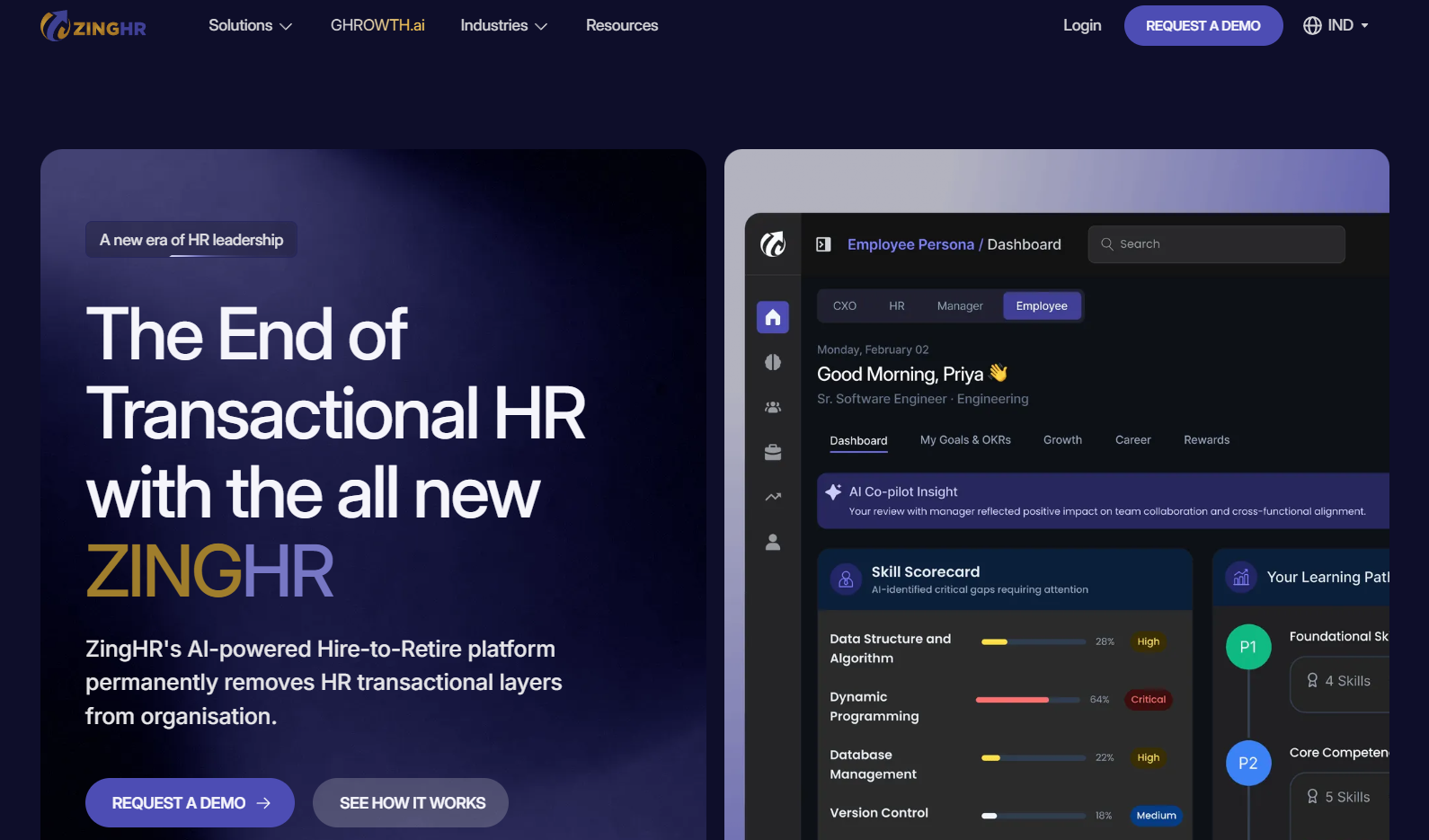
ZingHR is the AI-powered Hire-to-Retire platform built around one stated purpose: to permanently remove transactional HR from enterprise operations.
Its 35+ modules were designed by one team on a single codebase and one database, which means performance data, payroll, attendance, succession, and engagement records all share one employee record. No middleware. No sync delays. No contradictory reports across modules.
Over 1,200 enterprises and 2.8 million active users across India, MEA, and SEA run on ZingHR. Gartner recognised the platform as a Customers' Choice in 2024. The platform supports 26+ languages and 12 purpose-built vertical solutions across BFSI, Manufacturing, IT-ITES, Retail-QSR, Pharma, Healthcare, Staffing, and Logistics.
Most competing suites in this list are assembled from acquired modules running on separate databases. ZingHR's 35+ modules were built in-house by one team, giving CHROs and CXOs a single source of truth from the first candidate click to the day an alumnus walks back in.
ZingHR's Key Features
- Ghrowth.ai, its agentic intelligence engine: Goes beyond standard dashboards by surfacing cross-functional signals across HR, Finance, and Operations in real time. Flight risks are flagged, development interventions are recommended, and performance trends are forecast before they reach the boardroom as problems. CHROs and CXOs see the full workforce picture without manually pulling data from separate systems.
- ZingZeroTAP, zero-touch attendance and payroll: The platform's payroll engine handles real-time reconciliation across every pay structure, location, and currency. For Indian operations, it automates PF, ESIC, PT, and TDS calculations state by state. Attendance data feeds directly into payroll from the same database, removing the manual reconciliation step where most payroll disputes originate.
- Unified architecture, one codebase and one database: ZingHR's modules, from talent acquisition and performance management to payroll and employee engagement, run on a single codebase and share one employee record. Reports across functions draw from the same data source, eliminating the contradictory numbers that emerge when HR, Finance, and Operations each run separate systems.
- Talent Acquisition and Succession Planning: The talent module covers AI-ranked shortlists, cognitive assessments, personality profiling, digital onboarding, and offer management. The succession planning engine identifies critical positions, maps skills visibility, and enables smart talent redeployment, giving Boards the data to manage leadership continuity. ZingHR's AI Recruitment Agent delivers a 70% reduction in hiring effort.
- Employee Engagement Suite: Zing Social, rewards and recognition, an AI-powered HR chatbot, pulse surveys, and continuous feedback tools keep distributed enterprise workforces connected. Organisations using ZingHR's engagement tools report measurable improvements in eNPS scores and reduced voluntary attrition.
ZingHR's Pros
- Unified architecture with 35+ modules on one codebase and one database eliminates integration debt and contradictory reporting across HR, Finance, and Operations
- Ghrowth.ai surfaces workforce risks, attrition signals, and compliance exposure without manual data mining
- Deep statutory compliance with multi-state payroll accuracy, ZingZeroTAP automation, and automatic regulatory updates
ZingHR's Cons
- Enterprise-grade deployment requires a structured implementation engagement, not a self-serve setup
- Custom pricing positions ZingHR for organisations above 500 employees; smaller teams may find the investment disproportionate
2. Kredily
Best for: Bootstrapped startups and SMEs that need free HR and payroll software with zero upfront cost
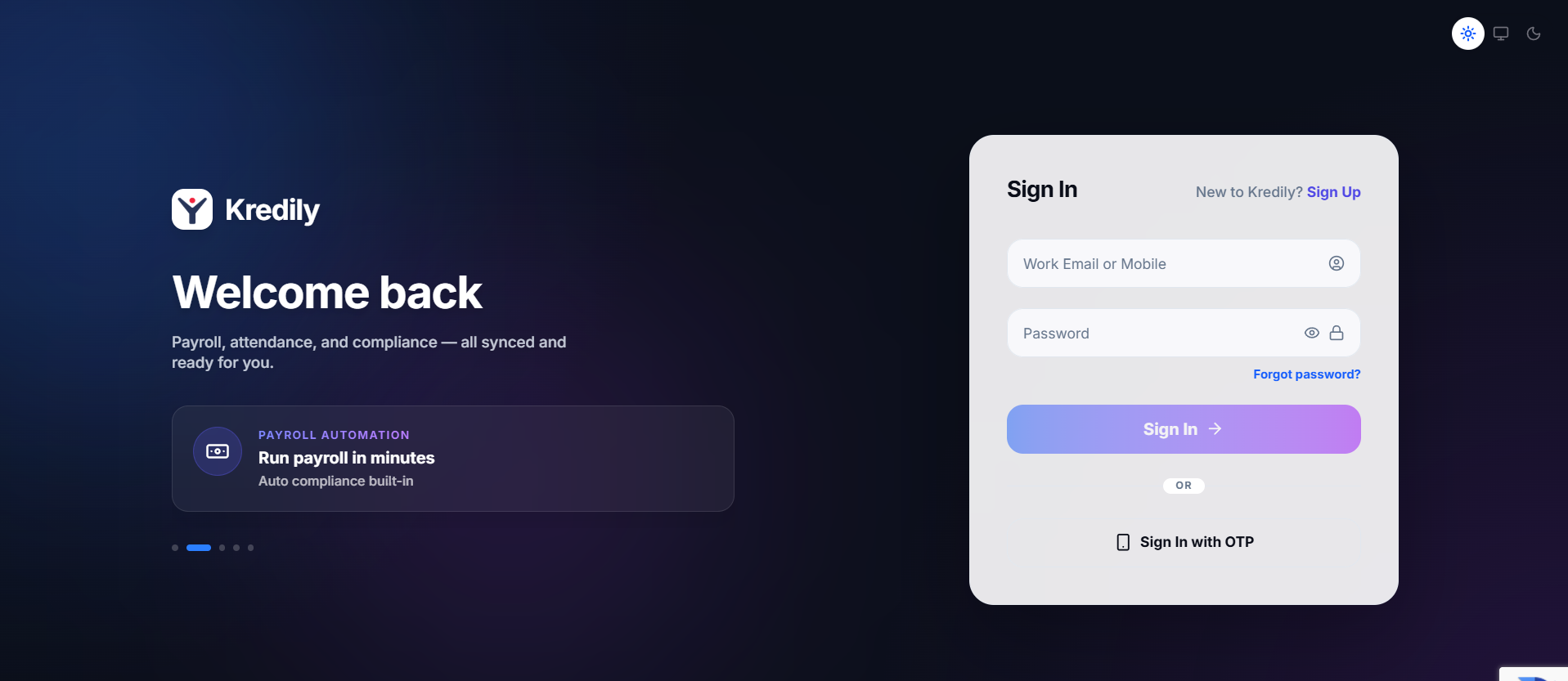
Kredily is built to democratize HR technology for Indian small businesses. The platform offers core HR and payroll features at no cost, making it one of the most accessible entry points for organizations that are transitioning away from spreadsheets.
Trusted by 20,000+ companies and 800,000+ employees, Kredily's focus on affordability has positioned it as one of the fastest-growing HR software choices for Indian startups.
Organizations using Kredily typically find it most valuable during their early growth phase when budgets are tight but the need for structured attendance, payroll, and leave management is immediate.
The free-forever model allows teams to formalize HR processes without financial commitment, though businesses that scale beyond 100–200 employees may eventually need more advanced modules.
Kredily's Key Features
- Free Payroll Processing: Kredily processes payroll at no cost, calculating salaries, deductions, and generating payslips. For startups managing their first 10–50 employees, this eliminates the cost barrier to accurate, timely salary disbursement while maintaining basic statutory compliance.
- Attendance and Leave Management: The platform tracks daily attendance and leave balances, allowing managers to approve or reject requests digitally. This replaces manual registers and email-based leave tracking with a centralized, searchable record.
- Expense Management and E-Exit: Kredily includes expense claim submission and approval workflows, plus a digital exit process (FnF settlement). These features cover the employee lifecycle from onboarding through separation without requiring additional tools.
Kredily's Pros
- Easy to manage employee activity, store information, and track individual records at zero cost
- Effective workflow automation for basic HR tasks
- Convenient and intuitive interface for non-technical users
Kredily's Cons
- The free version contains known bugs that affect reliability
- Intermittent login issues reported by multiple users
3. Pocket HRMS
Best for: Mid-sized Indian companies (200–1,000 employees) seeking affordable, AI-powered hire-to-retire automation
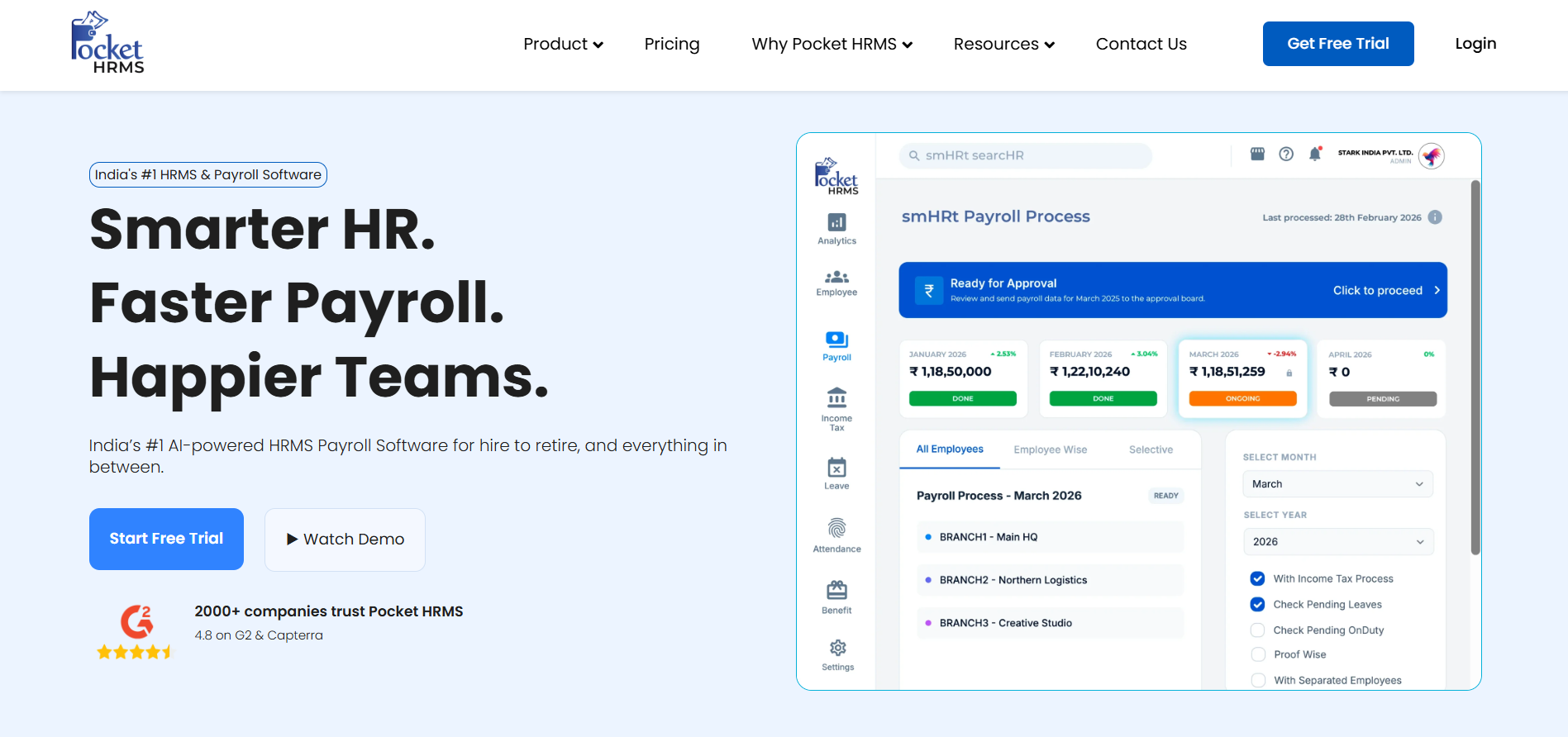
Pocket HRMS is a cloud-based HRMS that brings core and strategic HR functions together on a single platform. With 1,500+ Indian businesses and 3,500+ HR professionals relying on it, the platform is known for its understanding of Indian statutory compliance and local HR needs.
Its AI-powered chatbot (smHRty) differentiates it from basic HRMS tools by handling routine employee queries automatically.
In practice, Pocket HRMS works well for organizations that need comprehensive payroll automation, employee self-service, and recruitment tools without enterprise-level pricing.
Customizable workflows and mobile access make it practical for growing businesses, though larger enterprises may find its analytics and scalability limited compared to platforms designed for 1,000+ employee environments.
Pocket HRMS's Key Features
- AI-Powered HR Chatbot (smHRty): The smHRty chatbot handles routine HR queries including leave balance checks, policy clarifications, and payslip downloads, reducing the volume of repetitive requests reaching the HR team. This frees HR professionals to focus on strategic tasks rather than transactional queries.
- Payroll Automation with Compliance: Pocket HRMS automates salary calculations, PF, ESIC, PT, and TDS deductions based on Indian statutory rules. Payroll runs integrate directly with attendance data, minimizing manual data entry and calculation errors.
- Employee Self-Service Portal: Employees can download payslips, apply for leave, submit expense claims, and update personal information through a self-service portal. This reduces dependency on HR for routine administrative tasks and improves employee experience.
Pocket HRMS's Pros
- User-friendly interface with quick implementation for payroll, reports, and leave applications
- Payroll automation that cuts processing time significantly
- Strong understanding of Indian statutory compliance and local HR needs
Pocket HRMS's Cons
- Limited customization for complex enterprise workflows
- Mobile app interface feels outdated compared to newer competitors
4. Zimyo
Best for: Growing mid-market companies (50–500 employees) focused on employee engagement and operational automation
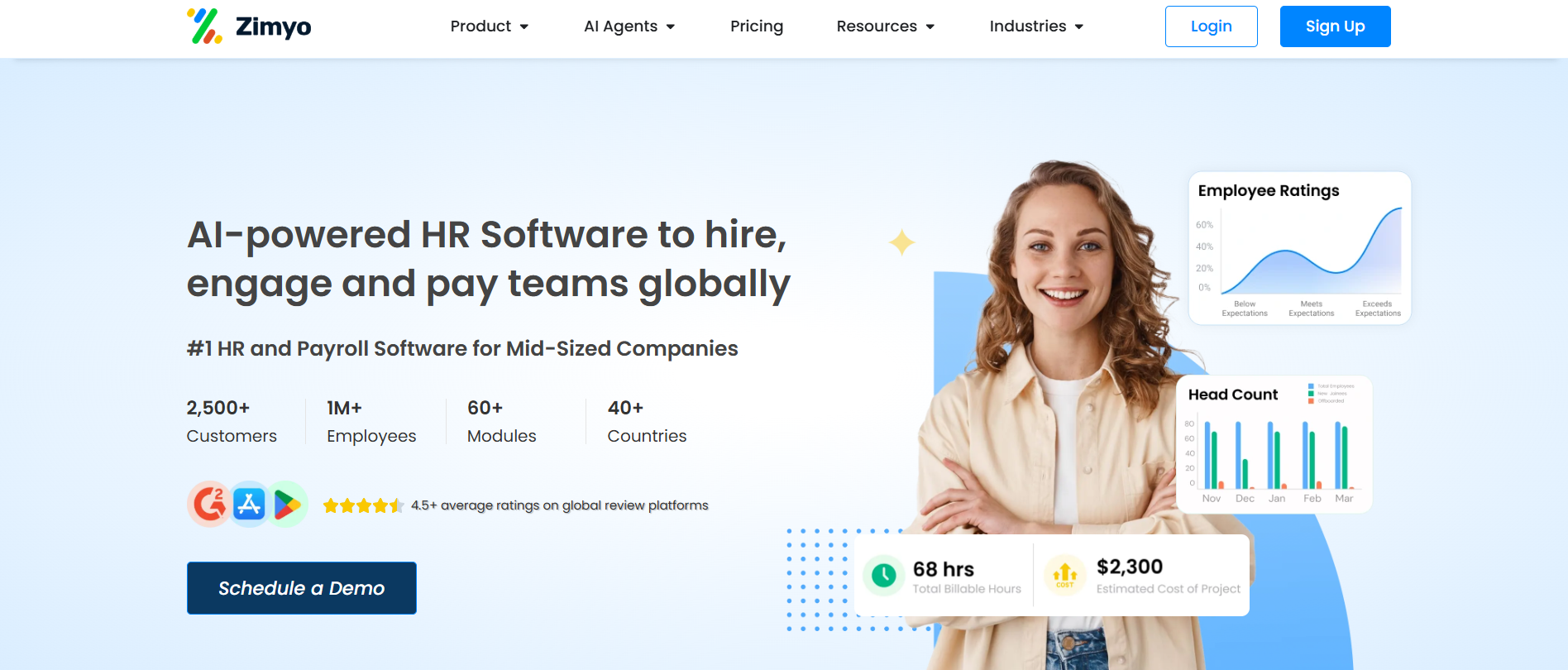
Zimyo is a comprehensive HR software that blends core HR operations with employee engagement tools. With 2,500+ organizations and 750,000+ employees on the platform, Zimyo has carved out a niche among companies that want a modern, user-friendly interface combined with workflow automation. Its appeal to younger workforces through intuitive design sets it apart from legacy HRMS providers.
Organizations using Zimyo typically find it effective for consolidating payroll, leave tracking, performance reviews, and travel management onto one platform. The automation layer reduces manual handoffs between HR sub-processes.
However, some modules are still evolving, and users have reported occasional lag in payroll automation that may affect time-sensitive processing cycles.
Zimyo's Key Features
- Employee Engagement Analytics: Zimyo provides engagement dashboards, pulse surveys, and sentiment analysis tools that help HR teams measure workplace satisfaction in real time. Managers can identify disengaged teams and intervene before attrition increases.
- Travel Desk Management: An integrated travel desk module handles employee travel requests, approvals, and expense tracking within the HR platform. This eliminates the need for separate travel management tools for mid-sized organizations.
- Workflow Automation Engine: Zimyo's automation engine allows HR teams to configure multi-step approval workflows for leave, expenses, onboarding, and offboarding. Each workflow can be customized by department, location, or role, reducing manual routing and approval delays.
Zimyo's Pros
- Modern, user-friendly UI that appeals to younger workforces
- Comprehensive feature set that consolidates multiple HR responsibilities
- Good automation for routine HR workflows and approvals
Zimyo's Cons
- Some modules are still maturing and may lack stability under heavy usage
- Lag reported in payroll automation processing
5. Qandle
Best for: Businesses of all sizes seeking modular, cloud-based HR with 40+ configurable modules and a mobile chatbot
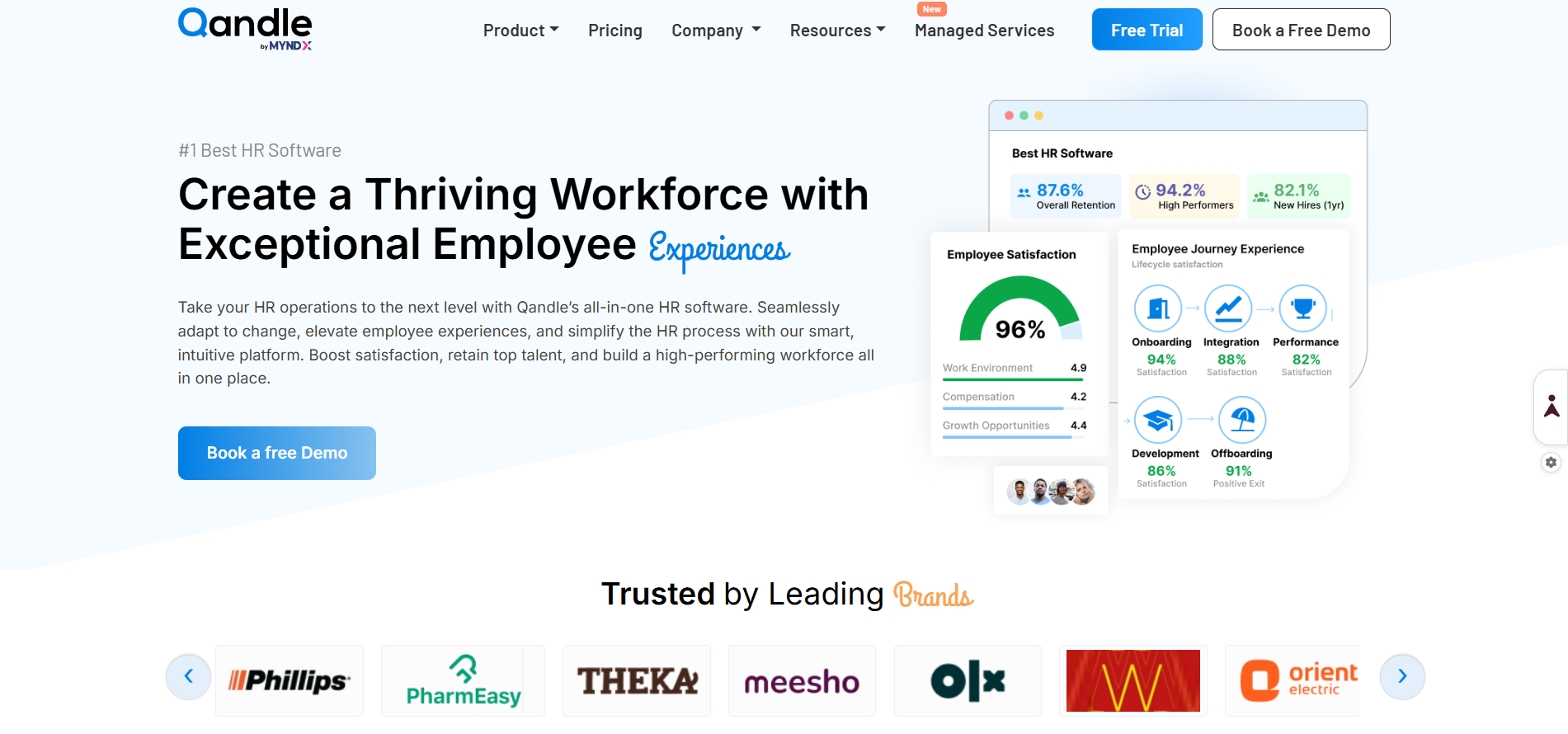
Qandle is a Gurgaon-based cloud HR platform designed to address the challenges of evolving Indian workplaces. With 2,500+ clients and 1,550,000+ users across 35+ industries, the platform differentiates itself through modular architecture. Organizations can select only the modules they need and scale as requirements grow. The intuitive mobile app and built-in chatbot simplify day-to-day HR interactions for employees and managers.
In practice, Qandle's pricing structure (₹2,450/month for up to 50 employees, ₹49 per additional employee) makes it competitive for SMBs that want flexibility without being locked into large contracts. The platform covers on/offboarding, time tracking, compliant payroll, OKR-based goal setting, and employee engagement.
Larger enterprises may find that the depth of analytics and niche modules does not match platforms specifically built for 1,000+ employee environments.
Qandle's Key Features
- Modular HR Architecture: Qandle offers 40+ modules that organizations can mix and match. This modular approach means a 50-person startup can start with payroll and attendance, then add performance management and recruitment as the business grows, without migrating to a different platform.
- OKR-Based Goal Setting: The performance module supports Objectives and Key Results (OKRs) alongside traditional KRA-based tracking. Managers can set, cascade, and monitor goals across departments with real-time progress visibility.
- Mobile App with Integrated Chatbot: Qandle's mobile app enables employees to mark attendance, apply for leave, check payslips, and get instant answers to HR queries through an AI chatbot, reducing the volume of tickets reaching the HR department.
Qandle's Pros
- Highly user-friendly app and interface that requires minimal training
- Strong customization potential to adapt to specific business workflows
- Competitive pricing and module options for SMBs
Qandle's Cons
- Lacks deep analytics and niche modules compared to enterprise-grade platforms
- Advanced reporting features require additional configuration
6. greytHR
Best for: SMEs to enterprises needing a proven, compliance-first payroll and HR platform with a strong Indian market track record
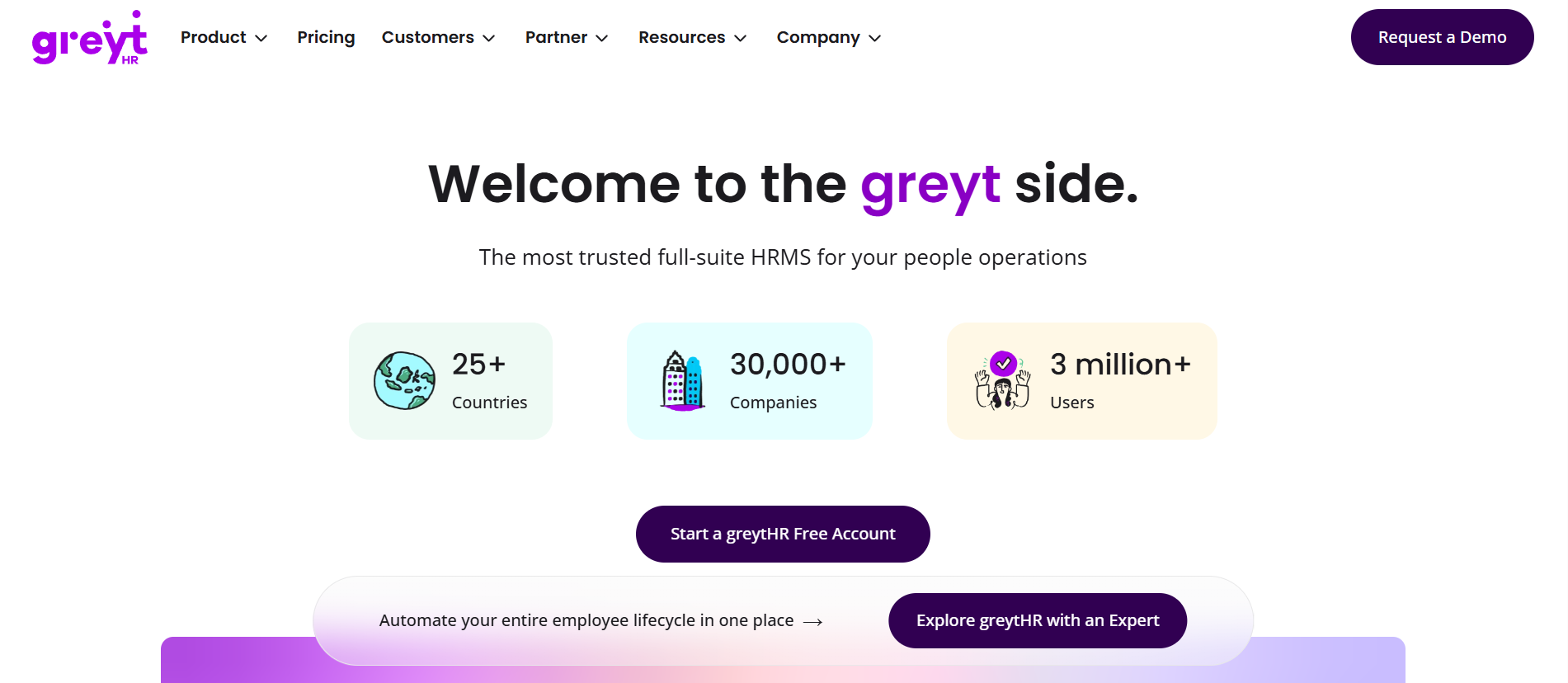
greytHR is one of the oldest and most trusted HR software providers in India, with roots going back to 1994. The platform serves 30,000+ clients and manages over 3 million employees across 25+ countries.
Its core strength is reliable payroll processing with deep Indian statutory compliance, handling salary calculations, tax deductions, payslips, PF, ESIC, and PT accurately.
Many users highlight that greytHR's interface is smooth, fast, and practical for daily tasks such as marking attendance, downloading payslips, and checking tax details. The free trial (₹0/month for up to 50 employees) makes it easy for small businesses to test the platform before committing.
Larger organizations with complex analytics or customization requirements may find the platform more limited compared to purpose-built enterprise solutions.
greytHR's Key Features
- Statutory Compliance Engine: greytHR automates PF, ESIC, PT, and TDS calculations with state-specific rule sets. The compliance engine updates automatically when government regulations change, reducing the risk of penalties from manual miscalculations.
- Payroll Processing: The payroll module handles salary computation, arrears, bonuses, reimbursements, and full-and-final settlements. Integration with attendance data ensures that payroll calculations reflect actual working days and overtime automatically.
- Employee Lifecycle Management: From offer management through onboarding, performance reviews, and exit processing, greytHR tracks the complete employee lifecycle. This provides HR teams with a single, continuous record for each employee rather than fragmented data across systems.
greytHR's Pros
- Globally trusted with a strong reputation in the Indian market
- Saves significant time during payroll with accurate salary calculations, tax deductions, and compliance
- Good for multi-location setups requiring consistent payroll processing
greytHR's Cons
- Interface feels dated compared to newer competitors
- Customer support delays reported during peak periods
7. RazorpayX Payroll
Best for: Startups and small businesses that want payroll automation tightly integrated with payment infrastructure
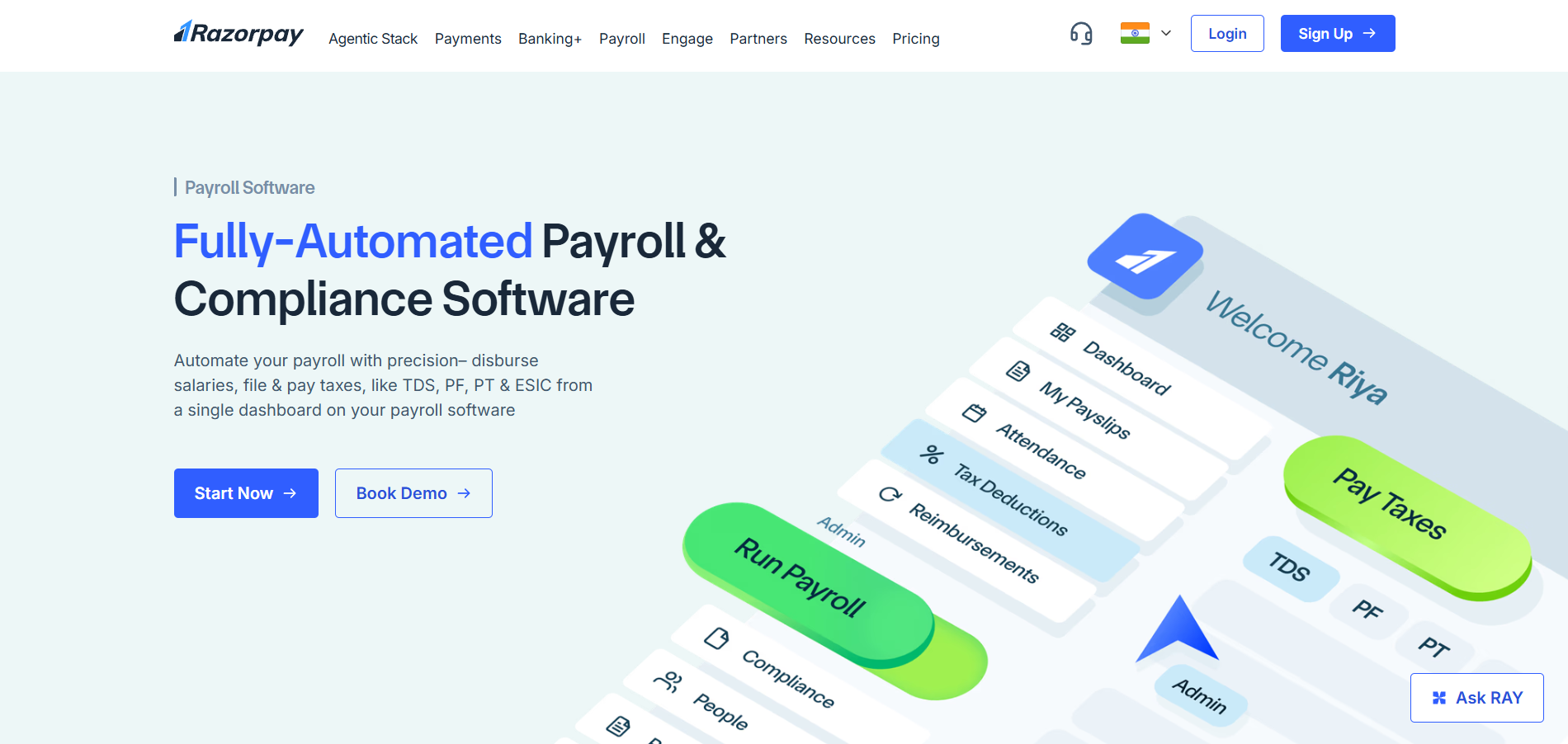
RazorpayX Payroll is designed to eliminate the complexities of manual payroll for startups and growing businesses in India. Built on top of Razorpay's established payment infrastructure, it integrates payroll processing with direct salary deposits, tax filing, and statutory compliance, all within a single ecosystem. Thousands of SMEs and startups that already use Razorpay for payments find the transition seamless.
The platform's 1-hour onboarding claim and simple admin interface make it one of the fastest HRMS tools to deploy. In practice, organizations using RazorpayX Payroll value its automated TDS, PF, and ESIC filing, which reduces end-of-month compliance workload.
However, the platform is focused on payroll and compliance. It lacks broader HRMS modules like performance management or recruitment, making it a complement to, rather than a replacement for, full-suite HR software.
RazorpayX Payroll's Key Features
- Automated Statutory Compliance: RazorpayX Payroll automates TDS filing, PF deposits, ESIC contributions, and professional tax payments. Compliance calculations update automatically based on current government rates, and filing reminders ensure deadlines are not missed.
- Direct Salary Deposits: Salaries are deposited directly into employee bank accounts through Razorpay's payment rails. This eliminates the need for separate banking portals and reduces settlement time compared to traditional NEFT/RTGS processes.
- 1-Hour Onboarding: New organizations can set up RazorpayX Payroll and process their first payroll run within an hour. The minimal configuration requirement makes it practical for startups that lack dedicated HR or IT teams.
RazorpayX Payroll's Pros
- Smooth automation of payroll including TDS, PF, and ESIC compliance
- Simple UI for both admin and employees with minimal training required
- Direct integration with the Razorpay payment ecosystem
RazorpayX Payroll's Cons
- Advanced payroll reporting and analytics are missing
- Customer support responsiveness has been criticized by users
8. FactoHR
Best for: All-sized businesses seeking strong payroll, biometric attendance, and mobile-first workforce management
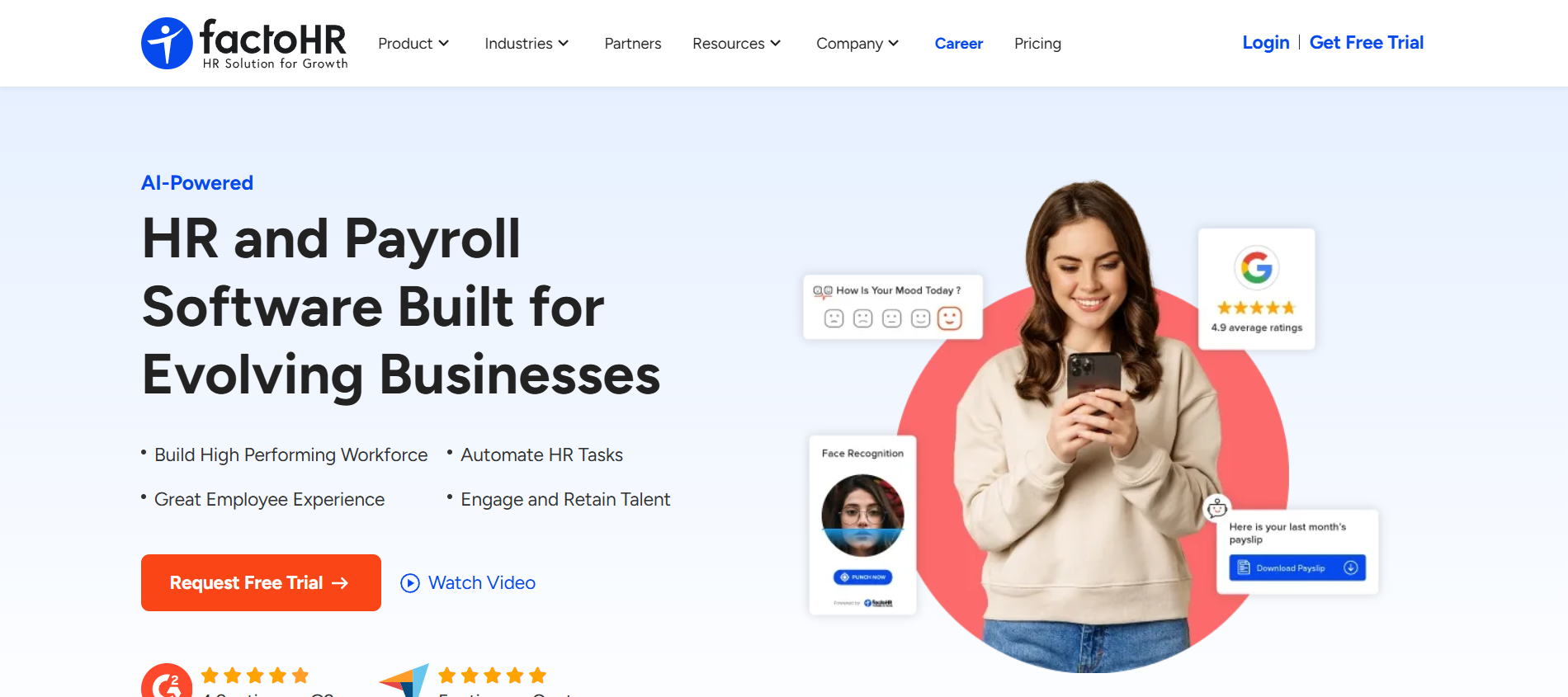
FactoHR is an enterprise-grade HR and payroll software that emphasizes making HR operations efficient through automation and data-driven insights. Over 3,500 organizations and 2.6 million users trust the platform for end-to-end workforce management.
FactoHR's particular strength lies in its attendance tracking capabilities, including biometric and GPS-based options that suit field teams and manufacturing environments.
Organizations using FactoHR typically find that payroll automation, leave management, and mobile access deliver the most immediate ROI. The platform also includes a learning management system (LMS) and a recruitment module, making it a reasonably complete solution for businesses that want to avoid stitching together multiple vendors. Users have noted occasional interface slowness under large data loads, a consideration for organizations with complex, high-volume processing needs.
FactoHR's Key Features
- Biometric and GPS Attendance Tracking: FactoHR supports biometric devices, geo-fencing, and GPS-based attendance marking. This is particularly useful for Indian businesses with field staff, manufacturing units, or multiple office locations where traditional punch-card systems are impractical.
- Payroll and Compliance Automation: The payroll module handles salary computation, statutory deductions (PF, ESIC, PT, TDS), bonus calculations, and full-and-final settlements. Attendance data feeds directly into payroll, ensuring accurate pay calculations without manual reconciliation.
- Learning Management System: FactoHR's built-in LMS allows organizations to create, assign, and track employee training programs. Completion tracking and certification management support compliance training requirements in regulated industries.
FactoHR's Pros
- Easy to use and implement with strong payroll, automation, and attendance capabilities
- Mobile access and security features suit distributed workforces
- Good user ratings on value for money and support quality
FactoHR's Cons
- Loading speed and performance lag under large data sets
- Limited customization for complex enterprise-specific workflows
9. Zoho People
Best for: SMBs already using the Zoho ecosystem that need affordable, integrated HR management
Zoho People is part of Zoho's extensive SaaS ecosystem of 55+ products serving 120 million users across 150+ countries.
For businesses that already use Zoho CRM, Zoho Books, or other Zoho tools, adding Zoho People creates a seamless workflow across sales, finance, and HR. The platform covers hiring, onboarding, core HR, performance, learning, and payroll at pricing that starts at ₹48/user/month billed annually.
Organizations using Zoho People value its affordability and the integration depth with other Zoho applications. The self-service portal, customizable forms, and HR automation workflows handle most SMB requirements effectively. However, the platform's payroll depth for Indian compliance is not as mature as dedicated Indian HRMS tools, and larger enterprises may encounter scalability limitations.
Zoho People's Key Features
- Zoho Ecosystem Integration: Zoho People integrates natively with Zoho Books (accounting), Zoho Recruit (hiring), Zoho Expense (reimbursements), and Zoho Analytics. This eliminates data duplication across business functions and creates a unified view of employee-related costs and activities.
- HR Automation Workflows: Configurable workflows automate approval chains for leave, onboarding, document submissions, and policy acknowledgments. HR teams can set up multi-level approvals based on department, designation, or location without coding.
- Learning and Engagement: The built-in LMS supports course creation, assignment, and completion tracking. Combined with employee engagement surveys and feedback tools, it helps organizations maintain workforce development and satisfaction metrics.
Zoho People's Pros
- Affordable and integrates directly with the broader Zoho ecosystem
- Simple setup for small teams with customizable forms
- Efficient for managing timesheets, leaves, attendance, and daily clock-in/out
Zoho People's Cons
- Lacks deep Indian payroll features compared to dedicated HRMS tools
- Scalability becomes an issue for firms exceeding 500 employees
10. Darwinbox
Best for: Mid to large enterprises requiring mobile-first HR with AI-enabled analytics and digital onboarding
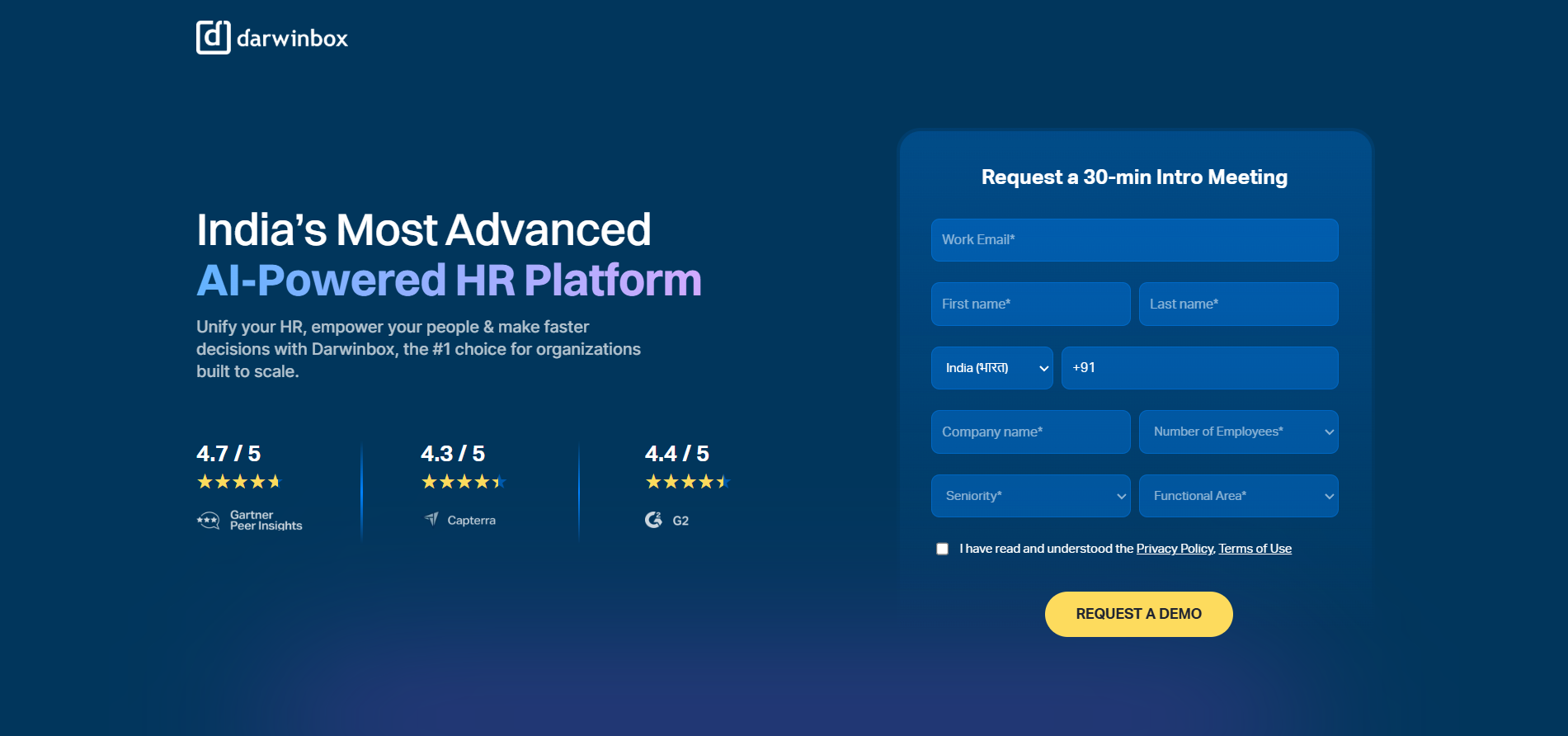
Darwinbox was founded to create a scalable HR solution adapted to the demands of developing businesses across Asia. The platform has quickly gained prominence as one of Asia's top HR software platforms, digitizing the entire employee lifecycle from recruitment through retirement. Its focus on mobile-first design, AI-enabled analytics, and face-recognition attendance suits organizations with large, distributed workforces.
Organizations using Darwinbox typically find the employee self-service portal, 360-degree performance appraisals, and real-time HR analytics most valuable. The platform integrates with third-party applications and offers customizable workflows.
Its pricing is custom-based, positioning it for mid to large enterprises rather than cost-sensitive SMBs. Users have noted that the payroll module has room for improvement compared to India-focused payroll specialists.
Darwinbox's Key Features
- AI-Enabled HR Analytics: Darwinbox's analytics engine provides predictive insights on attrition risk, workforce planning, and engagement trends. Dashboards are configurable by role, allowing CHROs and line managers to access the data most relevant to their decisions.
- Face Recognition Attendance: The platform supports face-recognition-based attendance marking through its mobile app, eliminating buddy punching and proxy attendance. This is particularly useful for manufacturing, retail, and field-operations environments.
- 360-Degree Performance Appraisal: Performance reviews incorporate feedback from peers, managers, direct reports, and self-assessment. The 360-degree approach provides a balanced evaluation and reduces bias in annual or quarterly review cycles.
Darwinbox's Pros
- Employee self-service portal effectively handles PTO and attendance verification
- Intuitive, user-friendly interface with strong mobile-first design
- Comprehensive employee lifecycle management across geographies
Darwinbox's Cons
- Payroll module functionality can be improved for complex Indian compliance
- Implementation and setup can be time-intensive for large organizations
11. Deel
Best for: Companies hiring global remote employees who need employer-of-record (EOR) services and multi-country compliance
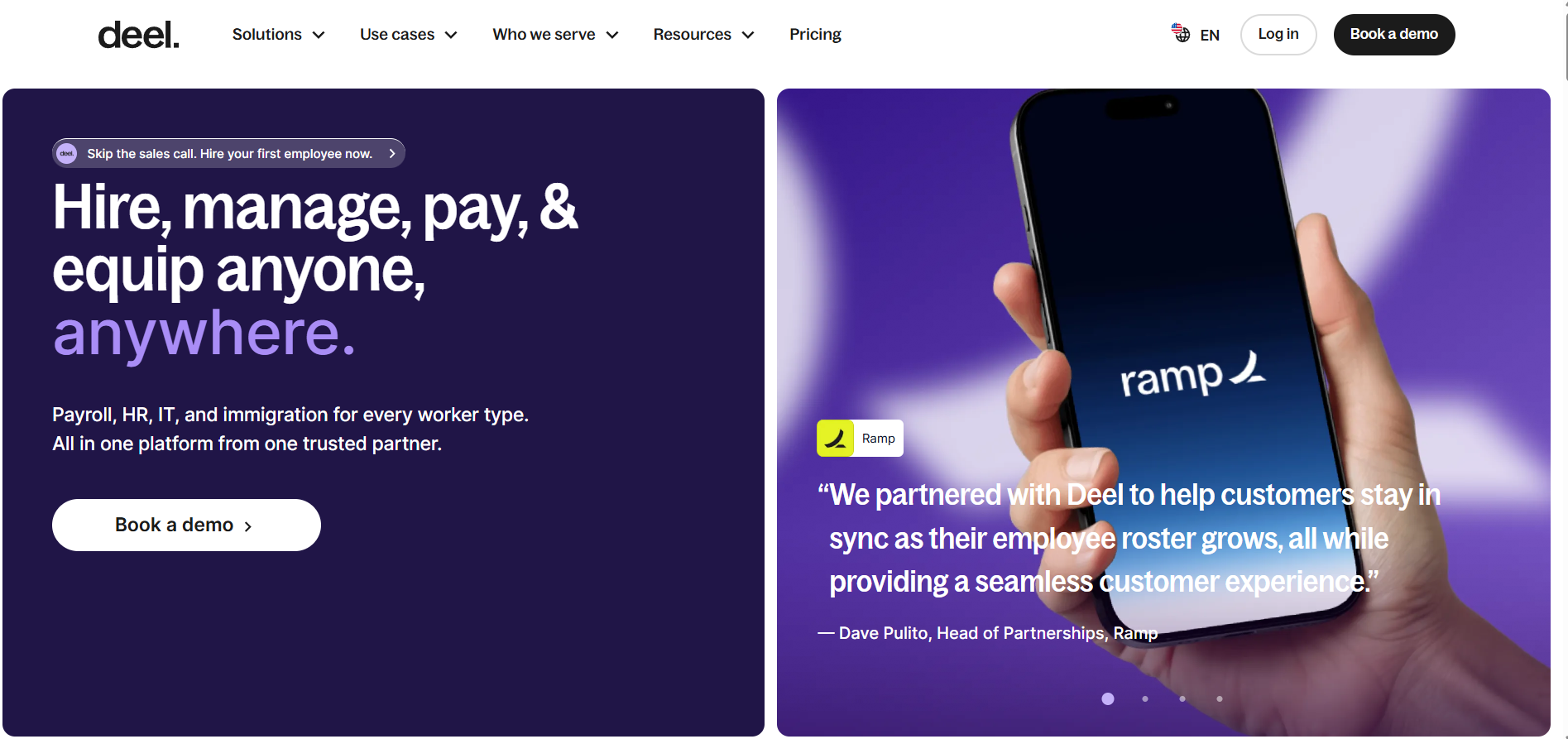
Deel is a global HR tech firm that simplifies payroll and compliance for distributed teams across 150+ countries.
Its employer-of-record (EOR) service allows Indian companies to hire internationally, or global companies to hire in India, without establishing a legal entity in each country. Founded in 2019, Deel has expanded quickly by solving the specific pain point of cross-border employment compliance.
Organizations using Deel typically value its multi-currency payroll, automated tax compliance, and localized contract generation. The platform handles contractor management alongside full-time employment, making it versatile for companies with mixed workforce models.
However, Deel's pricing (approximately ₹4,100 per worker/month for full-time employees) positions it as a premium solution, and it does not currently offer a mobile app, a notable gap for India's mobile-first workforce.
Deel's Key Features
- Employer of Record (EOR): Deel's EOR service allows companies to hire employees in countries where they have no legal entity. Deel becomes the legal employer, handling local tax, benefits, and labor law compliance while the client manages day-to-day work.
- Multi-Currency Payroll: Payroll is processed in local currencies across 150+ countries, with automated exchange rate handling and transparent fee structures. This eliminates the complexity of managing multiple banking relationships for international payroll.
- Automated Global Compliance: Deel generates locally compliant employment contracts, files taxes according to each country's regulations, and provides real-time compliance alerts. This reduces legal exposure for organizations expanding their global footprint.
Deel's Pros
- Automated invoices and payments in different currencies with transparent breakdown
- Detailed salary and tax deduction breakdowns for employees in every jurisdiction
- Fast onboarding with locally compliant contracts generated automatically
Deel's Cons
- Does not offer a mobile app, limiting accessibility for mobile-first Indian users
- Premium pricing may not suit smaller Indian businesses
12. KekaHR
Best for: Indian SMEs and mid-market firms (50–500 employees) building a performance-driven, high-engagement culture
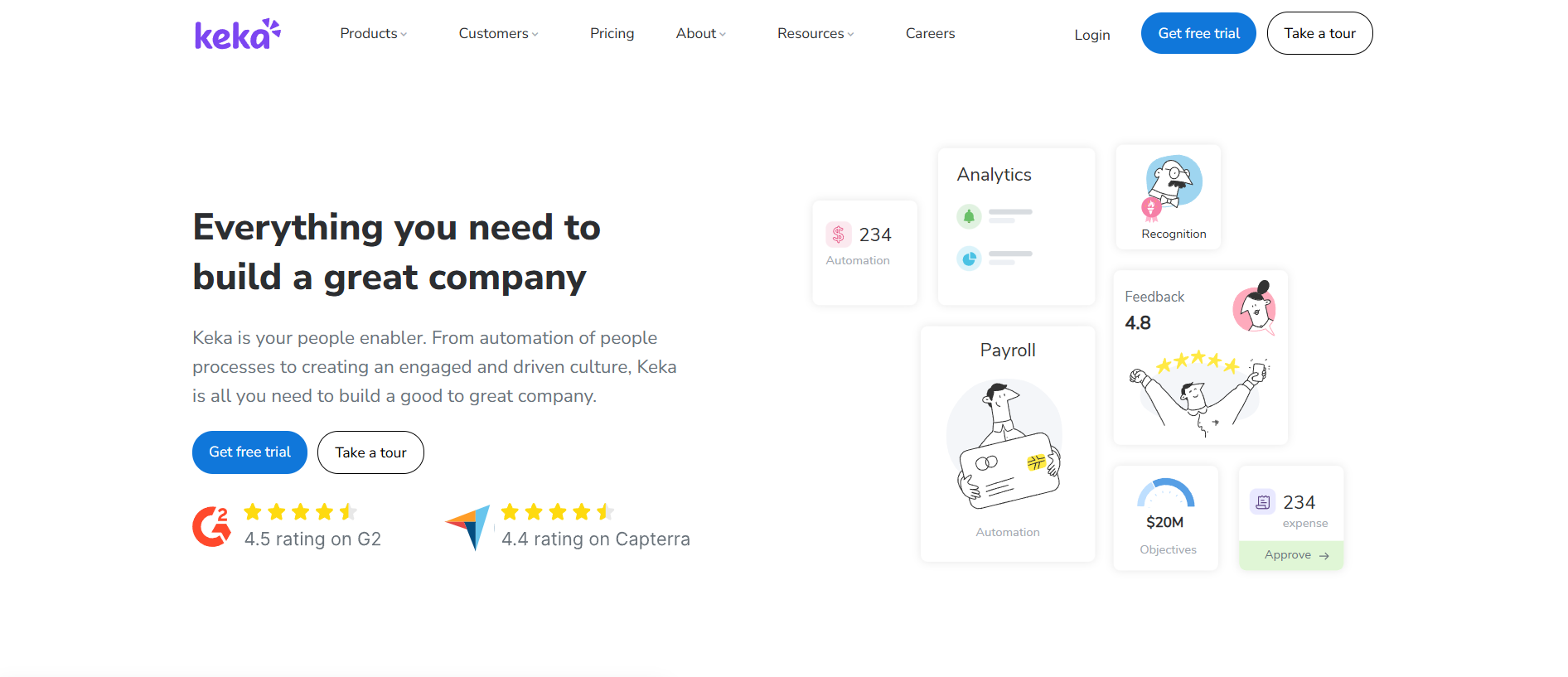
KekaHR aims to simplify and automate HR operations while placing employee experience at the centre. Founded in 2015, the platform has built a growing customer base by focusing on creating employee-centric solutions that let organizations prioritize people over paperwork.
Its combination of payroll compliance, OKR-based performance tracking, and pulse surveys makes it a strong contender for companies that want both operational efficiency and cultural alignment.
Organizations using KekaHR consistently rate it highly for its intuitive UI, seamless payroll processing, and attendance-to-payroll sync. Employee work hours flow directly into payroll calculations, eliminating manual data reconciliation. The platform also includes a helpdesk feature that centralizes employee queries. Larger enterprises may find that advanced analytics and file management capabilities do not match dedicated enterprise platforms.
KekaHR's Key Features
- OKR and KPI Performance Tracking: KekaHR supports both OKR (Objectives and Key Results) and traditional KPI frameworks. Managers can set goals, track progress, and link individual performance to department-level objectives, creating visibility into how each employee contributes to business outcomes.
- Payroll with Statutory Compliance: The payroll engine automates PF, ESIC, PT, and TDS calculations, processes salary disbursements, and generates compliant payslips. Attendance data syncs directly to payroll for accurate calculations, removing the most common source of payroll errors.
- Pulse Surveys for Engagement: KekaHR's built-in pulse survey tool enables HR teams to measure employee sentiment at regular intervals. Results feed into engagement dashboards where trends can be identified by team, location, or tenure segment.
KekaHR's Pros
- Seamless payroll with statutory compliance and direct attendance-to-payroll sync
- Intuitive UI that significantly reduces training time for new users
- Centralized helpdesk feature to handle employee queries from one hub
KekaHR's Cons
- No file management system with shared access within the company
- Integration with some third-party tools can be clunky
13. Paychex
Best for: US-headquartered companies with India operations needing proven global payroll and compliance support
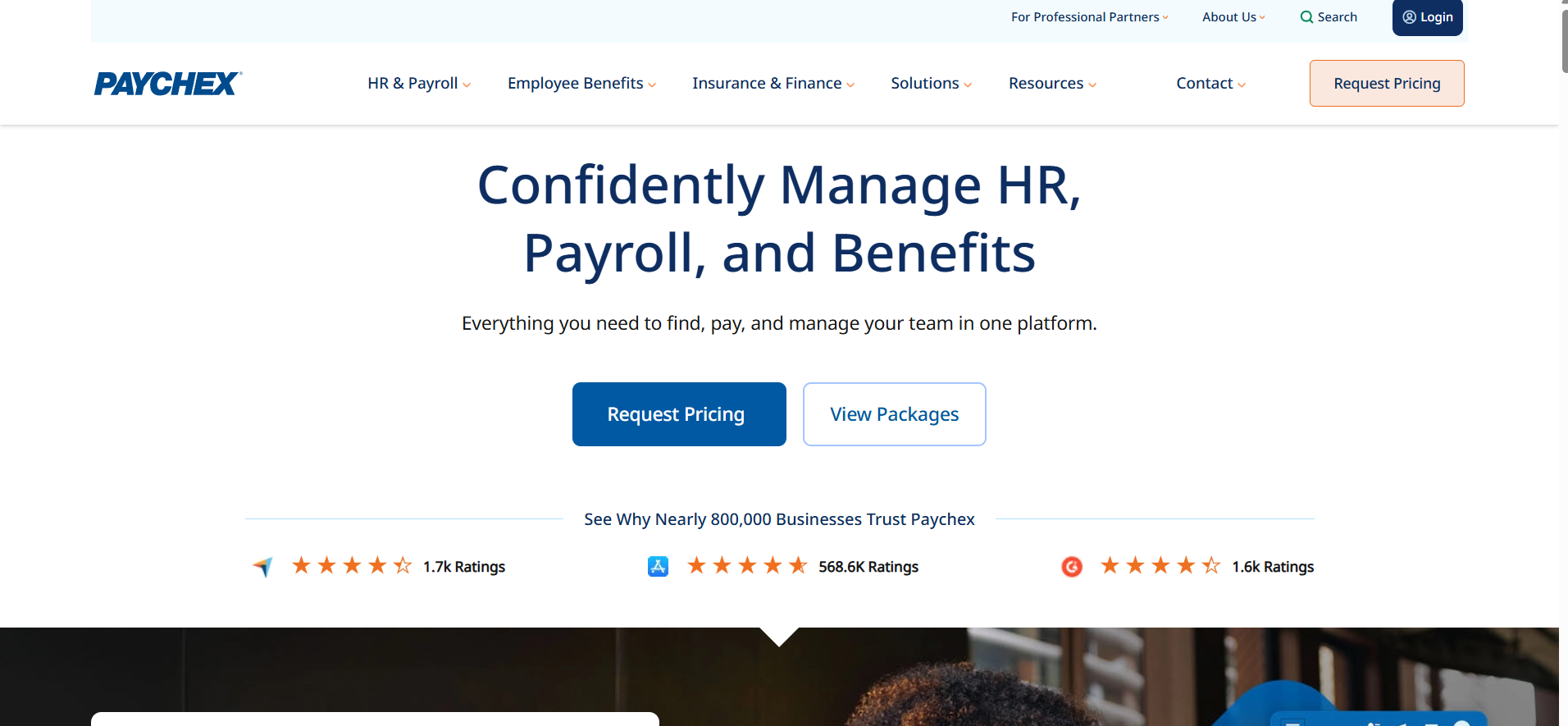
Paychex, headquartered in the United States and founded in 1971, is a leading payroll and HR outsourcing provider for small and medium-sized enterprises globally.
With decades of market expertise, Paychex offers a full spectrum of HR solutions covering payroll, tax filing, retirement plan administration, and benefits management. For Indian businesses with US ties or multinational operations, Paychex provides a familiar, compliance-tested platform.
In practice, Paychex's strength lies in its payroll accuracy, customizable reporting, and mobile access for both managers and employees. The integrated retirement plan (401(k)) administration is relevant for US operations. Indian-specific compliance features, however, are not as deep as locally built Indian HRMS tools, and the pricing structure (₹3,250/month + ₹410 per employee) may not be competitive for purely domestic Indian organizations.
Paychex's Key Features
- Automatic Payroll and Tax Filing: Paychex automates salary calculations, tax withholdings, and regulatory filings across jurisdictions. Payroll reports can be customized and generated in minutes, giving finance and HR teams rapid access to compensation data.
- HR Compliance Support: The platform provides compliance guidance aligned with industry regulations, including labor law updates and audit support. For multinational organizations, this reduces the risk of cross-border compliance gaps.
- Employee Benefits Administration: Paychex manages health insurance, retirement plans, and other employee benefits through a centralized portal. Employees can enroll, modify, and review benefits through self-service, reducing HR administrative overhead.
Paychex's Pros
- Payroll reports can be customized and generated quickly
- Easy mobile access for both managers and employees
- Decades of proven payroll reliability and compliance expertise
Paychex's Cons
- Moving employees between departments is cumbersome
- Indian statutory compliance depth is limited compared to local platforms
14. Sage HR
Best for: Small to medium businesses wanting a simple, adaptive HRMS with strong expense management and a native mobile app
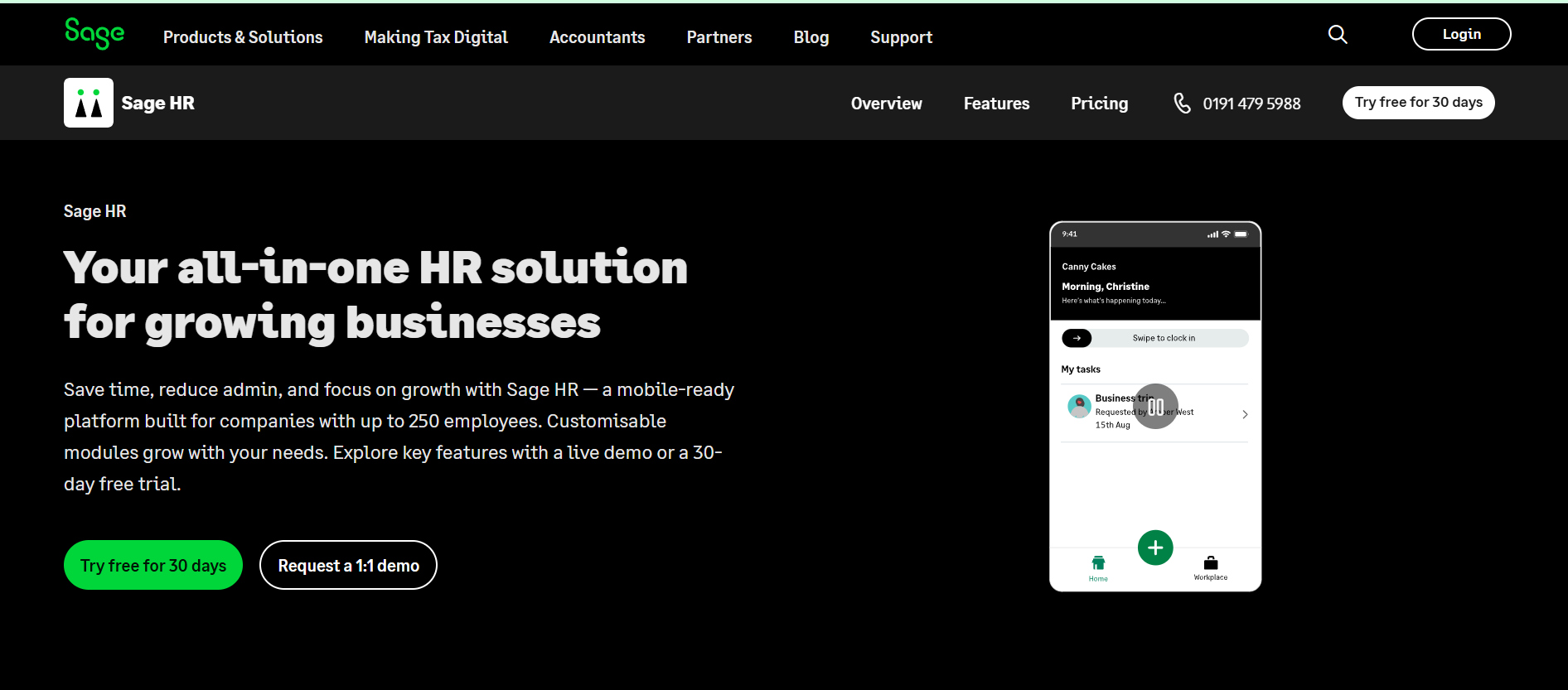
Sage HR is an easy-to-set-up HRMS platform from the global Sage Group (founded 1981) designed for small to medium-sized businesses. It simplifies and automates core HR processes, including leave management, performance reviews, timesheets, and expense tracking, while helping companies engage employees through surveys and feedback tools. The native mobile app provides on-the-go access to all HR functions.
Organizations using Sage HR value its clean interface and straightforward review process functionality. The platform is well-suited for businesses that need a focused, no-frills HRMS without the complexity of enterprise-grade systems.
Pricing starts at ₹550 per employee/month, positioning it in the mid-range. Data syncing across modules has been flagged by users as an area for improvement.
Sage HR's Key Features
- Customizable Employee Profiles: Each employee profile can be configured with custom fields relevant to the organization, such as certifications, skills, contract terms, and compliance documents. This flexibility ensures the platform adapts to specific business needs rather than forcing a rigid structure.
- Timesheets and Expense Management: Sage HR's timesheet module tracks project-based hours, while the expense management feature handles claim submissions, receipt uploads, and multi-level approvals. These tools are particularly useful for professional services and consulting firms.
- Performance Reviews with Goal Tracking: The performance module supports structured reviews with goal setting and progress tracking. Managers can conduct quarterly or annual reviews using customizable templates, linking individual goals to team objectives.
Sage HR's Pros
- Review process functionality is straightforward and easy to use
- Accurate compensation and timecard management
- Native mobile app that provides comprehensive on-the-go HR access
Sage HR's Cons
- Data syncing across modules needs improvement
- Limited depth of Indian statutory compliance features
15. PeopleHR
Best for: Scaling SMBs seeking a UK-origin HR automation platform with employee self-service and 360-degree feedback
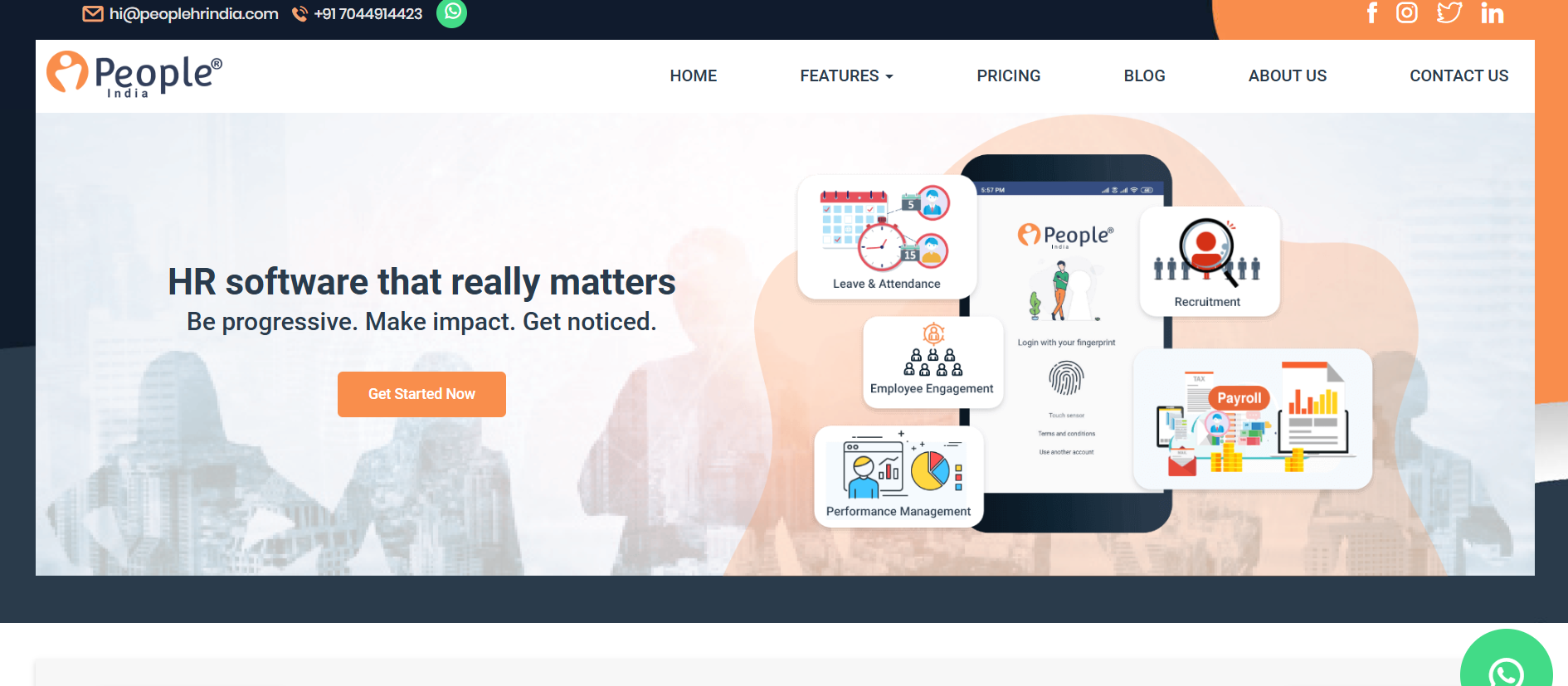
PeopleHR is a UK-based HR software firm dedicated to providing solutions that simplify HR administration. The platform focuses on building simple, intuitive tools that help organizations streamline recruiting, performance management, and employee engagement.
At ₹400 per employee/month, it offers a mid-range option for businesses looking for cloud-based employee database management, applicant tracking, and 360-degree feedback tools.
Organizations using PeopleHR find its reporting capabilities accurate and its annual leave planner useful for scheduling employee time off. The platform integrates with third-party payroll providers rather than offering its own payroll engine, which means businesses need to pair it with a separate payroll solution for Indian compliance. The org chart feature has been noted by users as needing usability improvements.
PeopleHR's Key Features
- 360-Degree Feedback Performance Reviews: PeopleHR supports multi-rater feedback that incorporates input from peers, managers, and direct reports. This balanced approach produces more complete performance assessments and reduces single-rater bias.
- Automated Applicant Tracking: The recruitment module tracks candidates from application through hiring, with automated status updates, interview scheduling, and candidate communication. This reduces manual follow-up work during hiring campaigns.
- Workforce Analytics and Insights: Built-in analytics provide visibility into headcount trends, attrition rates, leave patterns, and diversity metrics. Reports can be generated on demand or scheduled for regular stakeholder distribution.
PeopleHR's Pros
- Accurate reporting capabilities for HR data
- Built-in annual leave planner simplifies employee leave scheduling
- Clean, intuitive interface that requires minimal training
PeopleHR's Cons
- Org chart is not user-friendly and needs interface improvements
- Relies on third-party payroll integration rather than native Indian payroll
Benefits of HR Software in India
For Indian organizations specifically, the right HRMS removes the compliance risk that comes with processing payroll across multiple states, each with different PT slabs, minimum wage rules, and LWF regulations.
Here is the operational impact you can expect:
1. Eliminates Manual Payroll Errors and Compliance Risk
Manual payroll processing across Indian states, each with different PT slabs, minimum wage rules, and LWF regulations, is one of the highest-risk HR activities. HR software automates PF, ESIC, PT, and TDS calculations based on current statutory rules and employee-specific parameters.
In practice, organizations that switch from spreadsheets to automated payroll reduce calculation errors by up to 95% and avoid the penalties associated with late or incorrect filings.
2. Reclaims 15–20 Hours of Administrative Time Monthly
Attendance-to-payroll integration, automated leave management, and employee self-service portals eliminate the repetitive data entry and email-based approvals that consume HR teams.
According to industry analysis, Indian SMEs save 15–20 hours monthly on manual HR tasks by adopting HRMS platforms with workflow automation, freeing time that can be redirected toward strategic talent initiatives.
3. Improves Employee Experience and Retention
Self-service portals, mobile apps, and AI chatbots give employees instant access to payslips, leave balances, tax documents, and policy information.
This reduces dependency on HR for transactional queries and improves the overall employee experience. Organizations that invest in employee-facing HR technology often see measurable improvements in eNPS scores and reduced voluntary attrition.
4. Enables Data-Driven Workforce Decisions
Modern HR software provides real-time dashboards on headcount, attrition, hiring pipeline, and engagement trends. For CXOs and board members, these analytics transform HR from a cost centre into a strategic function that informs workforce planning, compensation benchmarking, and talent investment decisions.
The India HR analytics market generated USD 161.5 million in revenue in 2025 — Grand View Research, 2026 — reflecting the growing appetite for data-driven HR.
5. Scales Efficiently Across Multiple Locations and Entities
Indian businesses expanding across states or internationally need HR systems that handle location-specific compliance, multi-entity payroll, and diverse workforce regulations.
Cloud-based HR software scales without proportional increases in HR headcount, making multi-location management operationally feasible for growing organizations.
Key Features of Modern HR Software in India
Most HRMS vendors lead with the same feature list. The real test sits one layer deeper.
Do statutory rate changes flow into payroll automatically, or does HR enter them manually? Does mobile attendance feed payroll from the same source of truth, or does the data sync later? Can the performance module manage OKRs, or does it stop at annual KRA reviews?
These details decide how much manual work your team inherits after go-live.
1. Indian Statutory Compliance Automation (PF, ESIC, PT, TDS)
Any HR software deployed in India must automate Provident Fund, Employee State Insurance, Professional Tax, and TDS calculations based on state-specific rules. Generic global HRMS platforms often lack the granularity required for India's multi-state regulatory environment. Evaluate whether the platform updates statutory rates automatically when government regulations change and whether it generates audit-ready compliance reports.
2. Attendance-to-Payroll Integration
The single highest-ROI feature in Indian HR software is the automatic sync between attendance data (biometric, GPS, or app-based) and payroll calculations. This eliminates manual reconciliation, ensures accurate pay for actual working days and overtime, and removes the most common source of payroll disputes. For manufacturing, retail, and field-service businesses, GPS and geofencing capabilities add an additional layer of accuracy.
3. Employee Self-Service Portal and Mobile App
In India's mobile-first workforce, employees expect to access payslips, apply for leave, submit expense claims, and update personal information from their phones. A well-designed self-service portal reduces HR ticket volume by 60–70% and improves employee satisfaction. Evaluate mobile app functionality separately from the desktop interface. Many platforms still have feature gaps on mobile.
4. Recruitment and Onboarding Automation
HR software should streamline the hiring pipeline from job posting through candidate tracking, interview scheduling, offer management, and digital onboarding.
In regulated industries such as BFSI and Pharma, onboarding workflows must also capture compliance-related documentation (KYC, background verification, certification uploads) as part of the hiring process.
Read More: Explore best resources in HR tech to evaluate recruitment module depth.
5. Performance Management with Goal Frameworks
Modern HR software supports OKR, KRA, and 360-degree feedback frameworks. Look for platforms that link individual goals to department-level and organizational objectives, enable continuous feedback (not just annual reviews), and integrate performance data with learning and development modules.
This is particularly important for organizations in competitive talent markets where career growth visibility directly impacts retention.
6. AI and Analytics Capabilities
The 2026 generation of HR software increasingly incorporates AI for resume screening, interview analysis, attrition prediction, and policy compliance monitoring.
While not every organization needs AI-driven features today, evaluating a platform's AI roadmap ensures it will remain relevant as workforce management becomes more data-intensive.
Why Choose ZingHR as Your Organization’s HR Software Stack?
Fourteen platforms in this list fix HR tasks. ZingHR removes the need for HR teams to manage transactional work at all.
The architecture makes this possible. One codebase. One database. One employee record across 35+ modules built in-house by one team. No middleware, no sync delays, no contradictory reports between payroll, performance, and compliance data.
- Ghrowth.ai, its agentic intelligence engine: Flags flight risks, compliance exposure, and workforce trends before they become boardroom problems, across HR, Finance, and Operations simultaneously.
- ZingZeroTAP: PF, ESIC, PT, and TDS calculations run state by state automatically. Attendance feeds payroll from the same database. The month-end reconciliation ritual disappears.
- 12 vertical solutions: BFSI, Manufacturing, IT-ITES, Retail-QSR, Pharma, Healthcare, Staffing, and Logistics each get domain-specific compliance rules and workflow configurations built in, not bolted on.
- Board-level command centre: Headcount, attrition risk, hiring pipeline, and compliance exposure correlate with revenue and operational metrics in one view. CXOs bring numbers to the Board, not summaries.
ZingHR is built for organisations managing 1,000+ employees across geographies.
Request a demo to see it against your specific requirements.
Choose the Right HR Software and Start Transforming Your Workforce Today
The right HR software depends on your employee count, statutory compliance needs, and how much HR work you want the system to handle without manual follow-up.
Startups with 10–50 employees can begin with a free tool like Kredily and move to a larger HRMS as headcount grows. Mid-market companies with 200–500 employees will usually need stronger payroll, attendance, leave, and performance workflows, which makes tools like Pocket HRMS, KekaHR, and Qandle worth evaluating. Enterprises with 1,000+ employees across states, business units, and geographies need deeper control over compliance, approvals, workforce data, and reporting.
ZingHR is built for that enterprise category. Its Agentic Intelligence layer, 30+ modules, multi-state payroll compliance, and board-level analytics help CXOs see workforce risks, hiring gaps, attrition patterns, and compliance exposure from one system.
Companies in BFSI, IT-ITES, manufacturing, retail-QSR, pharma, and the public sector use ZingHR to bring scattered HR processes into a single command center for hiring, retention, compliance, and workforce planning.
If your organization is ready to move beyond administrative HR and into strategic workforce management, request a ZingHR demo to see how the platform handles your specific compliance requirements, employee count, and business objectives.
Frequently asked questions (FAQs)
For Indian startups with 10–100 employees, Kredily and KekaHR are strong choices. Kredily offers a free-forever plan that covers basic payroll, attendance, and leave management, ideal for bootstrapped teams. KekaHR (starting at ₹6,999/month for up to 100 employees) provides deeper functionality, including OKR-based performance tracking, pulse surveys, and statutory compliance. Both platforms include employee self-service portals that reduce repetitive HR queries. As startups scale beyond 500 employees, enterprise platforms like ZingHR become necessary to handle multi-location compliance and board-level analytics.
All major Indian HR software platforms reviewed in this guide, including ZingHR, greytHR, KekaHR, Pocket HRMS, FactoHR, and Qandle, are built specifically for Indian statutory compliance. They automatically calculate Provident Fund (PF), Employee State Insurance (ESIC), Professional Tax (PT), and Tax Deducted at Source (TDS) based on state-specific rules. This eliminates manual compliance errors and ensures payslips are audit-ready. ZingHR adds multi-geography compliance for enterprises operating across Indian states and international markets.
Indian HR software pricing ranges from free (Kredily) to ₹550+ per employee monthly (Sage HR), with most mid-market solutions costing ₹48–₹100 per employee/month. Enterprise platforms like ZingHR and Darwinbox use custom pricing based on employee count, module selection, and implementation scope. Most solutions include payroll, attendance, and leave management in their base plans. Budget ₹30–₹100/employee/month for SME-focused tools and request custom quotes for organizations exceeding 500 employees.
Yes. Most HRMS platforms allow organizations to select specific modules such as payroll, performance, recruitment, and learning, and configure workflows, approval chains, and reporting dashboards to match their processes. Even businesses in different industries using the same platform can deploy functionalities in entirely different ways. Enterprise solutions like ZingHR offer deeper customization including multi-entity configurations, geography-specific compliance rules, and role-based analytics dashboards for CXOs and Boards.
Indian SMEs should prioritize five core features: (1) automated payroll with PF, ESIC, and TDS compliance, (2) attendance-to-payroll integration that eliminates manual data entry, (3) an employee self-service portal for leave, payslips, and document access, (4) leave and holiday management with automated approvals, and (5) clean HR reports for audits and management reviews. These features alone reduce administrative work by 15–20 hours monthly. Advanced capabilities like AI-powered recruitment, predictive analytics, and succession planning can be added as the organization scales.
Yes. Leading Indian HR software platforms like Zoho People, KekaHR, greytHR, and FactoHR integrate with accounting platforms (Zoho Books, Tally), banking APIs for salary disbursement, and government portals for statutory filing. ZingHR extends integration capabilities to ERP systems and third-party business intelligence tools used in enterprise environments. When evaluating HR software, verify that the platform supports automating payroll calculations with your existing accounting infrastructure to avoid data duplication and reconciliation overhead.
HR software brings core HR work into one system, including payroll, attendance, leave, onboarding, employee records, performance reviews, and statutory compliance. For Indian companies, a good HRMS should calculate PF, ESIC, PT, and TDS based on state and employee rules, so HR teams do not have to manage these checks through spreadsheets. Cloud-based HRMS gives HR teams, managers, and employees access to the same employee data through web and mobile apps. ZingHR extends this beyond daily HR administration with workforce analytics, planning, and compliance governance across multiple locations and geographies.
ZingHR is built specifically for organizations with 1,000+ employees operating across multiple geographies or business units. Three capabilities set it apart for large enterprises: board-level workforce analytics that give CXOs real-time visibility into headcount, attrition risk, and compliance exposure; Agentic Intelligence that goes beyond automation to enable proactive governance and strategic workforce decisions; and 30+ modules covering the full employee lifecycle, from talent acquisition and succession planning to payroll, learning, and engagement. ZingHR’s support for 26+ languages and its recognition as a Gartner Customers’ Choice make it a proven choice for BFSI, IT-ITES, Manufacturing, Retail, Pharma, and Public Sector organizations managing complex, distributed workforces.
What to do next?
See ZingHR in Action
Join the 1,200+ enterprises that have replaced fragmented HR with one intelligent, future-ready platform. See ZingHR in 30 minutes.
Build the Organization You Want
Great HR drives retention, capability, and culture. ZingHR takes care of the operational layer so your people team owns the strategy.

Elevating Impact.
Defining Destiny
See how ZingHR's AI-powered Hire-to-Retire platform frees your CPO to lead with purpose and deliver the outcomes your Board is watching for


ZingHR is the AI-powered Hire-to-ReHire platform built for one purpose to remove every transactional layer of HR from your organisation, permanently.