Succession Planning in HR: A Future-Ready Guide for 2026
Table of contents
One unstitched HR platform to manage your entire workforce, from hire to rehire.
Talent Management solutions built for growing and exceptional people
Built-in compliance tools that update with changing regulations
Automated payroll, attendance, and leave management
Insights that help HR leaders make faster, better decisions

Key Takeaways
- Succession planning is the continuous, data-driven process of identifying critical roles, assessing internal readiness, and preparing successors before business continuity is at risk.
- CHROs managing leadership risk, HRBPs validating successor pools, managers contributing readiness feedback, and HR operations teams maintaining data quality across business units.
- Distributed enterprises (manufacturing, retail/FMCG/QSR) need multi-location role visibility; regulated sectors (BFSI, healthcare) need compliance-aware successor pipelines; conglomerates need cross-business governance.
- Organisations with advanced workforce analytics are 2.3x more likely to report strong succession pipelines for critical roles.
- ZingHR's offers a single system of record and action that connects performance, skills, learning, engagement, and analytics from hire to rehire.
"Who's actually ready to step into this role if someone leaves tomorrow?" Most CHROs can't answer that with confidence, because readiness data lives in a manager's head, not a system. It shows: only 21% of HR professionals say their organisation has a formal succession plan, and 56% report having none at all (SHRM, 2025).
"Why does succession planning still happen once a year in a spreadsheet?" Because performance, learning, and engagement data sit in separate tools that never talk to each other. In fact, 68% of HR leaders say their current succession processes are too manual and fragmented across systems to support enterprise-scale workforce planning (HR.com, 2025).
"Are we actually building leaders, or just filling vacancies as they happen?" Without visibility into skills and readiness, succession becomes reactive rather than a plan for continuity.
This blog breaks down how to turn succession into a measurable, ongoing process, and how ZingHR's unified HCM platform gives HR teams the real-time visibility to make it happen.
What Is Succession Planning?
Succession planning is the structured process of identifying critical roles, assessing internal talent readiness, closing capability issues, and preparing successors before business continuity is at risk. For enterprise HR teams, it should be a continuous workflow connected to performance, skills, learning, engagement, and workforce planning data.
There is an important distinction between a replacement chart and an ongoing succession planning program. A replacement chart simply names who fills a vacancy next. A succession planning program develops a pipeline of ready successors over time through development actions, knowledge transfer, and readiness tracking.
The difference matters at enterprise scale, where leadership vacancies across business units, geographies, and compliance-heavy roles can create operational and regulatory risk.
ZingHR supports this approach through a talent management platform that connects successor identification, development actions, skills data, and internal mobility in one place. This lets enterprise HR teams move from spreadsheets to connected talent workflows that managers and HRBPs can act on.
Succession Planning Framework
A succession planning framework is a structured, strategic approach to identifying and preparing future leaders inside the organisation in line with its strategic goals and business goals.
This framework analyses current leadership roles, forecasts future needs, and develops talent pipelines to ensure a smooth transition when key positions become vacant.
- Identify which positions are critical for the organisation's success. Focus on business critical roles that significantly impact business outcomes, operational continuity, and compliance.
- Evaluate the skills, experience, and potential of current employees to identify people who can fill key roles. HR data and analytics can be a useful starting point for spotting key talent and potential leadership candidates.
- Create development plans that involve training, mentoring, job rotations, and leadership workshops to prepare candidates.
- Review progress regularly with ongoing monitoring and key performance indicators, and adjust development plans or successor candidates as business conditions change.
Why Succession Planning Matters for Enterprise HR Leaders
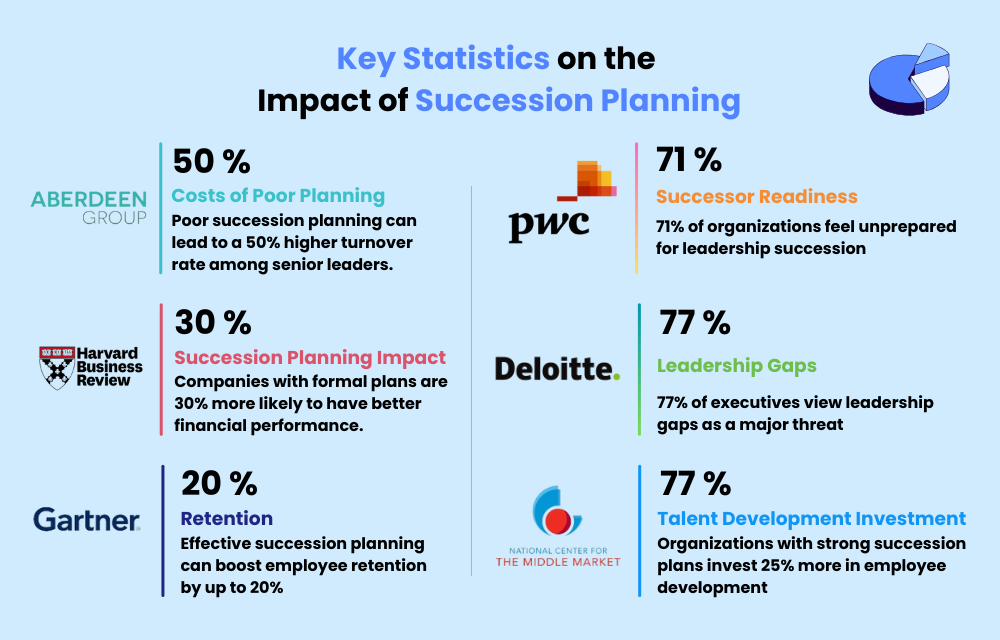
Succession planning plays a direct role in business continuity, leadership risk management, and long-term workforce readiness. The data underlines the urgency: only 19% of organisations report having formal succession plans in place for key leadership roles (ScottMadden, 2025), even as 74% of organisations rate internal mobility and succession as a 'top 3' talent priority for the next two years - Deloitte, 2025. Here is why CHROs, HRBPs, and people leaders should prioritise it in 2026.
1. Develop Tomorrow's Talent Now
Succession planning is about identifying high-potential employees and giving them the opportunities to grow today. Preparing your talent for tomorrow is a proactive approach to developing future leaders for future success, so the organisation is not disrupted by leadership change and critical roles remain in capable hands.
This process links today's leaders with tomorrow's, helping you identify potential future leaders and align everyone with the company's long-term vision.
Tip: Focus on leadership capability, technical expertise, and behavioural competencies. Since 72% of organizations use formal learning for leadership development, they use mentorship, coaching, and structured learning to develop potential leaders.
2. Unlock Cross-Functional Collaboration
An effective succession plan goes beyond individual roles. It encourages cross-functional learning, which is essential for leaders who need exposure to business operations across functions, not just a broad end-to-end view. Organisations groom more versatile leaders by exposing them to multiple areas of the business, building both capability and a culture of collaboration.
Tip: Use cross-departmental initiatives, job rotations, and challenging projects to develop flexible skill sets. This deepens business understanding and improves a successor's capacity to lead across functions.
3. Outpace Competition with Strategic Talent Redeployment
Succession planning helps an organisation develop employee skills across more than one department, enabling HR teams to place the right people in the right roles at the right time. This agility lets enterprises adapt quickly to market shifts and capitalise on opportunities ahead of competitors.
Tip: Analyse talent strengths and match them to business requirements. Use workforce analytics and talent intelligence to detect skill shortages and deploy individuals where their abilities are most valuable.
4. Unlock Opportunities and Hidden Talent for an Inclusive Workforce
A strong succession plan surfaces hidden talent within your workforce and promotes an inclusive, diverse leadership pipeline. Investing in internal talent rather than defaulting to external hiring means assessing internal candidates with consistent criteria rather than relying on visibility alone, which gives employees an incentive to learn, grow, and perform while strengthening the future leadership team.
Tip: Create a structured talent development program that identifies and supports employees from diverse backgrounds. Use consistent, merit-based evaluation criteria to build a fair and inclusive leadership pipeline, because subjectivity in selection can create the Crowned Prince Syndrome.
5. Preserving Organisational Knowledge
When experienced leaders leave, they take valuable knowledge, insights, and know-how with them, context that is difficult to replace. Succession planning ensures this knowledge is preserved and transferred to successors who can learn directly from the leaders who have run the business for years.
Tip: Create knowledge-sharing forums where leaders document insights, processes, and best practices. Use job shadowing and mentorship programs to transfer knowledge before an exit occurs.
6. Enhancing Employee Morale and Encouraging Growth
Succession planning improves morale by clearly outlining growth opportunities. When employees see the organisation investing in their development, they feel valued, which strengthens loyalty, employee retention, and performance. By prioritising internal growth, succession planning promotes a motivating culture where employees are engaged in contributing to long-term success. This connection is reinforced when career visibility ties into employee engagement signals that flag retention risk early.
Tip: Communicate succession options openly. Make it clear that the organisation invests in development and encourages employees to participate actively in their own growth.
7. Opportunity for Existing Employees to Grow
Employees are motivated when they see a clear path to advance their careers. A robust succession plan signals the organisation's commitment to both its own future and its people's futures, fostering a culture of growth that boosts morale and loyalty.
Tip: Provide development programs suited to individual requirements: leadership training, workshops, and cross-functional projects. Review and update career pathways regularly so employees can see their advancement possibilities.
8. Save Recruitment Costs
Hiring an internal successor is often faster and less costly than turning to expensive external candidates who do not know the ins and outs of your business. A well-developed succession plan reduces, and often eliminates the need to hire externally by developing internal talent for future leadership roles. Indeed, organisations that systematically develop internal successors fill 60–70% of leadership vacancies from within, compared with less than 30% for organisations without structured succession planning (McKinsey, 2025).
Tip: Build a talent pipeline by recognising and developing high-potential individuals early. This decreases reliance on external recruiting, saving money and time while fostering internal mobility.
Comparing: Existing Employees vs. New Hires
Enterprise HR teams weigh internal development against external hiring constantly. The table below compares the two on the dimensions that matter most for succession decisions.
Existing employees vs. new hires across six succession-relevant dimensions.
8 Proven Strategies for Succession Planning
Building an effective succession plan requires a strategic approach from both HR and current leaders. These eight strategies give enterprise HR teams a repeatable playbook.
1. Identify the Critical Job Positions
Before building a plan, identify the roles that have a direct impact on operations, revenue, or compliance, including more than any one leadership position and also specialized roles with major business impact. Once mapped, you can begin preparing potential successors for those roles, enabling a transition that does not disrupt operations.
2. Select Current Employees as Potential Successors
After identifying critical positions, evaluate which employees can succeed in them by assessing potential successors for each role. Combine performance reviews and feedback with structured conversations, including input from senior managers, to understand each employee's aspirations, readiness, and leadership potential. Use this to shortlist candidates who fit future leadership roles.
3. Use Hackathons for Problem-Solving
Problem-solving is a core leadership skill. Hackathons put cross-functional teams together to solve realistic business problems under time pressure, letting current leaders observe collaboration, creativity, and composure. They are an effective way to identify potential leaders and assess how candidates handle leadership readiness and talent decisions in a dynamic setting.
4. Assess the Talent Pool
Assess shortlisted employees through performance management in HRM, skill-shortfall identification, and readiness evaluation. This helps you understand which employees are ready now and which need further development, so you can fill the right role with the right person at the right time.
5. Create Development Plans
Create a development plan tailored to each candidate's skill set and shortfalls. Plans typically include training, cross-functional projects, stretch assignments, and targeted experience designed to prepare successors for leadership responsibilities; 70% of organizations use stretch assignments for potential leaders.
6. Offer Mentorship and Coaching
Mentorship connects junior employees with senior leaders, enabling knowledge transfer and real-world learning that goes beyond formal training. One-on-one coaching accelerates the development of future leaders.
7. Create Clear Career Paths
Clear career planning keeps employees motivated and aligned with the organisation's long-term vision. A visible progression path shows employees what they need to do to advance, helping you improve retention through employee engagement and reduce stagnation.
8. Show You Care About Career Development
Career development is part of strategic workforce planning and supports internal leadership development by helping employees build skills, knowledge, and experience. When employees see a clear path for growth, they are more likely to stay with the organisation. Investing in development also builds a strong internal talent pipeline for future leadership demands.
Why career development matters: it reduces attrition, increases job satisfaction, fosters a learning culture, adapts to changing market needs, encourages loyalty and trust, improves productivity, and aligns employee goals with company objectives.
8 Steps in the Succession Planning Process
Succession planning is complex at enterprise scale, but how to implement succession planning becomes manageable when the process is broken into clear, repeatable steps.
Step 1: Shortlist Critical Positions
Begin by identifying the roles that directly affect how your organisation functions. These are typically leadership and operationally critical roles.
Step 2: Define Assessment for Each Critical Position
Develop specific criteria and evaluation methods to assess employees for leadership or critical roles. Assessments typically include skill tests, interviews, and performance evaluations.
Step 3: Identify Ability, Skills, and Knowledge
Once you have assessed candidates, identify their skills, abilities, and knowledge to align them with suitable future roles. This involves evaluating both technical and behavioural competencies.
The three components of successor readiness, with examples and ways to evaluate them.
Step 4: Develop Successors
Create a development plan for each potential successor focused on identifying and developing successors based on their individual skills and requirements. Plans typically include developing talent through training, cross-functional projects, mentorship, leadership workshops, feedback sessions, and targeted experiences aimed at nurturing talent.
Step 5: Provide Leadership Training
Train identified successors to be leaders, developing both technical and behavioural competencies: strategic thinking, problem-solving, decision-making, leadership and behavioural competencies, conflict resolution, and team management. This prepares them to handle the complex challenges of leadership roles.
Step 6: Implement a Mentorship Program
Pair experienced leaders with their potential successors. Successors learn from current leaders' experience, gaining insights about the business and the role, while the organisation builds a culture of continuous learning.
Step 7: Evaluate Candidate / Job Handover
Before a successor takes a critical role, evaluate their readiness against their development progress. A trial period working alongside the current leader lets the successor gradually assume responsibilities, ensuring continuity during the transition.
Step 8: Review and Revise the Succession Plan Regularly
Treat review and revision as an ongoing process. Resistance to change can stall updates and leave plans outdated. Because business conditions change, plans must be updated continuously, and 53% of companies lack a CEO succession contingency plan. A platform dashboard gives you an overview of plan health, helping you make improvements where needed.
Succession Planning Checklist for HR Operations Teams
Use this checklist to operationalise succession planning through integrated HR workflows across locations and business units.
- Identify critical roles by function, geography, and business impact.
- Map potential successors using performance, skills, tenure, and readiness data.
- Assign development actions through learning and mentoring workflows.
- Review succession risk with CHROs and business leaders quarterly.
- Track readiness movement by monitoring progress through dashboards, talent analytics, and defined key performance indicators.
Enterprise Succession Planning Use Cases
Succession planning looks different across industries and workforce structures. These use cases show how enterprise HR teams execute it at scale.
- Manufacturing and Auto
A manufacturing enterprise with 20 locations needs visibility into plant managers, shift supervisors, safety leads, and regional operations leaders. Succession planning should map readiness by site, function, and operational risk so HR can prevent vacancies that halt production.
- BFSI and Micro Finance
A BFSI organisation needs successors for compliance-heavy roles where external hiring creates regulatory and continuity risk. HRBPs can use performance, certification, skills, and tenure data to identify internal successors earlier and maintain audit-ready leadership coverage.
- Retail, FMCG, and QSR
High-volume, distributed workforces need succession plans for store managers, area managers, and operations leaders. Role-based dashboards help HR teams identify high-performing employees across hundreds of locations and promote consistently.
- Hospitals and Healthcare
Clinical and administrative leadership roles carry both patient-care and regulatory implications. Succession planning here must balance credentialing, experience, and readiness to ensure continuity of care during transitions.
- Conglomerates
Diversified groups need succession governance that standardises how each business unit identifies critical roles, evaluates successors, and reports readiness, without losing the flexibility each unit requires.
Role-Based Succession Planning Workflow
- CHROs: Review leadership risk, readiness coverage, and succession health across business units.
- HRBPs: Validate successor pools with managers and track development actions.
- Managers: Provide performance, skills, and readiness feedback for potential successors.
- HR operations teams: Maintain data quality, workflows, reminders, and reporting cadences.
- Business unit heads: Confirm critical roles and approve succession priorities.
Why Succession Planning Works Better Inside a Unified HCM Platform
Succession planning fails when talent data is fragmented. Performance reviews sit in one system, learning records in another, employee profiles in spreadsheets, and readiness discussions in manager meetings. For enterprise HR teams, this creates blind spots, which is why only 21% of HR professionals report having a formal succession plan (SHRM, 2025).
The performance difference is measurable. Enterprises using integrated HCM platforms for succession planning are 1.8 times more likely to rate their leadership transitions as 'highly effective' than those relying on spreadsheets and disconnected HR systems, and companies with advanced workforce analytics are 2.3 times more likely to report strong succession pipelines for critical roles.
ZingHR brings these signals together in one AI-powered HCM platform with data-driven insights. HR leaders can identify critical roles, evaluate internal talent, assign development actions, monitor readiness, and support business continuity from a single system of record and action.
- AI-powered talent insights: Surface readiness gaps, high-potential employees, and leadership risk.
- Performance-linked successor identification: Build succession pools using consistent employee data.
- Automated workflows: Trigger learning, mentorship, review, and follow-up actions without adding manual HR work.
- Enterprise governance: Standardise succession planning across business units, functions, and locations.
Benefits of Succession Planning Software
- Protects Business Continuity
Succession planning software ensures critical roles always have a ready successor, preventing the operational disruption and lengthy leadership vacancies that occur when key personnel leave. This matters when a record 4.2 million Americans reach age 65 in 2025, intensifying leadership succession risk for employers.
- Improves Talent Retention
By making career paths and development opportunities visible, succession software boosts morale and engagement. Employees who see a clear route to advancement are more likely to stay, reducing costly attrition.
- Reduces Recruitment Costs
Developing internal successors reduces dependency on external hiring. Software that tracks readiness lets HR teams promote from within before leadership vacancies become hiring emergencies, saving recruitment, onboarding, and ramp-up costs.
- Preserves Institutional Knowledge
By structuring mentorship, shadowing, and knowledge-transfer workflows, succession software safeguards critical institutional knowledge and transfers it to the next generation of leaders before an exit occurs.
- Enables Data-Driven Decisions
Connected platforms link performance, skills, learning, and engagement data so CHROs and HRBPs can assess readiness objectively. Given that fewer than 1 in 3 organisations have a robust leadership succession pipeline for their most critical roles (Visier, 2025), data-driven visibility is a meaningful competitive advantage.
Key Features of Effective Succession Planning Software
- Critical Role Mapping
Look for the ability to flag critical positions by function, geography, and business impact. Enterprises with distributed and multi-location workforces (manufacturing, retail, BFSI) need this to maintain leadership visibility across the whole organisation.
- Readiness Dashboards and Bench Strength
Strong platforms provide readiness dashboards that show successor pools, bench strength, and readiness movement over time. This lets CHROs review succession health across business units at a glance.
- Skills-Gap and Talent Intelligence
AI-powered talent intelligence surfaces skill gaps, high-potential employees, and leadership risk. This is essential in regulated industries where successors must hold specific certifications or compliance knowledge before stepping up.
- Performance-Linked Successor Pools
The software should connect succession pools to performance history so decisions are grounded in consistent, objective employee data rather than manager opinion alone.
- Automated Development Workflows
Look for automation that assigns learning, mentorship, and review tasks and sends reminders, reducing manual HR work while keeping development on track across thousands of employees.
- Governance and Role-Based Access
For conglomerates and multi-business enterprises, governance features standardise succession processes across units while role-based access ensures CHROs, HRBPs, managers, and HR operations see the right data for their responsibilities.
Why Choose ZingHR Succession Planning Software?
ZingHR helps enterprise HR teams move succession planning from static spreadsheets to connected talent workflows. With unified employee data, analytics, automation, and talent management capabilities, HR leaders can identify successors, track readiness, and assign development actions from one platform, a single system of record and action.
- Single view of talent: Bring employee profiles, performance history, skills, learning records, and career data into one system.
- AI-powered insights: Surface readiness shortfalls, high-potential employees, and workforce risks with data-backed visibility.
- Automated development actions: Assign learning, mentorship, and review tasks without increasing manual HR work.
- Manager and HRBP collaboration: Give stakeholders a shared system to evaluate, act, and monitor progress.
- Reduce dependency on external hiring: Identify internal successors earlier, track readiness, and redeploy talent across roles before leadership gaps become hiring emergencies.
- Hire-to-rehire continuity: Connect succession planning with the broader employee lifecycle, from hiring and onboarding to growth, redeployment, and rehire.
Book a demo to see how a unified talent management platform can connect succession planning to your enterprise HR strategy.
Frequently asked questions (FAQs)
Succession planning in HR is the process of identifying critical roles and preparing internal employees to step into them when needed. It is designed to protect business continuity and build a pipeline of future leaders over time, typically across a 12-to-36-month preparation horizon rather than as a one-time replacement decision.
It helps organisations avoid disruption when key people retire, resign, or leave unexpectedly. It also supports talent retention by giving employees a visible path for development and advancement, and it reduces recruitment costs by enabling promotion from within. With only about one in five organisations having a formal plan, those that do gain a meaningful continuity and retention advantage.
A common sequence is: identify critical roles, evaluate high-potential employees, develop successors, and monitor progress. Enterprise frameworks often add knowledge transfer, leadership training, candidate evaluation/handover, and regular review as separate steps to make the process measurable and repeatable.
Succession planning should cover not only senior leadership but any role critical to operations, revenue, compliance, or long-term success. In distributed enterprises this includes plant managers, area managers, compliance leads, and clinical or technical leaders, any position whose vacancy would create operational or regulatory risk.
HR teams combine performance data, skills assessments, manager feedback, and peer reviews to evaluate future potential. The goal is to find employees who show strong communication, adaptability, learning agility, and readiness for greater responsibility. AI-powered talent intelligence helps surface these candidates objectively across large, distributed workforces.
Replacement planning is narrow. It simply names who fills a vacancy next. Succession planning is broader and more strategic: it develops a pipeline of ready talent over time through development actions, knowledge transfer, and readiness tracking. At enterprise scale, succession planning reduces leadership risk continuously.
What to do next?
See ZingHR in Action
Join the 1,200+ enterprises that have replaced fragmented HR with one intelligent, future-ready platform. See ZingHR in 30 minutes.
Build the Organization You Want
Great HR drives retention, capability, and culture. ZingHR takes care of the operational layer so your people team owns the strategy.

Elevating Impact.
Defining Destiny
See how ZingHR's AI-powered Hire-to-ReHire platform frees your CPO to lead with purpose and deliver the outcomes your Board is watching for


ZingHR is the AI-powered Hire-to-ReHire platform built for one purpose to remove every transactional layer of HR from your organisation, permanently.