7 Best Employee Leave Management Systems in India Reviewed (2026)
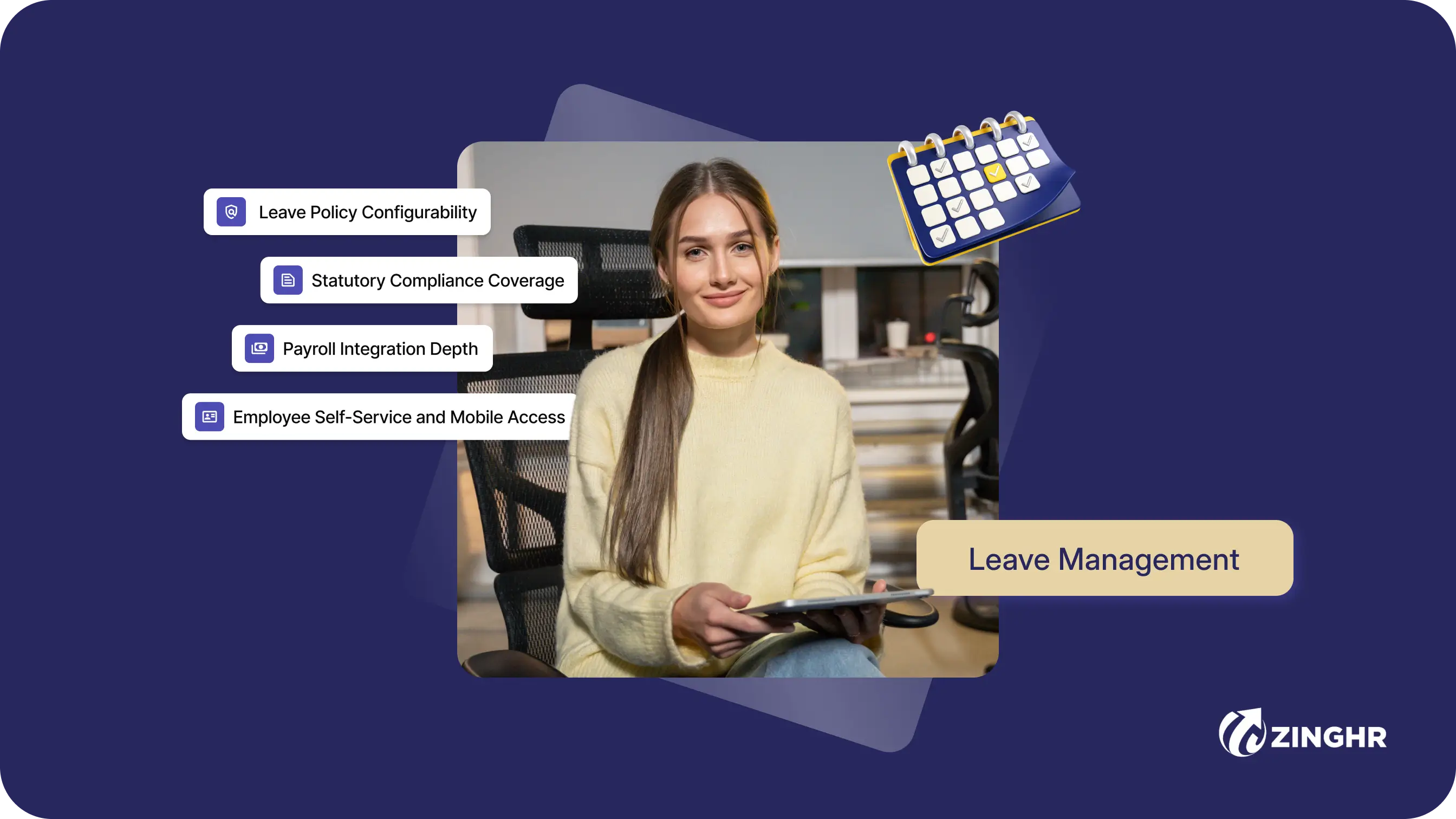
Table of contents
One unstitched HR platform to manage your entire workforce, from hire to rehire.
Talent Management solutions built for growing and exceptional people
Built-in compliance tools that update with changing regulations
Automated payroll, attendance, and leave management
Insights that help HR leaders make faster, better decisions

Key Takeaways
- ZingHR is the top pick for enterprises with 1,000+ employees. Automated leave workflows, multi-state holiday calendars, and payroll-integrated LOP management run from a single platform. AI-driven absence analytics flag absenteeism risks before they become operational problems.
- We reviewed seven platforms across leave policy configurability, payroll integration, compliance coverage, and mobile-first employee experience.
- Indian businesses must manage Earned Leave, Casual Leave, Sick Leave, Maternity Leave, and Comp-Off simultaneously across state-specific Shops & Establishments Acts, the Factories Act, and the Maternity Benefit Act.
- Manual tracking creates payroll errors, compliance gaps, and employee dissatisfaction. The right employee leave management system eliminates all three.
According to Gallup's State of the Global Workplace report, South Asia, primarily India, experienced an eight-point decline in manager engagement in 2025, the largest decline of any region. Managers who are checking out are also the ones approving or ignoring leave requests. When that approval layer becomes unreliable, leave data becomes inaccurate, and payroll follows.
An employee leave management system does not fix engagement on its own. But it removes one specific source of friction: the administrative burden of applying for leave, waiting for approval, and having no visibility into balances. That matters more than it sounds when the workforce is already disengaged.
This guide covers seven India-first platforms for leave management, evaluated for the specific complexity Indian HR teams face.
How We Assessed These 7 Tools
Our assessment drew from Gartner Peer Insights, G2, and Capterra ratings, assessed across four criteria specific to Indian businesses.
1. Leave Policy Configurability
The HR software must support Earned Leave, Casual Leave, Sick Leave, Maternity and Paternity Leave, Comp-Off, and company-defined types, all on separate accrual logic. Carry-forward caps, encashment triggers, and optional holidays must be configurable by HR without IT involvement.
2. Statutory Compliance Coverage
State-specific holiday calendars, Shops and Establishments Act rules, Factories Act earned leave accrual, and Maternity Benefit Act provisions must be built into the platform for statutory compliance.
3. Payroll Integration Depth
Leave data must feed into payroll as a live sync. LOP deductions, encashment payouts, and arrear calculations must be processed without a reconciliation step between two different systems.
4. Employee Self-Service and Mobile Access
Employees across office, field, factory, and retail locations must be able to apply for leave, check balances, and track approval status from a mobile device without requiring training to do so.
Quick Comparison: 7 Best Employee Leave Management Systems in India
The most common mistake in evaluating a leave management system is comparing features before comparing fit. The table below gives you the starting filter.
Seven employee leave management platforms in India compared by target segment, key strength, and trial availability as of June 2026.
1. ZingHR
Verdict: The strongest option for enterprises with 1,000+ employees managing leave across multiple Indian states. Automated workflows, payroll-integrated LOP management, and AI-driven absence analytics sit inside one platform that also covers attendance, workforce planning, and statutory compliance.
ZingHR Key Leave Management Features
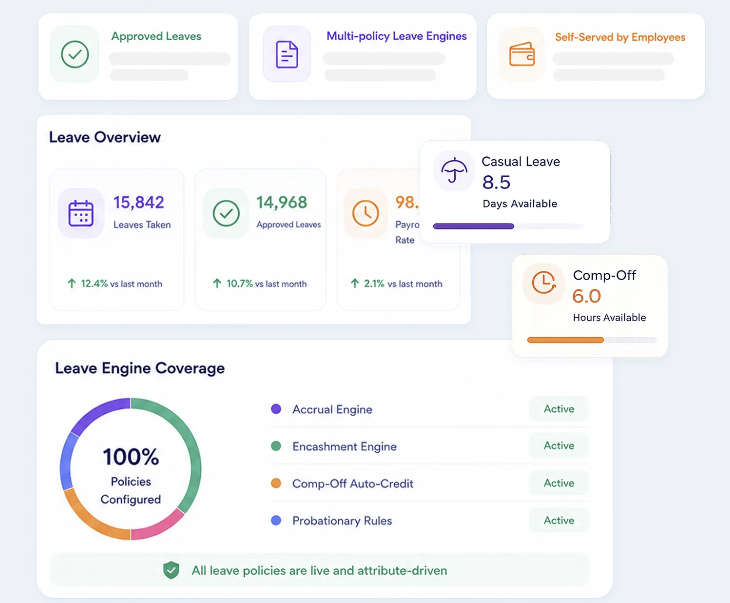
ZingHR's leave management system operates as part of its Workforce Management suite.
Each feature below is built for the scale and compliance complexity that organisations across multiple states face:
- Automated leave workflows: Employees apply via mobile or web. Requests route through configured approval chains without manual follow-up. Escalation triggers fire automatically if approvals stall past a defined window.
- Multi-state holiday calendar management: State-specific public holidays, optional holidays, and restricted holidays apply by employee work location. A company with offices in Mumbai, Bengaluru, and Chennai runs three different holiday calendars without three separate configurations.
- Configurable leave types and accrual rules: Earned Leave, Casual Leave, Sick Leave, Maternity Leave, Paternity Leave, Comp-Off, and company-defined types each run on independent accrual logic. Carry-forward limits and encashment triggers configure once and apply automatically.
- Payroll-integrated LOP calculations: Leave data moves directly into the payroll engine. Loss-of-pay deductions, encashment payouts, and arrear calculations run without manual reconciliation between two separate systems.
- AI-driven absence analytics via Zing Intelligence Hub: The Zing Intelligence Hub surfaces absenteeism trends by team and department. HR teams see patterns building before they affect project timelines or payroll accuracy.
- Shops and Establishments Act compliance: Leave entitlements apply based on the state-specific S&E Act that governs each employee's location, without manual rule-setting for every new state the business enters.
- Mobile-first employee self-service: Factory staff, field teams, and office employees all use the same mobile interface to check balances, apply for leave, and track approvals.
ZingHR Pros
- The deepest India-specific leave compliance coverage among platforms reviewed, with state-level rules applied without manual maintenance.
- A single data layer connecting leave, attendance, payroll, and workforce analytics means no reconciliation gaps at month-end.
- Board-level visibility into leave liabilities, encashment exposure, and absenteeism trends across every location and entity.
ZingHR Cons
- Built for enterprises with 1,000+ employees. Organisations below that threshold will find more features than they currently need.
ZingHR is Best For
Large enterprises in BFSI, Manufacturing, Pharma, Retail & QSR, Healthcare, and IT with workforces spread across five or more Indian states. Particularly useful where field, factory, and office employees all exist within the same organisation and need the same leave management access from different devices and locations.
ZingHR Pricing
Quote-based, scaled to headcount and module selection. Book a demo for a walkthrough based on your workforce size and state footprint.
2. Darwinbox
Verdict: A well-regarded mid-to-large enterprise platform with a clean interface and flexible approval workflows. Works well for companies with moderate compliance needs across 3-5 states. Organisations with contract labour, factory populations, or 10+ state operations will find the compliance depth thinner than enterprise-first platforms.
Darwinbox Key Leave Management Features
- Multi-level approval workflows configurable to actual reporting structures without needing IT support.
- Leave policy configuration by department, location, and employment type.
- Attendance and leave data integration feeding into payroll for LOP automation.
- Dedicated Android and iOS apps for employee self-service.
- Biometric and geo-fencing support for attendance-linked leave tracking.
Darwinbox Pros
- Interface is accessible for HR generalists and employees alike, with minimal training required for daily leave tasks.
- Deployment timelines for mid-market organisations are significantly faster than global enterprise platforms.
Darwinbox Cons
- Advanced reporting and workflow configuration have a learning curve. Complex customisations often need technical support.
- Multi-state PT slab management and CLRA compliance require workarounds for companies in 10 or more states.
Darwinbox is Best For
Enterprises with 500 to 3,000 employees in IT, professional services, and FMCG, operating across three to five states. Companies where the primary leave management requirement is structured approval workflows and payroll integration, without heavy blue-collar or contract labour compliance, will find the platform adequate.
Darwinbox Pricing
Pricing is quote-based and available on request directly from the vendor.
3. Keka HR
Verdict: The most practical entry point for Indian SMEs that want payroll-integrated leave management without a long implementation. Multi-state compliance and contract labour tracking begin to stretch at headcounts above 500.
Keka HR Key Leave Management Features
- Custom leave policies with accrual rules, carry-forward limits, and encashment triggers configured without IT.
- Policy hierarchy from global rules down to individual employee exceptions, with automatic recalculation when HR policies and procedures change.
- Leave data connected directly to payroll for LOP deductions without manual cross-checking.
- Team availability calendar so managers see coverage gaps before approving requests.
- Employee self-service portal for balance visibility, leave applications, and approval tracking.
Keka HR Pros
- Payroll-native leave calculations remove the reconciliation step that causes salary errors in disconnected systems.
- Interface requires minimal training, which matters for HR teams without dedicated IT support.
Keka HR Cons
- Organisations operating in five or more states encounter manual workarounds for PT slab variations in states with frequent rule changes.
- Contract labour tracking and CLRA compliance are outside the platform's scope.
Keka HR is Best For
Growing businesses with 50 to 500 employees in one to three Indian states. IT companies, professional services firms, and startups with standard leave types and no contract labour complexity will find Keka covers their requirements at a predictable cost.
Keka HR Pricing
Pricing is available on request and varies based on headcount, modules selected, and implementation scope.
4. HROne
Verdict: A HRMS software with strong workflow configurability suited to mid-market organisations that have outgrown basic tools. Everything from leave types to escalation paths is configurable. The platform works well for companies with distributed or field-heavy workforces where geo-tagged attendance matters.
HROne Key Leave Management Features
- Multi-level approval workflows with escalation paths and delegation support.
- Geo-tagging, selfie attendance, and biometric integration for attendance-linked leave tracking.
- Full payroll integration with leave-driven LOP calculations.
- Analytics dashboard showing absenteeism patterns and department-level leave utilisation.
HROne Pros
- Strong core HR and payroll features that cover the needs of most mid-market Indian businesses.
- Mobile-first interface with geo-aware features for distributed and field workforces.
- Relatively fast to implement compared to enterprise platforms of comparable workflow depth.
HROne Cons
- Interface feels dated compared to newer leave management platforms.
- Report formatting has limited customisation without additional configuration work.
HROne is Best For
Mid-market businesses with 200 to 1,000 employees, particularly those with field teams or distributed locations across three to six states. Companies that need complex approval hierarchies configured without outside technical help will find HROne suited to that requirement.
HROne Pricing
The platform offers a Basic plan at ₹4,950/month, Professional plan at ₹6,500/month, and custom pricing for enterprises.
5. PeopleStrong
Verdict: A strong option for large enterprises where leave management is tightly connected to attendance, workforce scheduling, and payroll. PeopleStrong handles high-volume leave operations across distributed and shift-based workforces, making it particularly suitable for manufacturing, retail, healthcare, logistics, and services organisations.
PeopleStrong Key Leave Management Features
- Configurable leave policies supporting Earned Leave, Casual Leave, Sick Leave, Comp-Off, Maternity Leave, and company-defined leave types with separate accrual and carry-forward rules.
- Attendance-linked leave management that synchronises with payroll systems to automate LOP deductions and minimise reconciliation errors.
- Workforce analytics that provide visibility into absenteeism trends, leave utilisation, and team availability.
- Multi-location support for office, field, and frontline employees operating across different locations.
PeopleStrong Pros
- Leave, attendance, payroll, and workforce management operate from the same platform.
- High-volume leave administration remains manageable across multiple business units and locations.
PeopleStrong Cons
- Advanced reporting requires configuration. Custom dashboards and analytics may need additional setup.
- Implementation complexity increases with workforce size. Large enterprises often require detailed workflow and policy mapping.
PeopleStrong is Best For
Large enterprises in manufacturing, retail, healthcare, logistics, BFSI, and services with distributed or shift-based workforces. Organisations managing leave across multiple locations and employee categories will benefit from its workforce-centric approach.
PeopleStrong Pricing
Pricing is quote-based and depends on employee count, modules selected, and deployment scope.
6. Zimyo
Verdict: An HR platform that connects leave data to employee engagement signals. The leave module covers the standard requirements cleanly. The differentiation is that absenteeism patterns and engagement scores live in the same view, which matters for HR teams trying to understand the why behind rising absence rates.
Zimyo Key Leave Management Features
- Mobile-first ESS portal for leave applications, balance checks, and approval tracking.
- Configurable leave types and accrual policies by department and location.
- Payroll integration for LOP deductions and encashment processing.
- Leave data connected to the engagement module for cross-functional HR reporting.
Zimyo Pros
- Connecting leave data to engagement metrics gives HR a perspective that standalone leave tools cannot provide.
- 50+ HR modules are available so the platform can expand as broader HR requirements grow.
Zimyo Cons
- Leave compliance depth for businesses across seven or more states is less developed than enterprise platforms.
- Absenteeism prediction and AI-driven analytics are not as deep as ZingHR's offering.
Zimyo is Best For
Tech companies, startups, and mid-sized businesses where employee experience sits alongside compliance as a priority. HR teams that want context for rising absenteeism will find Zimyo's engagement integration worth the trade-off on compliance depth.
Zimyo Pricing
Pricing starts at ₹80 per user/month for the Basic plan, ₹120 per user/month for the Standard plan, and ₹160 per user/month for the Enterprise plan, with minimum billing amounts of ₹4,000, ₹6,000, and ₹8,000 respectively.
7. SAP SuccessFactors
Verdict: A comprehensive leave management platform for multinational organisations that need consistent leave policies, approval workflows, and compliance controls across multiple countries and business units. SAP SuccessFactors treats leave management as part of the broader employee lifecycle, connecting absence management with workforce planning, payroll, and employee self-service.
SAP SuccessFactors Key Leave Management Features
- Global leave policies with support for country-specific regulations and business-unit-level configurations.
- Configurable leave encashment rules, carry-forward limits, and leave eligibility criteria across different employee groups.
- Employee and manager self-service portals for leave requests, balance visibility, and approval tracking.
- Integration with payroll and time management systems for accurate absence calculations and salary adjustments.
SAP SuccessFactors Pros
- Organisations can standardise leave processes while accommodating local regulations and policies.
- Leave management connects naturally with payroll, workforce planning, and employee lifecycle management.
SAP SuccessFactors Cons
- Implementation complexity is significant. Large deployments often require extensive configuration and change management.
- Businesses with simple leave policies may find the platform unnecessarily complex for their use case.
SAP SuccessFactors is Best For
Multinational enterprises and large organisations with complex leave policies, multiple legal entities, and employees spread across countries. Companies seeking standardised leave governance alongside broader HCM capabilities will benefit most from the platform.
SAP SuccessFactors Pricing
Pricing is quote-based and depends on employee count, modules selected, countries supported, and implementation scope.
How to Choose the Right Employee Leave Management System
A leave management system that fits a 200-person IT company in one state will not serve a 2,000-person manufacturing business across eight. Use these five criteria to choose the right platform for your operational reality.
1. Match the Tool to Your Actual Workforce Size and State Footprint
A platform built for SMEs will hit its limits at 500 employees or in the fifth state. A platform built for 1,000+ employee enterprises will have more configuration depth than a 100-person business needs.
Calculate the real per-employee cost over 12 months at your actual headcount before comparing sticker prices.
2. Treat Payroll Integration as a Hard Requirement
A leave management system that produces a CSV export for the payroll team is not integrated.
Ask vendors specifically: does leave data sync to payroll automatically before every salary run, or does someone manually transfer it? The answer changes the compliance risk profile significantly.
3. List Every Leave Type Before Entering Any Demo
Earned Leave, Sick Leave, Casual Leave, Comp-Off, Maternity Leave, Paternity Leave, Optional Holidays, and any company-specific types your policy currently includes.
If a platform cannot configure all of them on separate accrual logic without workarounds, cross it off before the conversation goes further.
4. Audit Your State Compliance Obligations Specifically
Every state your business operates in adds a separate Shops and Establishments Act, a Professional Tax slab, and a holiday calendar. Some platforms claim multi-state support but require manual configuration for each state.
Ask vendors to show you how they handle a new state addition and support it.
5. Test the Mobile Experience With Your Actual Workforce in Mind
A plant worker in Pune and a sales rep in Coimbatore should be able to apply for leave and check their balance in under a minute, without connectivity dependent on strong signal.
If the demo requires a desktop browser or a training session, field adoption will be low and the system will fail in practice.
How ZingHR Approaches Leave Management for Large Enterprises
ZingHR positions leave management as part of a unified workforce intelligence function. Every leave transaction connects to payroll systems, attendance, compliance, and workforce analytics in one data layer.
1. One Platform Across All Leave Data
Leave balances, approval records, LOP deductions, encashment history, and carry-forward liabilities are all accessible from the same interface.
Corporate HR and plant-level managers see the same data in real time. Month-end payroll does not require manual cross-checking between systems.
2. Workforce Intelligence Through the Zing Intelligence Hub
The Zing Intelligence Hub connects leave data to broader workforce signals. Department-level absenteeism trends surface before they affect delivery timelines. Carry-forward liability reports give finance teams advance visibility of encashment exposure before year-end.
Leave pattern analysis feeds into workforce planning rather than sitting as historical records.
3. Multi-State Compliance Without Manual Maintenance
India's leave compliance framework changes. State governments revise Shops and Establishments provisions. Holiday lists update annually. Factories Act accrual rules differ from S&E Act rules.
ZingHR applies state-specific rules natively across every employee location, so companies operating across Maharashtra, Karnataka, Tamil Nadu, Telangana, and Delhi simultaneously are not maintaining five separate leave policy configurations by hand.
4. Leave Connected to Employee Engagement
ZingHR's Employee Engagement module connects to leave data directly.
In 2025, South Asia, primarily India, experienced a decline in manager engagement, the largest regional drop Gallup recorded that year. Teams showing rising absenteeism alongside low engagement scores appear in the same view, giving HR the context to act rather than just observe.
5. Built for India's Full Workforce Complexity
Factory workers on Factories Act accrual schedules, office staff under state S&E Acts, and field teams with geo-fenced attendance all operate under different leave rules.
ZingHR's Workforce Management platform handles every layer within a single deployment. The HR Launchpad provides a structured path to get there for enterprises beginning their HR digitisation.
If leave tracking, payroll reconciliation, and multi-state compliance are currently three separate problems being solved with three separate workarounds, that gap has a compounding cost that shows up in every salary cycle.
Book a demo with ZingHR to see how the platform handles all three in one place, built specifically for Indian businesses at enterprise scale.
Frequently asked questions (FAQs)
An employee leave management system is software that automates leave applications, approvals, balance tracking, and payroll integration. It replaces email chains and spreadsheets with a central system where employees apply, managers approve, and data feeds into payroll without manual transfer.
No specific law mandates software for employee leave management. However, Indian labour law requires accurate leave records across the Factories Act, Shops and Establishments Acts, and the Maternity Benefit Act. Manual systems make meeting those obligations significantly riskier, especially across multiple states.
ZingHR’s employee leave management system is built for enterprises with 1,000+ employees managing multi-state compliance and distributed workforces. It covers the full range from leave workflows to workforce analytics in one platform purpose-built for Indian statutory requirements.
Leave data, specifically LOP deductions, encashment calculations, and arrear adjustments, should sync automatically to the payroll engine before every salary run. Platforms like ZingHR, Keka HR, and SAP SuccessFactors do this natively. Systems that require a manual export between tools create reconciliation errors in salary processing.
SME-focused tools like Keka HR and SAP SuccessFactors typically go live in two to four weeks. Mid-market platforms like HROne take four to eight weeks. Enterprise employee leave management platforms like ZingHR and Darwinbox run 8-16 weeks depending on the number of states, leave policy complexity, and payroll integration scope.
What to do next?
See ZingHR in Action
Join the 1,200+ enterprises that have replaced fragmented HR with one intelligent, future-ready platform. See ZingHR in 30 minutes.
Build the Organization You Want
Great HR drives retention, capability, and culture. ZingHR takes care of the operational layer so your people team owns the strategy.

Elevating Impact.
Defining Destiny
See how ZingHR's AI-powered Hire-to-ReHire platform frees your CPO to lead with purpose and deliver the outcomes your Board is watching for


ZingHR is the AI-powered Hire-to-ReHire platform built for one purpose to remove every transactional layer of HR from your organisation, permanently.