HR Software Features Checklist: What Enterprise HR Teams in India Should Look For
A practical checklist for CHROs and HR operations teams evaluating AI-powered HCM software that connects payroll, workforce management, talent, automation, and analytics in one platform.

Table of contents
One unstitched HR platform to manage your entire workforce, from hire to rehire.
Talent Management solutions built for growing and exceptional people
Built-in compliance tools that update with changing regulations
Automated payroll, attendance, and leave management
Insights that help HR leaders make faster, better decisions

Key Takeaways
- HR software features are the core capabilities that automate employee records, payroll, time tracking, recruitment, compliance, and workforce analytics on one platform.
- Enterprise HR teams benefit most from a unified system of record and action that reduces manual reconciliation across payroll, attendance, and talent workflows.
- Prioritise mobile access, payroll automation, and analytics first if you manage distributed or field-based teams; layer engagement, performance, and succession planning as you scale.
- ZingHR connects all 10 features below in one AI-powered HCM platform built for the hire-to-rehire lifecycle.
- Look for compliance-ready workflows, role-based visibility, and real-time dashboards that serve CHROs, HRBPs, managers, and employees.
Every payroll cycle that runs on manual reconciliation is a compliance incident waiting to happen.
Picture a 3,000-employee organisation where attendance sits in one tool, leave approvals in another, and payroll gets run off a spreadsheet someone updates manually before the 25th. A transfer gets missed, an exit isn't reflected in time, and payroll goes out wrong, again.
The root cause traces back to fragmented systems, where data lives in disconnected tools instead of one unified platform. HR software is a system that centralises core HR, payroll, attendance, recruitment, performance, and compliance so data flows automatically instead of being re-entered by hand.
This guide breaks down:
- Core features every enterprise HR platform should have
- Advanced capabilities that separate scalable systems from basic tools
- How to prioritise features based on your organisation's size and compliance needs
10 HR Software Features to Unify Enterprise HR Operations
The table below maps the 10 essential HR software features enterprise teams in India should evaluate, what each capability does, and who benefits most.
The 10 HR software features to evaluate, mapped to capability and best-fit team
What Enterprise HR Teams Should Expect from an HCM Platform
An enterprise HCM platform should connect five critical layers: core HR data, workforce management, payroll and compliance, talent workflows, and analytics. When these layers work together, HR teams spend less time reconciling systems and more time improving workforce outcomes.
This is the difference between a fragmented set of point tools and true human capital management software that operates as one system of record and action. The shift toward AI in HR software makes this integration even more valuable, because connected data is what allows automation to detect exceptions, prioritise workflows, and surface predictive insights instead of acting as a vague buzzword.
.webp)
Core Features of Modern Enterprise HR Software
Below is a closer look at each of the 10 essential HR software features and how each one benefits enterprise organisations in India that need to manage scale, compliance, distributed teams, and accurate workforce data from one platform.
1. Mobile App
Best for: Enterprises with office-based, remote, and field-based employees who need HR services on the go.
For enterprises with office-based, remote, and field-based employees, mobile access is essential for HR adoption. Employees should be able to mark attendance, apply for leave, access payslips, update information, and receive HR notifications without depending on desktop access.
Mobile access significantly improves user adoption, accelerates approval processes, and supports distributed teams. Managers should be able to approve requests, view team updates, and act on exceptions in real time. ZingHR's Android and iOS applications support these everyday HR actions, helping organisations improve response time, reduce administrative follow-ups, and support distributed workforces.
ZingHR's Mobile App Key Features
- On-the-go employee actions: Employees can check attendance, apply for leave, view payslips, and receive updates without logging into a desktop system. This keeps field and remote teams connected to HR processes regardless of location.
- Real-time manager approvals: Managers receive instant notifications, review requests, and approve actions from the app. This reduces approval bottlenecks and follow-up emails that slow down distributed operations.
- Notifications and updates: Push notifications keep employees informed about policy changes, payroll events, and pending tasks, improving engagement and reducing dependency on HR helpdesks.
2. Payroll Management
Best for: HR operations and finance teams managing complex, multi-component salary structures and statutory compliance.
Payroll management is a critical feature of HR software in India due to complex salary structures, statutory compliance, and frequent regulatory updates. Payroll is particularly complex here because of multiple allowances, variable incentives, taxes, and statutory contributions such as Provident Fund (PF), Employee State Insurance (ESI), and professional tax.
ZingHR connects payroll with attendance, leave, overtime, incentives, deductions, and statutory compliance workflows. This payroll automation helps HR and payroll teams reduce manual reconciliation, close payroll faster, and maintain compliance confidence across large and distributed workforces.
ZingHR's Payroll Key Features
- Connected payroll inputs: Attendance, leave, overtime, and variable pay flow directly into payroll, removing the manual data transfers that introduce errors and delay payroll closure.
- Statutory compliance automation: The system accounts for PF, ESI, professional tax, and TDS, and updates as regulations change, helping HR operations teams stay audit-ready.
- Variable and incentive handling: ZingHR automatically processes overtime, incentives, deductions, and variable pay components, supporting complex enterprise compensation structures without manual workarounds.
3. Recruitment and Onboarding
Best for: Talent acquisition teams that need hiring and onboarding to work as one connected workflow.
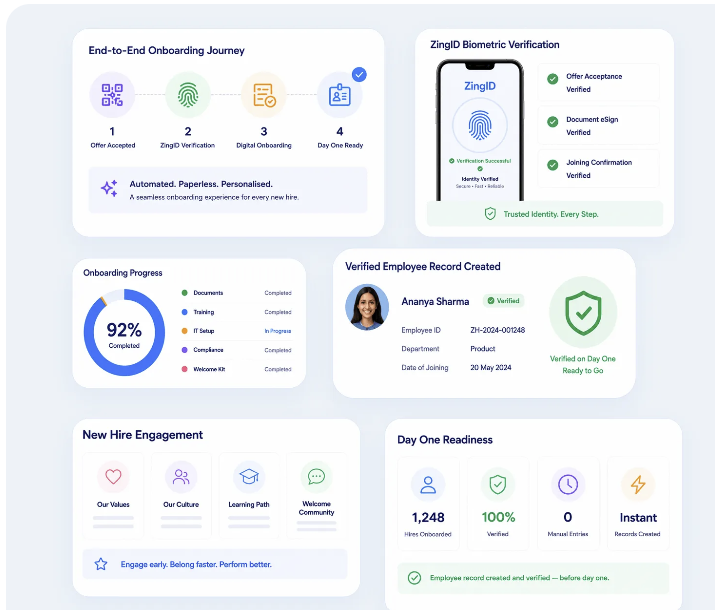
Hiring and onboarding should work as one connected workflow. Enterprise HR teams need visibility from job creation and candidate screening to offer release, documentation, policy acknowledgement, and employee record creation.
ZingHR's digital onboarding app allows new hires to complete documentation, understand company culture, review company policies, and initiate their candidate journey seamlessly. As a result, organisations can deliver a smooth, consistent, and engaging onboarding experience from day one, while keeping recruitment and onboarding data connected in one system.
ZingHR's Recruitment & Onboarding Key Features
- Digital documentation and policy acknowledgement: New hires complete forms, upload documents, and acknowledge policies before day one, reducing first-week administrative load on HR teams.
- Connected hire-to-onboard flow: Candidate data carries through from offer to employee record creation, eliminating duplicate data entry between recruitment and core HR.
- Consistent onboarding experience: Structured onboarding journeys help every new hire receive the same experience regardless of location or business unit, supporting enterprise consistency.
4. Attendance and Leave Management
Best for: Multi-location enterprises with growing teams that need a reliable source of workforce data.
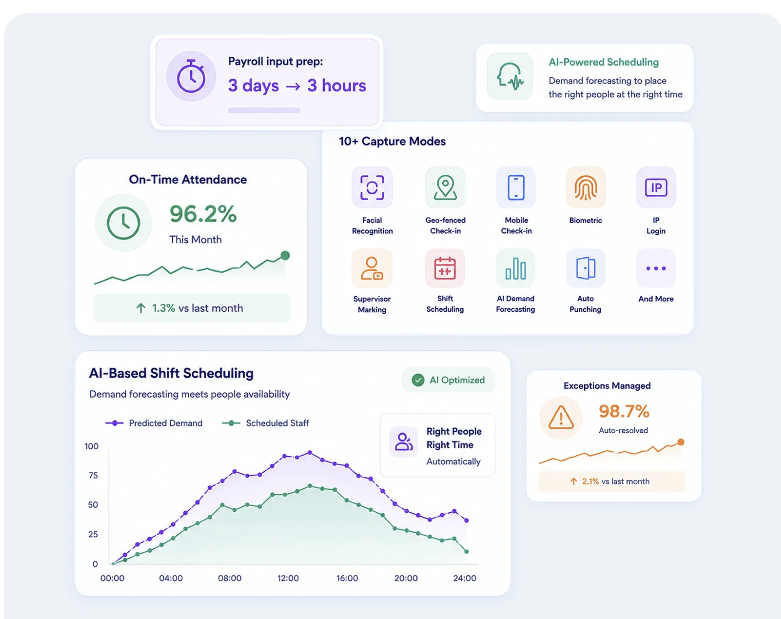
Managing leave and attendance manually often leads to inconsistencies, errors, and disputes. This directly impacts payroll accuracy, compliance, workforce planning, and overall productivity, especially for large enterprises with growing teams. Digital leave management also improves employee satisfaction and helps teams forecast workload more accurately.
Connected HR systems provide a single reliable source of truth for tracking employee work hours, shifts, overtime, holidays, leave balances, and employee attendance.
ZingHR digitises attendance and leave workflows through mobile apps, web portals, facial attendance, manager-assisted attendance marking, and biometric device integrations. Leave workflows can also categorize requests such as sick, casual, or earned leave.
This supports office-based, remote, and field-based employees while giving HR teams a reliable source of workforce data. Employees can also apply for leave and check their balance through ZingHR's AI-powered chatbot, streamlining the entire process.
ZingHR's Attendance & Leave Key Features
- Multi-mode attendance capture: Mobile, web, facial recognition, manager marking, and biometric integration cover every workforce type, from desk-based to field staff.
- Single source of truth: Accurate, real-time records of work hours, shifts, overtime, holidays, and leave balances improve transparency and feed directly into payroll.
- AI-powered self-service: Employees apply for leave and check balances through an AI chatbot, reducing routine queries to HR teams.
5. Applicant Tracking System (ATS)
Best for: Recruiters and hiring managers who need a structured, measurable recruitment funnel.
An ATS acts as the operational backbone of recruitment by structuring every stage of the hiring lifecycle into a trackable and measurable workflow. Instead of managing resumes, interview feedback, and hiring decisions across emails and spreadsheets, an ATS centralises candidate data, hiring stages, recruiter actions, and evaluation records in one system.
ZingHR's ATS enables HR teams to manage the entire recruitment funnel from job creation to final selection within one AI-powered recruitment platform. Recruiters can manage job posting, workflows, resume screening, shortlisting, and interview coordination. This saves recruiters time and helps them focus on productive, high-value activities. For a deeper look at the capabilities to prioritise, review these recruitment software features.
ZingHR's ATS Key Features
- Centralised candidate data: All resumes, feedback, and hiring stages live in one system, removing the fragmentation of spreadsheets and email threads.
- End-to-end funnel management: From job creation to final selection, every stage is trackable and measurable, giving hiring managers visibility into pipeline health.
- Resume screening and shortlisting: Automated screening and shortlisting reduce recruiter effort on high-volume roles and accelerate time-to-fill.
6. Employee Engagement
Best for: HRBPs and people leaders who want to act on engagement signals earlier.
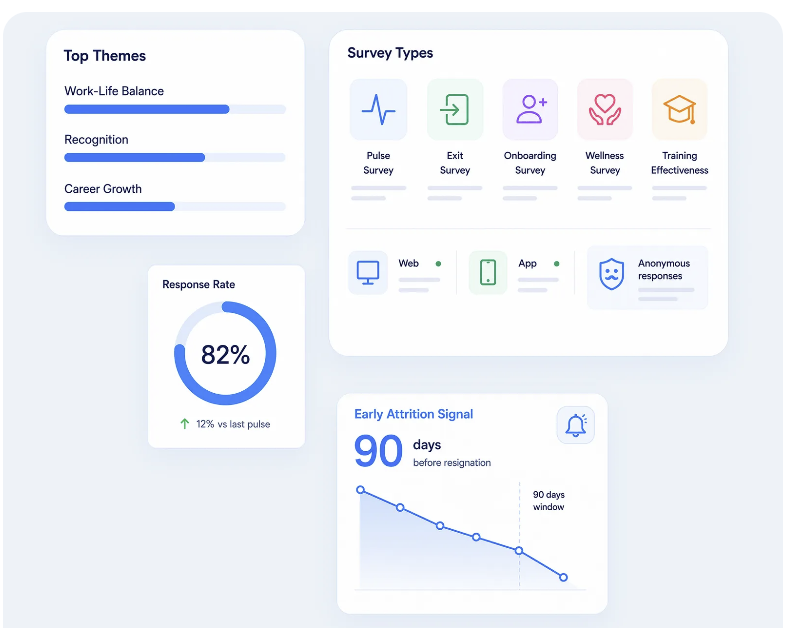
Employee engagement goes beyond periodic feedback and surveys. It reflects how employees interact with the work environment, leadership, and internal processes. Effective engagement happens through two-way feedback, meaningful recognition, and employee participation across the organisation.
ZingHR connects engagement signals with HR workflows so HRBPs and leaders can identify participation patterns, act on feedback, and improve retention. Through integrated communication, structured feedback, and interactive employee experience tools, HR teams gain clear visibility into engagement patterns and can take proactive steps to improve satisfaction and retention.
ZingHR's Employee Engagement Key Features
- Two-way feedback mechanisms: Structured feedback channels let employees and managers exchange input continuously rather than only during annual cycles.
- Recognition and participation tools: Built-in recognition features and interactive experiences encourage participation across teams and locations.
- Engagement visibility for HRBPs: Engagement insights help HRBPs spot disengagement early and address concerns before they become attrition risks.
7. Performance Management System
Best for: Managers and HR teams aligning individual contributions with business outcomes.
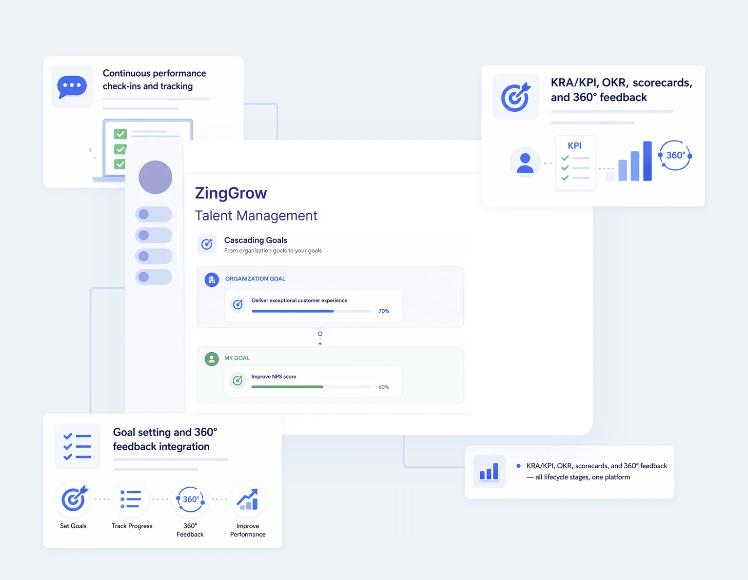
A Performance Management System (PMS) provides a structured framework to define expectations, measure outcomes, and support employee development. Advanced systems go beyond annual reviews with continuous feedback, goal tracking, and progress monitoring throughout the performance cycle.
95% of HR managers find traditional performance management complicated, which is why continuous, software-supported workflows matter for employee performance and performance tracking. To design your review cadence, see these performance management strategies.
ZingHR's performance management system empowers organisations to define clear goals, monitor real-time progress, and conduct data-driven evaluations. It tracks ongoing performance trends, captures real-time feedback, and ensures alignment between individual contributions and overall business outcomes.
ZingHR's Performance Management Key Features
- Goal setting and tracking: Clear, measurable goals are defined and monitored in real time, keeping employees and managers aligned throughout the cycle.
- Continuous feedback: Ongoing feedback replaces once-a-year reviews, giving managers timely visibility into progress and development needs.
- Data-driven evaluations: Evaluations draw on tracked performance data and trends, reducing bias and improving the quality of review conversations.
8. Employee Self-Service Portal
Best for: Employees and HR administrators who want accurate, self-managed HR data.
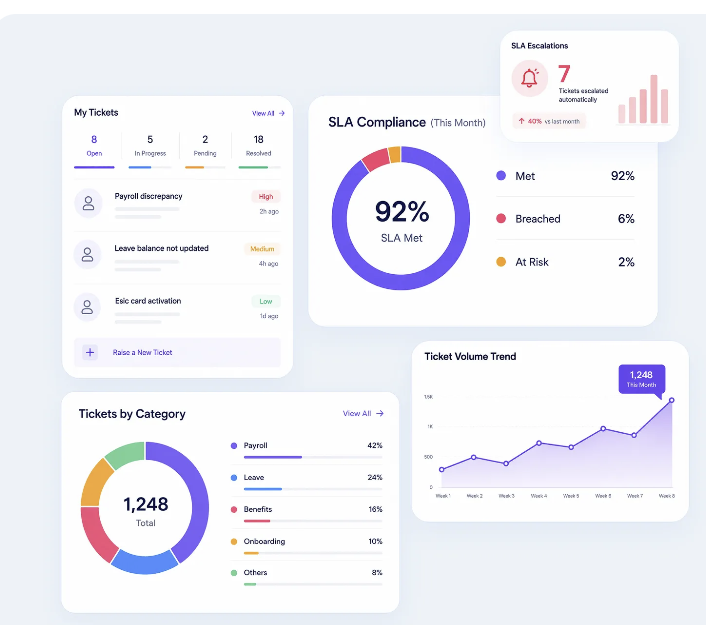
An employee self-service portal allows employees to manage routine HR requests without depending on HR teams for every update. This reduces repetitive administrative work and keeps employee data more accurate.
ZingHR offers an Employee Self-Service (ESS) or helpdesk feature where employees can upload documents, access personal information, download payslips, apply for leave, update details, and track requests in real time. As a result, HR teams and employees work with synchronized data at all times.
ZingHR's ESS Key Features
- Self-managed requests: Employees handle leave, document uploads, and profile updates independently, freeing HR administrators from repetitive transactional tasks.
- Real-time data synchronization: Updates made by employees reflect immediately across the system, keeping the employee database accurate and reducing reconciliation.
- Document and payslip access: Employees download payslips and access personal records on demand, reducing routine HR queries.
9. Succession Planning
Best for: CHROs and leadership preparing for future workforce transitions.
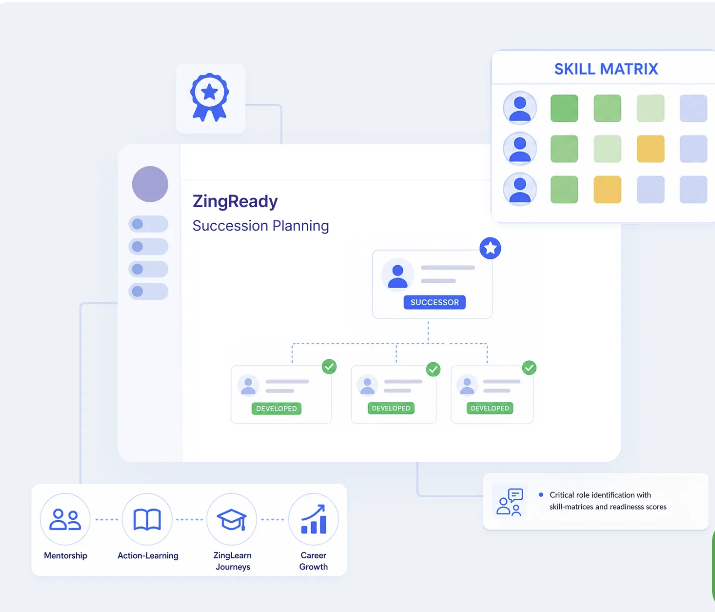
Succession planning helps organisations prepare for future workforce transitions by identifying critical roles and developing internal talent for vacant positions. To understand the fundamentals, explore succession planning in HR.
ZingHR facilitates succession planning by enabling HR teams to identify key roles, assess employee readiness, and map future career paths. The system provides visibility into talent availability, readiness, and leadership pipelines, enabling proactive workforce planning and long-term organisational stability.
ZingHR's Succession Planning Key Features
- Critical role identification: HR teams flag business-critical roles and the risks associated with potential vacancies, enabling proactive planning.
- Readiness assessment: Employee readiness is assessed against future roles, helping leadership prioritise development investments.
- Leadership pipeline visibility: Clear visibility into talent pipelines supports continuity planning and reduces disruption from key departures.
10. HR Analytics
Best for: CHROs and HR operations leaders who need real-time, decision-grade workforce insights.
ZingHR's analytics layer gives HR leaders real-time visibility across hiring, attendance, payroll, performance, retention, and workforce health. HR analytics transforms workforce data into measurable business insights that support decisions in hiring, performance, retention, and workforce planning.
Notably, 71% of companies prioritize HR analytics for decision-making.
ZingHR provides Outcomation Analytics and real-time dashboards that help HR leaders monitor workforce trends, identify risks, and track HR metrics tied to hiring, payroll, retention, and employee performance while measuring organisational health through actionable insights.
ZingHR's HR Analytics Key Features
- Real-time dashboards: CHRO-level dashboards surface workforce metrics and trends as they happen, supporting faster, better-informed decisions.
- Cross-module insights: Analytics span hiring, attendance, payroll, performance, and retention, giving leaders a connected view rather than siloed reports.
- Risk and effectiveness tracking: Leaders monitor attrition risk, hiring effectiveness, and organisational health, turning workforce data into proactive action.
Benefits of HR Software for Enterprise Teams
Features are only half the story. What matters to enterprise HR teams is what those features actually deliver, in reduced overhead, stronger compliance posture, and better decisions. Here's what a connected HR platform translates to in practice.
- Reduced manual work and fewer errors
When attendance, leave, payroll, and employee records flow through one connected system, HR operations teams spend far less time on data entry and reconciliation. Automation handles repetitive calculations and approvals, reducing the human errors that lead to payroll disputes and compliance issues.
- Stronger compliance confidence
Statutory requirements in India change frequently, and manual tracking is risky at scale. HR software with built-in, regularly updated compliance workflows helps enterprises stay audit-ready across PF, ESI, professional tax, and labour regulations, even across multiple locations and entities.
- Better employee experience
Self-service portals, mobile apps, and AI-powered chatbots give employees control over routine HR tasks. This reduces friction, speeds up approvals, and frees HR teams to focus on higher-value work like culture, capability, and retention.
- Faster, evidence-based decisions
Real-time analytics give CHROs and HR operations leaders visibility into hiring, attendance, performance, and retention trends. Instead of waiting on month-end reports, leaders can act on workforce signals as they emerge, improving planning and reducing risk.
- Scalability across the workforce
A unified platform scales across locations, roles, business units, and workforce types, from office-based staff to remote and field employees, so growing enterprises don't outgrow their HR systems.
Why Choose ZingHR HR Software?
ZingHR brings core HR, payroll, workforce management, talent workflows, automation, and analytics into one AI-powered HCM platform built for the employee lifecycle from hire to rehire. As one of the core HRMS software features in modern HR management software, its centralised employee database supports employee database management, employee management, and protection of sensitive employee data.
Rather than stitching together point tools, enterprise HR teams get one system of record and action, which means less time reconciling systems and more time improving workforce outcomes.
Across CHROs, HR operations teams, HRBPs, managers, and employees, ZingHR connects the workflows that matter: compliance-ready payroll, multi-mode attendance, connected recruitment and onboarding, analytics, and employee records, covering essential HR functions in one place. This makes it easier to evaluate hr software solutions when growth requires scalable systems for onsite teams and remote employees alike, instead of choosing a disconnected hr tool. AI-powered automation works in the background to detect exceptions, prioritise workflows, and surface insights that support faster decisions.
Organisations using ZingHR typically find that reducing transactional HR work frees their people teams to focus on strategy, capability, and culture. While most hr software varies widely in pricing and scope, the real advantage comes from having connected workflows in a single platform.
Book a demo to explore how ZingHR can support your HR transformation.
Frequently asked questions (FAQs)
The most important HR software features usually include a centralised employee database, payroll and tax automation, time and attendance tracking, recruitment and onboarding, employee self-service, and reporting and analytics. These are the core modules most enterprises prioritise because they reduce manual work, improve data accuracy, and feed every other HR process from one trusted source.
HR software is the broad term for tools used to manage HR processes, while HRMS usually refers to a more structured system that centralises employee data and automates key workflows. In practice, both cover payroll, recruitment, onboarding, analytics, and employee records — but HRMS and HCM platforms like ZingHR are used when the platform has a stronger all-in-one data layer and operates as a single system of record and action.
For enterprises in India, the most valuable features are payroll with statutory compliance automation, multi-location attendance and leave management, mobile access for distributed teams, and real-time analytics for leadership. Compliance complexity, workforce scale, and distributed operations make connected data and automation especially important.
Compliance and security are supported by controlled, role-based access, secure document storage, audit-friendly records, and automated tracking of statutory deadlines such as PF, ESI, and professional tax. Regularly updated compliance workflows help enterprises stay audit-ready as regulations change, which matters for regulated industries like BFSI, manufacturing, and pharma.
Recruitment is handled through an applicant tracking system that structures the hiring funnel, while onboarding includes digital documentation, policy acknowledgement, task checklists, and employee record creation. When these work as one connected workflow, candidate data flows straight into core HR, reducing duplicate entry and speeding up time-to-productivity.
Enterprise platforms increasingly include AI-powered workforce insights, predictive analytics, AI-driven self-service chatbots, and connected automation across payroll, attendance, and talent workflows. These features help enterprises detect exceptions, forecast attrition risk, manage compliance at scale, and support hybrid and field-based work from one AI-powered HCM platform.
What to do next?
See ZingHR in Action
Join the 1,200+ enterprises that have replaced fragmented HR with one intelligent, future-ready platform. See ZingHR in 30 minutes.
Build the Organization You Want
Great HR drives retention, capability, and culture. ZingHR takes care of the operational layer so your people team owns the strategy.

Elevating Impact.
Defining Destiny
See how ZingHR's AI-powered Hire-to-ReHire platform frees your CPO to lead with purpose and deliver the outcomes your Board is watching for


ZingHR is the AI-powered Hire-to-ReHire platform built for one purpose to remove every transactional layer of HR from your organisation, permanently.