Payroll Process in UAE: Steps, WPS & Compliance Guide
A practical guide to the payroll process in the UAE, covering WPS, salary calculations, compliance, gratuity, and monthly payroll deadlines.

Table of contents
One unstitched HR platform to manage your entire workforce, from Hire to Re-Hire.
Talent Management solutions built for growing and exceptional people
Built-in compliance tools that update with changing regulations
Automated payroll, attendance, and leave management
Insights that help HR leaders make faster, better decisions

Key Takeaways
- The payroll process in the UAE runs on compliance, and the 2026 WPS Resolution tightens it with a first-of-month salary deadline.
- Enterprise payroll spans nine control points, from Emirates ID and contract validation through gross-to-net, WPS filing and the exit settlement.
- Manual and disconnected systems create file rejections and penalty exposure, which becomes board-level risk at scale.
- A repeatable monthly close checklist aligns operations to the new deadline, with hard cut-offs from data lock to salaries cleared.
- ZingHR runs the whole cycle from one command centre, pairing agentic payroll execution with board-level compliance dashboards.
A new WPS Resolution, effective 1 June 2026, tightens the salary-payment deadline so wages clear by the first day of each Gregorian month. The on-time compliance threshold also lifts from 80% to 85% of total wages.
For a shift-heavy manufacturing plant, or a QSR chain with variable overtime across outlets, the impact is real. It compresses your payroll calendar and raises the cost of a late data cut-off.
What follows sets out what changed in 2026 and the compliance pillars every payroll team governs.
What Makes the Payroll Process in the UAE Different in 2026
Three forces separate UAE payroll from most markets. A mandatory electronic wage-transfer regime sets the baseline. Entity-specific rules then vary by jurisdiction, and the treatment of nationals differs from expatriates. The 2026 changes sharpen every one.
1. The 2026 WPS Resolution and the First-of-Month Deadline
Treat the 2026 resolution as an operational SLA change, because that is what it is. Issued by the Ministry of Human Resources and Emiratisation (MOHRE) as Ministerial Resolution No. 340 of 2026, effective 1 June 2026, it requires wages for the preceding month to clear by the first day of each Gregorian month. The single deadline replaces the older 15-day grace window many teams relied on.
At the same time, the on-time compliance threshold rises from 80% to 85%. An establishment is compliant when it transfers at least 85% of total wages due by the first, and compliance is also tested per employee. New hires now fall within WPS (electronic salary transfer system) from their first month, since the earlier exemption was removed.
At 1,000+ headcount, the arithmetic turns unforgiving fast. A batch of overtime approvals stuck in a manager's inbox can pull your paid total below the threshold. The resolution moves your real cut-off earlier, and it leaves less room to fix errors before submission.
Also read: UAE Payroll Regulations 2026: WPS Rules, Deadlines and Compliance Explained
2. Mainland, Free Zone and DIFC/ADGM Obligations
Your obligations shift with where each entity registers. MOHRE-registered mainland employers run wages through the standard Wage Protection System, using WPS-enabled banks and exchange houses.
Major free zones like JAFZA and DMCC now mirror WPS-style requirements, with their own file formats and timelines. The financial centres work differently. The Dubai International Financial Centre (DIFC) replaces traditional gratuity with the DIFC Employee Workplace Savings (DEWS) scheme. The defined-contribution model needs monthly contribution files instead of a lump sum at exit.
An organisation across all three runs one payroll calendar over three rule sets and three sets of deadlines.
3. Emirati and Expatriate Payroll
Nationality drives the deduction and benefit logic. GCC and UAE nationals need mandatory social security, remitted through the General Pension and Social Security Authority (GPSSA).
Rates vary by emirate, with unemployment insurance added where it applies. Expatriates sit outside state social security. Their long-term entitlement is end-of-service gratuity, or a DEWS-style savings contribution in the relevant free zones. Your payroll management engine applies the right treatment automatically, per employee, at scale.
The Core Compliance Pillars Every Payroll Team Must Govern
Four pillars sit under every compliant UAE payroll run. Labour law defines the contract, WPS moves the money, social security and gratuity fund the long term, and record-keeping proves it later. Miss any one and you are exposed to fines, permit suspensions or a labour-court escalation that reaches your board.
1. Federal Decree-Law No. 33 of 2021
Federal Decree-Law No. 33 of 2021 governs employment contracts and working hours, and it sets the rules for overtime and leave. Overtime runs at 125% of the normal wage for daytime hours and 150% for night work. Employees earn 30 days of paid annual leave after one year. Termination and end-of-service benefits sit under the same law.
Every payroll calculation mirrors the registered contract, meaning contracted basic salary and the allowances filed with the authority.
2. Wage Protection System (WPS) and the Salary Information File (SIF)
The Wage Protection System is mandatory for most private-sector employers, jointly overseen by the MOHRE and the Central Bank of the UAE. Salaries move electronically through WPS-registered banks and exchange houses, and each transfer uses a Salary Information File (SIF).
The MOHRE reports that WPS now covers more than 99% of private-sector workers, with establishments transferring over AED 35 billion through the system every month.
The SIF has to carry company and employee identifiers, the IBAN and salary amounts in the exact prescribed format. One error blocks everything. A missing IBAN or a mismatched total rejects the file, salaries stay stuck, and you breach the deadline. Non-compliance can trigger warnings and fines, and it can suspend new work permits.
3. Social Security, Gratuity and DEWS
Fund these long-term obligations monthly, well before anyone exits. GPSSA contributions cover nationals, and monthly gratuity accrual covers expatriates. DEWS contribution files apply in the free zones that mandate them.
Gratuity is formula-based under Federal Decree-Law No. 33 of 2021, linked to basic salary and years of service, and an employee qualifies after one year of service. Accruing it every month protects your cash-flow timing, and it keeps the end-of-service liability auditable.
4. Data Protection and Record-Keeping
Payroll inputs carry sensitive data, from Emirates ID to IBAN, so every record needs careful handling. The set covers visa status and signed contracts, with attendance and overtime logs alongside.
UAE guidance requires payroll records to be kept for a minimum of two years, which supports audits and disputes.
Larger employers go further, aligning to GDPR-style principles, with lawful basis and data minimisation next to local free-zone frameworks. At scale, that retention layer earns its place, because it stands up when a regulator or a court asks for proof.
Why Generic and Manual Payroll Approaches Fail at Scale
At 1,000+ headcount, spreadsheets and disconnected HR systems create compliance risk. The failure modes are predictable, and each traces back to data living in too many places:
- Silo issues: HR owns contract and Emirates ID data, time and attendance sits elsewhere, and finance holds payroll accounts. Someone rekeys data between them every month, transposing IBANs, missing allowance rules, and getting SIF files rejected at the bank. Rejected files mean stalled salaries and rework against a hard deadline.
- Threshold problems: A supervisor holding 300 overtime approvals until the 23rd pushes an entire cohort past the reconciliation window. Under 2026 rules, that delay creates direct exposure with no grace period to absorb it.
- Governance limitations: Penalties and permit suspensions reach beyond the payroll team. They land on the CFO as cash-flow and audit risk, and on the CHRO as reputational and board-reporting risk. A structured, repeatable framework is the only thing that scales against that exposure.
The Payroll Process in the UAE: A 9-Step Framework
Nine control points sit in every payroll run, from master-data validation to the exit settlement. Treat each as a governed checkpoint with an owner and a deadline. The discipline separates the payroll process steps in UAE that hold up under audit from the ones that break under scale.
Step 1: Validate Employee and Contract Master Data
Everything downstream depends on this being right. Verify Emirates ID and visa status at onboarding, before the first payroll run touches the record. Confirm the IBAN and salary structure in the same pass, and align job grade and basic pay to the contract registered under Federal Decree-Law No. 33 of 2021.
Match allowances and overtime rules to that same record. Keep one source of truth across HR, payroll and finance, so every employee reaches a payroll run with validated banking and contract details.
Step 2: Capture Attendance, Leave and Variable Pay
Capture attendance from biometric devices, mobile check-ins or paper registers. Reconcile leave against approvals and overtime against sign-offs. Connected attendance and leave management earns its keep here, because reconciliation runs continuously instead of a scramble on the 21st.
Lock upstream inputs by the 20th to 22nd, and resolve every discrepancy before gross-to-net. An unresolved overtime dispute becomes a WPS rejection or a post-payment claim later.
Step 3: Calculate Gross Salary
Build gross pay from layered components. Basic salary and fixed allowances like housing and transport form the base, then approved variable pay adds overtime and bonuses on top. Every figure ties back to the contract and to UAE labour law.
At scale, the engine applies grade-specific allowance rules and overtime caps automatically. A QSR chain with hundreds of hourly staff avoids calculating each outlet by hand.
Step 4: Apply Lawful Deductions and Monthly Accruals
Apply only lawful deductions. Social security covers UAE and GCC nationals, and approved loan recoveries stay within legal limits. Then accrue the long-term obligations monthly. End-of-service gratuity for expatriates and DEWS-style contributions in the relevant free zones both build up over time.
Monthly accrual is the discipline that protects your cash flow, turning a cluster of exits into a funded payout the CFO already planned for.
Step 5: Confirm Net Pay and Reconcile Funds
Compare this month's gross-to-net against the salary structure and against prior months. Flag anomalies like a sudden overtime spike for HR and finance review before anything moves. Confirm payroll totals with finance, and secure funds sign-off on the payroll account by the 28th.
An underfunded account on submission day is a compliance breach dressed up as a treasury oversight.
Step 6: Generate and Validate the WPS/SIF File
Generate the Salary Information File in the exact format the authority and Central Bank require, or the free-zone equivalent. Include company and employee identifiers, the IBAN and the pay-period amounts. Validate every field before it leaves your system.
A missing IBAN or a wrong company code skips the warning and lands you a rejected file with unpaid salaries. It is the single highest-value validation point in the whole process.
Step 7: Execute Salary Transfers via WPS
Upload the validated SIF through your corporate bank or exchange-house portal. At scale this carries multi-level authorisation, where payroll prepares and finance approves before treasury releases.
Confirm salaries clear by the first of the month under the 2026 rules. Build in a buffer to catch a bounced transfer and re-run it ahead of the deadline.
Step 8: Issue Bilingual Payslips and Archive Records
Issue itemised payslips in Arabic and English. Each one shows the salary breakdown down to net pay, with accrued end-of-service benefits alongside. Then archive payroll reports, SIF files and approval trails in an auditable repository for a minimum of two years.
When a regulator or a court asks for proof, retrieval takes minutes instead of a week of digging.
Step 9: Manage Exits and End-of-Service Settlements
When an employee leaves, calculate gratuity and all final dues, then settle within 14 days of the last working day. Final dues cover unused leave, notice pay and recoveries. File the final WPS payment correctly, and close the record across HRIS, payroll and access systems in one motion.
The Monthly Payroll Close Checklist (Aligned to 2026 WPS)
The nine steps only work when they run on a calendar, and the first-of-month deadline sets that calendar for you. Treat the dates below as operational SLAs your CFO and COO can govern against. The milestones are hard checkpoints tied to the WPS payment deadline.
The monthly payroll close calendar, mapping each milestone to its owner against the 2026 WPS first-of-month deadline
From cut-off to salaries cleared, you get roughly 10 days. In that window you run gross-to-net and clear the validated file, resolving exceptions and securing funding on the way. It covers thousands of employees across multiple jurisdictions. The compression is exactly why manual close cycles struggle.
Implementation Considerations for UAE Payroll at Scale
Scaling the UAE payroll process demands accurate compliance, seamless integrations, and processes that can adapt as your workforce grows. The right implementation approach helps ensure efficiency, accuracy, and regulatory readiness at every stage.
1. Multi-Entity and Multi-Jurisdiction Complexity
Two challenges define multi-entity payroll, fragmented WPS obligations and manual reconciliation. A lot of large employers run several UAE entities across mainland and free zones, and many add a DIFC or ADGM presence.
Each carries its own WPS obligation and file format. A single rule engine holds all of it, so one payroll calendar governs three sets of deadlines. Mainland gratuity accrual runs alongside DIFC DEWS contribution files in the same close cycle.
When each entity sits in a separate system, reconciliation becomes a manual stitching job. Every stitch risks breaching the threshold on one entity while the others clear.
2. Payroll Operations Beyond the Run
Query volume and government data requests fill the space around every run. The monthly run is the visible part, and the work around it never stops. Employees raise queries about a deduction or an accrual balance, government bodies request data, and finance needs year-to-date reports by cost centre.
At 1,000+ headcount, the volume stays relentless. Done properly, payroll operations means self-service for routine queries and structured workflows for the rest. It frees your team to govern compliance instead of chasing tickets.
3. India-HQ Companies Expanding into the UAE
Expanding from an Indian headquarters into the GCC changes the compliance grammar completely. India runs no centralised wage-protection file, and you manage statutory filings like PF and ESI instead.
The UAE flips that. WPS rigour is absolute and the SIF stays unforgiving, though no personal income tax applies to salaries. Running two disconnected systems, one per region, is where trouble starts. You lose the consolidated workforce view your board wants, and you double the audit surface. The stronger model is a single system of record spanning Asia and the GCC.
Also read: International Payroll Providers: Top 8 Global Payroll Solutions Compared
How AI and Agentic Intelligence Are Changing UAE Payroll
Batch payroll waits for the run to find problems. Agentic payroll finds them before the run. The shift maps directly onto the pressure the new WPS rules create. Here is what changes when AI agents work the process instead of a team working it by hand:
- Automated input validation: Agents cross-check contract data and overtime approvals before a run starts, so a missing IBAN gets flagged at the source instead of at the bank.
- Policy-aware computation: The rule engine applies contract and labour-law logic per employee and per jurisdiction, and agents route anomalies for human review before they reach net pay.
- Self-healing WPS workflows: When an agent detects a SIF error like a wrong company code, it triggers a correction task before submission. The file that would have bounced gets fixed first.
- Compliance risk scoring: Models forecast your risk of missing the deadline from data latency and pending approvals, giving you a warning on the 24th with time to act.
Put together, this is the move from batch payroll to agentic payroll operations. It is a self-monitoring compliance function that catches breaches before they happen, not faster processing of the same manual model.
How ZingHR Approaches UAE Payroll
ZingHR combines unified HCM with agentic intelligence in one command centre. It is built for the CXOs who carry the compliance risk, not only the teams who run the process.
1. Unified Multi-Country Payroll as One System of Record
One system of record spans India's statutory complexity and the UAE's WPS and gratuity obligations. ZingHR runs both on the same platform, with PF and ESI on one side and SIF generation and DEWS files on the other.
Global data-protection expectations layer across both. For an India-HQ organisation scaling into the GCC, the unified multi-country payroll means one source of truth instead of two disconnected regional systems.
2. Agentic Payroll Operations for WPS Compliance
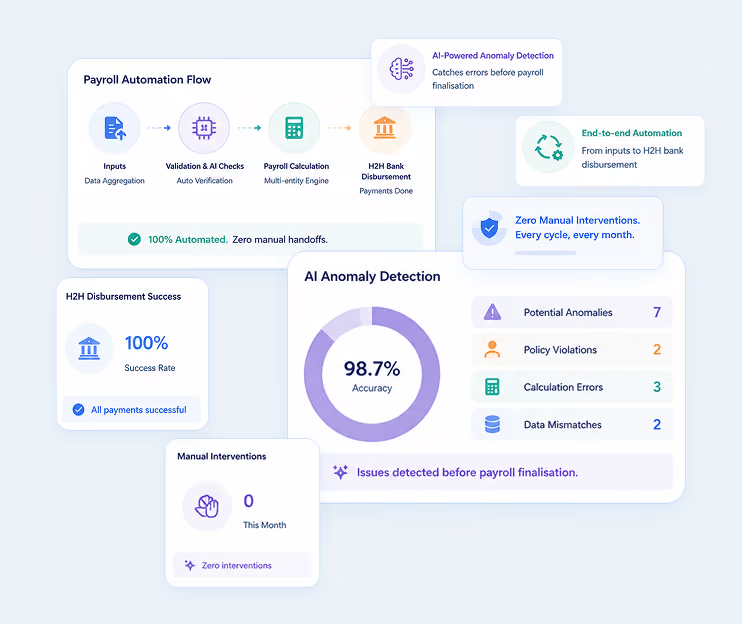
ZingHR's agentic intelligence puts AI agents on the WPS problem directly. They:
- Monitor the 85% on-time threshold live,
- Predict the risk of missing the first-of-month deadline
- Auto-validate SIF files field by field
- Orchestrate exception workflows
3. Board-Level Compliance Dashboards
Payroll data becomes workforce intelligence when your board can see it. ZingHR shows the metrics that matter to governance. Percentage paid on time against the 85% target sits next to cycle time and gratuity accrual against actual payouts.
Its regional customers include Teleperformance and Burjeel, alongside SGS and Shapoorji Pallonji, employers that run exactly this scale of multi-entity workforce.
Turn UAE Payroll Into a Governed Compliance Function
Payroll process steps in UAE use a governed, deadline-driven compliance function, and the stakes keep rising. The nine-step framework gives you a repeatable operating model, from master-data validation through the 14-day exit settlement.
It de-risks compliance before a penalty reaches the board, and protects cash-flow timing through disciplined accruals. Moreover, it gives the board live workforce intelligence instead of a month-end guess. An agentic HCM command centre runs the whole thing end to end, monitoring the threshold and healing the file before a rejection lands.
Book a demo to see how ZingHR's agentic intelligence HCM platform runs UAE payroll end to end.
Frequently asked questions (FAQs)
WPS is the UAE's mandatory electronic salary-disbursement system. Employers pay wages through WPS-registered banks using a Salary Information File. Under the 2026 resolution, wages must clear by the first of each Gregorian month, with at least 85% of total wages paid on time.
The payroll process steps in UAE run across nine checkpoints: validate master data, capture attendance and variable pay, calculate gross salary, apply deductions and accruals, confirm net pay, generate and validate the WPS/SIF file, execute transfers, issue bilingual payslips, and manage exits.
Missing the deadline or falling below the 85% threshold can trigger warnings and fines. It can also suspend new work permits or reach the labour courts. At 1,000+ headcount, a delayed cohort can pull your total below threshold, so the exposure reaches the CFO and CHRO.
Mainland employers use the standard Wage Protection System through WPS-enabled banks. Major free zones like JAFZA and DMCC mirror WPS-style rules with their own formats. DIFC works differently, replacing gratuity with the DEWS savings scheme and monthly contribution files. One calendar then spans three rule sets.
UAE guidance requires payroll records to be kept for a minimum of two years, supporting audits and disputes. The set covers payroll reports and approval trails, plus inputs like Emirates ID. Larger employers go further, aligning to GDPR-style principles like lawful basis and data minimisation.
What to do next?
See ZingHR in Action
Join the 1,200+ enterprises that have replaced fragmented HR with one intelligent, future-ready platform. See ZingHR in 30 minutes.
Build the Organization You Want
Great HR drives retention, capability, and culture. ZingHR takes care of the operational layer so your people team owns the strategy.
Chandrasekar (Chandru) Subramanian
Chief Growth & Operations Officer — EMEA
Chandrasekar (Chandru) Subramanian is the Chief Growth & Operations Officer for EMEA at ZingHR, where he drives growth, strategic partnerships, and market expansion across international markets. With over two decades in international sales and revenue leadership, he has built and scaled operations across diverse geographies. Chandru works closely with organizations to accelerate digital HR transformation through ZingHR's HCM solutions. His focus is on sustainable growth, high-performing teams, and long-term value for customers and stakeholders.

Elevating Impact.
Defining Destiny
See how ZingHR's AI-powered Hire-to-ReHire platform frees your CPO to lead with purpose and deliver the outcomes your Board is watching for


ZingHR is the AI-powered Hire-to-ReHire platform built for one purpose to remove every transactional layer of HR from your organisation, permanently.