HR Metrics in the UAE: Key KPIs for Smarter Workforce Decisions
Discover the HR metrics UAE organizations can use to measure workforce performance, control costs, and make better people decisions.

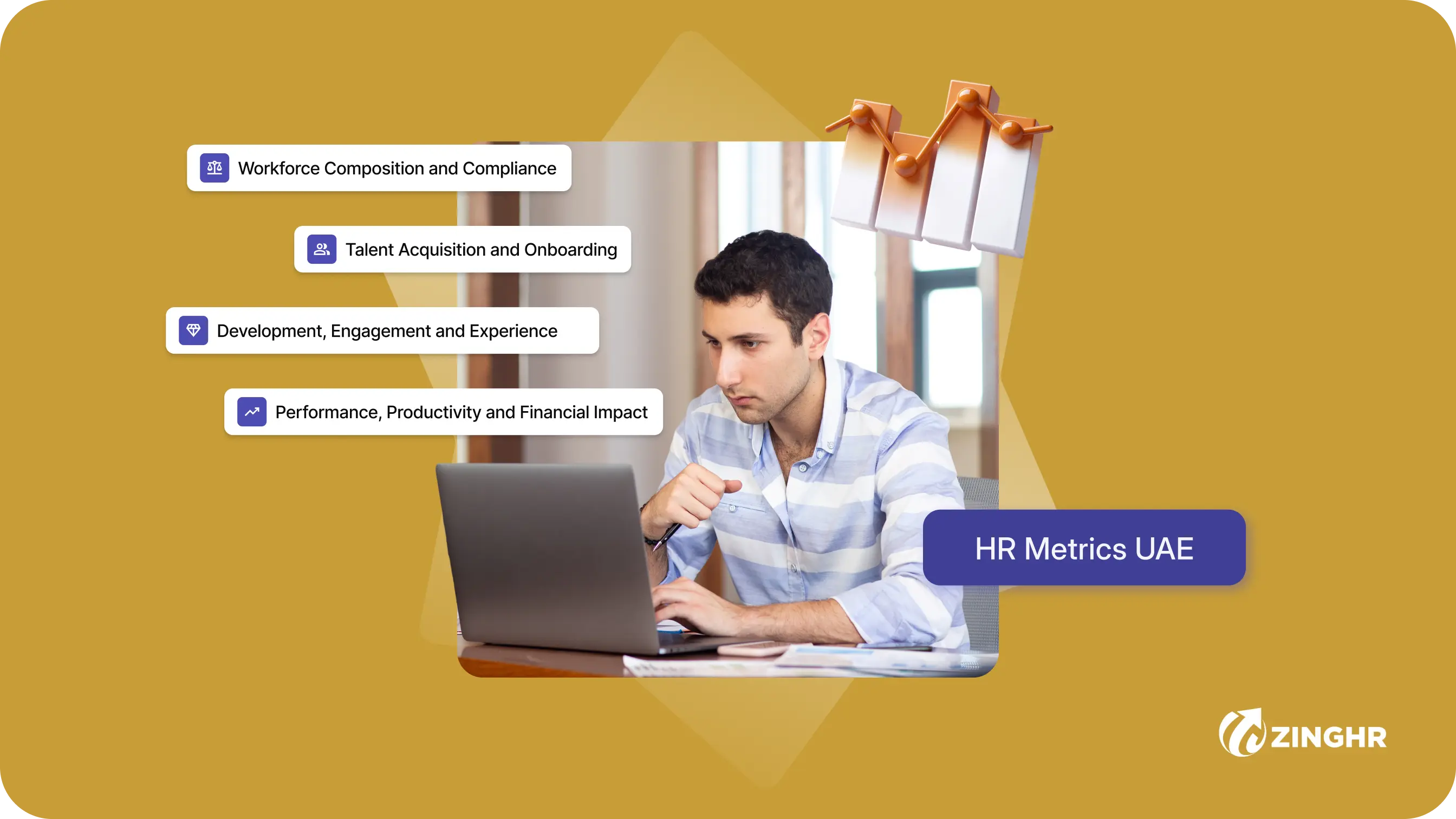
Table of contents
One unstitched HR platform to manage your entire workforce, from Hire to Re-Hire.
Talent Management solutions built for growing and exceptional people
Built-in compliance tools that update with changing regulations
Automated payroll, attendance, and leave management
Insights that help HR leaders make faster, better decisions

Key Takeaways
- Key HR metrics fall into four pillars, from workforce and compliance through talent acquisition, development and engagement, to performance and productivity.
- Compliance metrics deserve the same rigour as financial key performance indicators (KPIs), and they belong in automated, embedded dashboards instead of ad-hoc spreadsheets.
- UAE reporting carries a compliance weight most global templates miss, covering Emiratisation, WPS status and visa validity.
- People analytics here must respect UAE data-privacy law and DIFC/ADGM AI guidance, with lawful basis and consent kept in place.
- ZingHR turns static reporting into a board-level command centre, with forward-looking insight and UAE governance built in.
A CHRO in Dubai can pull a headcount report in seconds. The harder question is whether they can brief the board on one screen, live. Can they show Emiratisation progress by grade next to high-performer attrition, with compliance numbers reconciled and audit-ready? The disconnect between measuring HR activity and governing workforce outcomes is where most large employers get stuck.
The timing makes it urgent. The MEA HCM software market is projected to grow from USD 2.83 billion in 2026 to USD 4.63 billion by 2031.
Meanwhile, employees are already adopting AI faster than many HR reporting systems can keep pace. PwC's Middle East Workforce Hopes and Fears found that 72% of UAE employees used AI at work in 2025, with 24% using it daily. As workforce behaviour becomes more digital and data-driven, HR leaders need metrics that move beyond backward-looking reporting to give them a clearer view of compliance, talent, engagement and workforce performance.
This blog explores the HR metrics UAE enterprises need to track, how to organise them into a board-level framework, which compliance metrics require automation, and how AI can turn fragmented workforce data into governed, forward-looking intelligence.
What are HR Metrics?
HR metrics are quantifiable measures of workforce activity and outcomes, from time-to-hire to revenue per employee. They quantify how efficiently your HR functions run, and they connect HR data to business goals.
1. HR Metrics vs HR KPIs
A metric measures what is happening, while a KPI is the subset you tie to a strategic target. The table below sets them apart.
How an HR metric differs from an HR KPI
Why should your CFO or CEO care about these numbers? The board wants the three or four numbers that show whether the workforce strategy is working. An agentic HCM platform earns its place by filtering the operational metrics from the KPI layer that governs capital and risk. If you get that layering wrong, you either drown executives in detail or bury the signal that should have prompted action.
Why Enterprise HR Metrics Become Hard to Govern at Scale
At 1,000+ employees, fragmented HR systems and manual reporting make it harder to maintain a single, trusted view of the workforce. Data silos and manual compliance reporting recur across BFSI and manufacturing operators in the region, making it harder for the board to see reconciled, reliable numbers in one place.
1. Data Silos Across Systems
Your recruitment data lives in the applicant tracking system. Salaries and WPS files sit in payroll. Training records stay in the LMS, while headcount and grades live in core HR. When these systems stay disconnected, reconciling compliance data against performance data turns into manual stitching, and every stitch invites error.
Ask for high-performer attrition by nationality and grade, and someone spends two days exporting spreadsheets. It signals a governance problem, because you can only govern outcomes you see together in one place.
2. Compliance as Ad-Hoc Reporting
Emiratisation ratios and visa validity too often live in a shared spreadsheet that one person updates before the reporting deadline. The approach carries real audit risk and guarantees delays.
The hidden cost shows up as exposure when a visa lapses unnoticed or an Emiratisation figure gets reported wrong. Compliance metrics belong in embedded, automated dashboards, with alerts and reconciliation running continuously instead of by hand twice a year.
3. Static Reporting Falls Behind
With a quarter of UAE employees using generative AI every day, the workforce moves faster than a backward-looking dashboard can track.
A monthly report tells you what already happened. CXOs need foresight instead. Which high-performers sit at risk, and how will attrition trend next quarter?
Static people analytics dashboards describe the past. Agentic intelligence anticipates the future.
The 4 Pillars of HR Metrics for UAE Enterprises
Your board needs the main types of HR metrics organised around four pillars, from workforce composition to financial impact. The structure adapts the Federal Authority for Government Human Resources (FAHR) HRMI framework for enterprise use. It folds compliance into the same view as performance, so audit-readiness stays part of daily reporting.
1. Workforce Composition and Compliance
Workforce composition and compliance give you the baseline and the legal floor together. Headcount and FTE show the size of the operation, while nationality mix and gender ratio by grade show its shape. Contractor ratio rounds out the picture.
Then come the metrics that carry legal weight. Emiratisation rate, WPS compliance status, and visa validity are not diversity nice-to-haves in the UAE. They decide whether you operate lawfully, and they feed straight into regulatory reporting. For HR professionals managing workforce data in this market, these are as non-negotiable as the numbers themselves.
HR software that tracks these data points in real time gives HR teams the foundation for compliant, confident workforce planning.
2. Talent Acquisition and Onboarding
Recruitment metrics show how fast you fill roles and how well new hires stay. Track time-to-hire against UAE benchmarks, and watch cost per hire and vacancy rate to spot where the hiring process stalls. Offer acceptance rate tells you whether your packages compete in the market.
Quality of hire is what connects the recruitment process to long-term business outcomes. New hire turnover within the first year, which FAHR tracks as a distinct KPI, shows whether recruitment quality holds past the first few months. A new employee who leaves before twelve months represents wasted training cost, onboarding investment, and ramp-up time.
Analysing recruitment metrics at each stage of the funnel gives HR departments the data driven insights they need to improve hiring strategies before a bad quarter forces the conversation.
3. Development, Engagement and Experience
L&D spend per employee, paired with average training hours and competency coverage, turns training and development programs from a budget line into a measurable ROI story. Training effectiveness becomes a question of data rather than opinion, and HR teams can show which HR programs build capability and which are simply training expenses with no return.
Employee engagement splits into two signals worth tracking separately: behavioral indicators like absenteeism and internal mobility, and attitudinal measures like survey scores and employee net promoter score. Employee feedback is a valuable resource here, because the gap between what you promise and what people experience tends to surface later as attrition. Disengaged employees show up in people data before they become a retention problem.
Employee development is also a retention tool. Retention data consistently shows that perceived growth opportunity is a stronger predictor of long-term tenure than compensation alone. HR strategies that treat this pillar as a cost centre end up spending more on recruitment than they save on training.
4. Performance, Productivity and Financial Impact
Revenue per employee connects your human capital directly to the P&L, making workforce planning a legible input into financial decisions rather than a headcount exercise. A 9-box performance distribution shows where talent concentrates across the organisation, giving HR management and senior leadership a shared view of employee performance.
Salary range penetration keeps pay bands honest against actual performance levels, which matters for both fair compensation and HR accountability. When high performers cluster at the bottom of their pay band, the data is flagging an employee retention risk before the resignation lands.
HR Metrics Examples with UAE Benchmarks
Frameworks help, but you build dashboards from formulas. Below are important HR metrics examples, each with its calculation and a UAE benchmark to measure against. Read the benchmark ranges as indicative planning figures, so baseline each against your own data before you set a target.
1. Recruitment Metric Examples
Start with the three recruitment numbers every UAE HR ops team defends monthly.
Recruitment metrics with formulas and indicative UAE ranges
2. Retention and Turnover Metric Examples
Turnover is the headline retention metric, and the aggregate hides more than it reveals.
Retention and turnover metrics with formulas and what each reveals about workforce stability
Segment turnover by nationality and grade, and the compliance picture sharpens too. When Emirati talent leaves faster than the broader workforce, your Emiratisation ratio erodes even while you keep hiring. Early turnover, meaning recruits who leave within the first year, is the signal that recruitment quality slipped.
3. Engagement and Satisfaction Metric Examples
Engagement metrics split into two families, and enterprises get into trouble confusing them. Hard metrics are behavioural and countable, like the absenteeism rate, calculated as absent days divided by scheduled days times 100.
Soft metrics are perceptual, drawn from surveys, like the engagement score and the well-being index. Employee satisfaction is often measured on a 0-10 scale, and a higher score usually tracks with lower turnover.
Both families matter, since the hard numbers show what people do and the soft numbers show why. Watch career-path clarity too, because it is one of the strongest retention levers you can pull locally.
Compliance-Critical HR Metrics Every UAE Enterprise Must Automate
Three human resource metrics carry legal consequences in the UAE, and all three belong to automation instead of a spreadsheet and a deadline. Treat them with the rigour you would give financial control.
1. Emiratisation and MOHRE Reporting
The Emiratisation formula is simple, with UAE nationals divided by total employees, times 100. The operational demand runs heavier.
Guidance from the Ministry of Human Resources and Emiratisation (MOHRE) calls for monthly internal tracking, and the headline ratio alone falls short. You need Emiratisation broken down by grade and by core or critical jobs, because targets increasingly apply at that granular level.
A dashboard that shows the aggregate while hiding where nationals sit leaves you exposed when regulators ask the harder question.
2. WPS Compliance
The Wage Protection System (WPS) sets a monthly, measurable expectation. Under Ministerial Resolution No. 340 of 2026, effective 1 June 2026, wages for the preceding month clear by the first of each Gregorian month. An establishment stays compliant by transferring at least 85% of total wages due on time.
The metric belongs to automation, away from manual cross-checking of a payroll run against a bank file. Automated reconciliation between payroll and WPS payment records, with alerts on any exception, turns WPS from a monthly scramble into a control that runs itself.
3. Visa Validity and Labour Ratios
Visa validity and labour ratios need continuous monitoring, checked monthly instead of once a quarter. An expired visa means an employee works unlawfully, and the exposure hits immediately. Monthly monitoring of expiry dates, with escalating alerts as renewals approach, keeps you ahead. The same principle covers the labour ratios the authority expects.
Across all three, Emiratisation and UAE compliance metrics deserve the same governance you apply to financial KPIs. They are audited, they carry penalties, and the board owns the risk.
Also read: UAE Employment Law: A Complete Guide
Data Privacy and AI Governance in UAE HR Metrics
The moment you point AI at people's data, the rules change. Forward-looking attrition scoring and behavioural metrics carry legal obligations in the UAE that a global template rarely accounts for. Get the governance layer right before you scale the analytics.
1. Federal Decree-Law No. 47 of 2021
Federal Decree-Law No. 45 of 2021 on Personal Data Protection sets the ground rules for people analytics in the private sector. It reads much like GDPR and governs how you process employee data. It requires clear, unambiguous consent given through a positive action, though exemptions exist where processing meets an employment-law obligation or a legitimate interest. You still have to justify the purpose.
2. AI-Aware Metrics under MOHRE, DIFC and ADGM
Run an AI model over attrition or performance data and the governance bar rises again. The MOHRE framework expects transparent consent and lawful processing when AI touches HR decisions.
The Dubai International Financial Centre (DIFC) holds the same line for firms in its jurisdiction. The Abu Dhabi Global Market (ADGM) adds its own AI and data-protection guidance. Explainability matters most. When a model flags an employee as a flight risk, you should show how it reached that output. The explanation goes to the auditor and to the person affected.
Ras Al Khaimah's guidance on AI in the workplace goes further, recommending a formal AI-usage policy and staff training on permitted tools. Audit-readiness is the price of using AI on people data at all.
3. Cross-Border Considerations
If you oversee UAE operations from Mumbai or London, the good news is that the principles travel. India's Digital Personal Data Protection Act echoes the same themes of consent and purpose limitation, and so does GDPR in Europe. US frameworks like EEOC guidance push hard on keeping promotion and performance metrics free of algorithmic bias.
Build one governance standard that satisfies the strictest regime you operate under, then apply UAE-specific consent and residency rules on top. The single standard saves you from reconciling a dozen local policies every time the board asks for a global view.
An 8-Step Roadmap to Build Your UAE HR Metrics Dashboard
Moving from scattered reports to a governed command centre follows a sequence. The eight steps take you from strategy through to a dashboard that survives an audit and informs the board.
Steps 1-4: Strategy to Stakeholder Dashboards
- Clarify strategic goals and compliance obligations, tying every metric to a business priority or a regulatory duty. If a metric maps to neither, question why you track it.
- Define a UAE metrics catalogue, documenting each metric with a clear definition, a named owner and its formula, modelled on the FAHR HRMI structure.
- Standardise data sources and governance, mapping feeds from HCM, payroll, ATS, LMS and surveys, then setting the lawful basis and consent rules for each.
- Design dashboards by stakeholder, giving executives Emiratisation and high-performer attrition, HR ops time-to-hire and visa alerts, and line managers team engagement.
Steps 5-8: Embed AI to Integration
- Embed agentic analytics within the rules, deploying AI for anomaly detection and forward-looking insight. Keep it inside your consent and minimisation controls, with a human in the loop.
- Pilot on high-impact metrics where data quality is strongest, usually recruitment and compliance, tracking time-to-hire and cost-per-hire first.
- Review quarterly against benchmarks, comparing results to your own baseline and running variance analysis to prioritise action.
- Integrate with performance and rewards, feeding engagement drivers and high-performer signals into your performance management system to close the loop between measurement and decision.
How ZingHR Approaches HR Metrics in the UAE
Everything above points to one requirement. You need a single platform where compliance and financial-impact metrics live together, governed and forward-looking. ZingHR's agentic HCM platform is built to close that gap across UAE-operating organisations.
1. Pre-Configured UAE Compliance Metrics
The manual reporting cycle disappears when compliance metrics ship pre-built. ZingHR ships Emiratisation dashboards broken down by grade and critical job, and WPS reconciliation runs automatically between payroll and payment records.
Visa-expiry alerts escalate as renewals approach. It removes the hidden total cost flagged earlier, reclaiming the analyst-days lost to spreadsheets and closing the exposure of a missed lapse.
2. Agentic Intelligence with Governance Built In
Forward-looking attrition and skill-gap insight reach your board through a command centre.
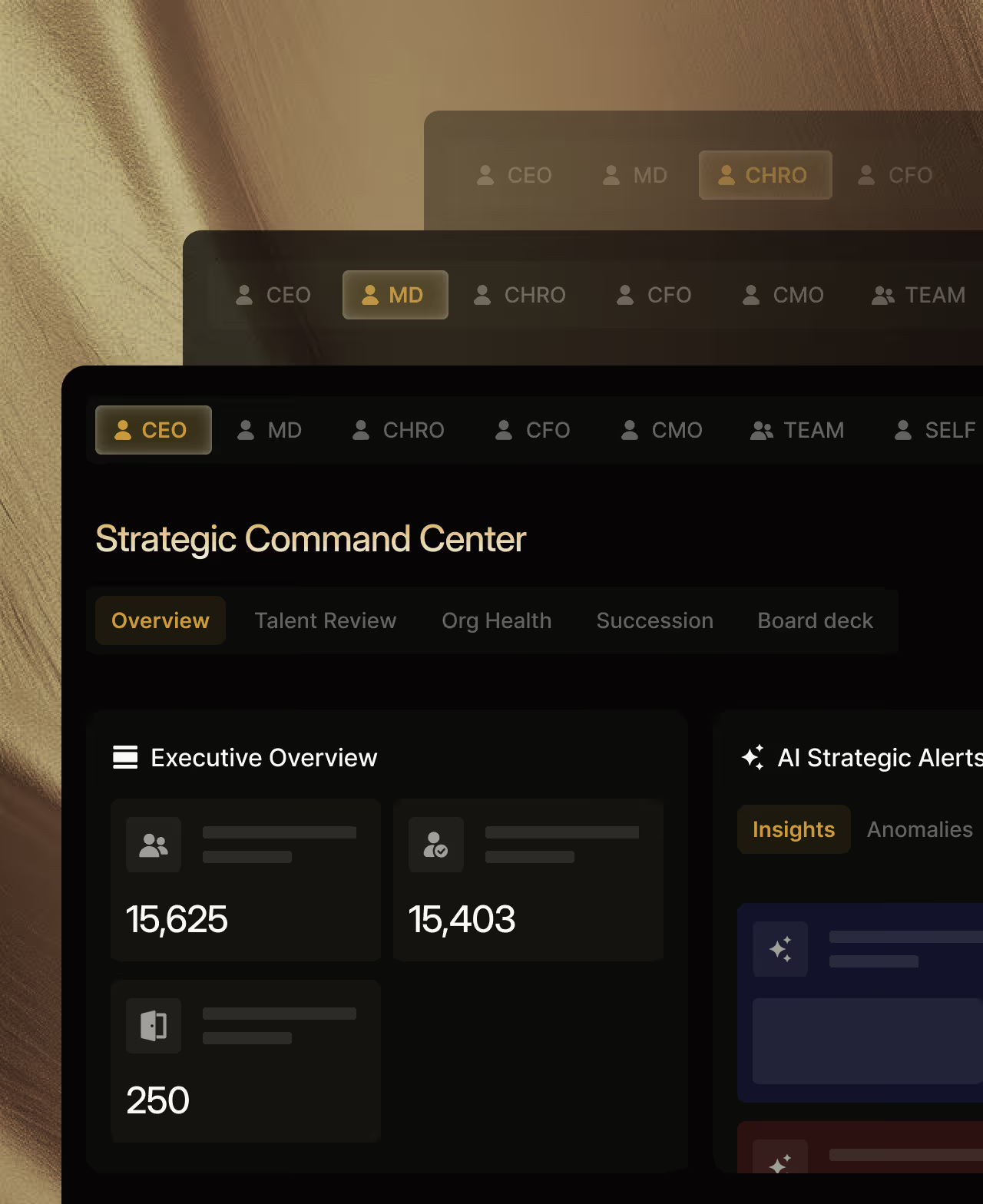
Anchored on Ghrowth.ai, ZingHR's agentic intelligence anticipates which high-performers sit at risk and where capability gaps will open next quarter. It runs with a human in the loop. Data-residency and consent controls align with Federal Decree-Law No. 47 of 2021 and DIFC/ADGM expectations, and the insight is explainable, which keeps it audit-ready.
3. Unified Data Across HCM, Payroll, ATS and L&D
One source of truth replaces the silos. ZingHR brings core HR and payroll together with recruitment and learning on one platform. You then pull high-performer attrition by nationality and grade in seconds instead of days.
CHRO, CFO and CIO look at the same governed data, each through the lens their role demands. Regional customers like Teleperformance and Burjeel, alongside SGS and Shapoorji Pallonji, run exactly this scale of multi-entity, multi-nationality workforce on the platform.
What Each CXO Should Track
The same command centre answers different questions depending on who is asking. Here is how the C-suite reads one governed dataset three ways.
1. CHRO View
The CHRO owns workforce outcomes. Priority metrics are high-performer attrition and Emiratisation progress by grade, with engagement scores and their drivers alongside. Emiratisation progress is execution work, well beyond reporting.
Seeing where Emirati talent concentrates, and where it leaves fastest, tells the CHRO where to intervene before the national target slips.
2. CFO View
The CFO reads the workforce through the P&L. Cost-per-hire against your indicative benchmark shows recruitment efficiency, and revenue per FTE links headcount to output.
L&D spend per employee, set against competency coverage, turns a training budget into a return calculation your finance team can defend.
3. CIO View
The CIO carries the governance and integration risk. The metrics that matter are data-residency and consent coverage. Integration health across the core HR and payroll stack ranks next. AI-model auditability completes the set.
When people analytics runs on explainable models inside UAE data-protection rules, the CIO can sign off and stay clear of compliance liability.
Turn HR Metrics Into Governed Workforce Intelligence
HR metrics in the UAE span four pillars, from workforce composition to financial impact. What makes local execution demanding is the compliance weight and the AI-governance obligations layered on top.
Emiratisation, WPS and visa validity each carry legal consequences, and data-privacy law shapes every forward-looking model you might run.
For boards and CXOs, the shift is clear. Stop measuring HR activity and start governing workforce outcomes with live, auditable intelligence. In practice, that moves compliance metrics off spreadsheets. It replaces backward-looking dashboards with foresight and puts the whole picture on one screen.
A modern agentic HCM platform like ZingHR turns fragmented reporting into strategic execution, and it lets your CHRO brief the board with numbers she trusts. Book a demo to see how it helps you stay on top of HR metrics.
Frequently asked questions (FAQs)
Compliance metrics like WPS and visa validity need monthly review, with continuous monitoring through dashboards. Strategic KPIs are best reviewed quarterly with the board, benchmarked against your own baseline and market practice.
Emiratisation rate, WPS compliance and visa validity are the compliance-critical metrics reported to the authority. They deserve the same rigour as financial KPIs, since they carry audit exposure and penalties, and the board owns the risk.
Time-to-hire leads the list, measured from application to offer acceptance. Cost-per-hire and quality of hire follow, with new-hire turnover in the first year showing whether recruitment quality holds. Treat any benchmark range as indicative and baseline against your own data.
AI and HR technology brings forward-looking analytics like attrition risk and skill-gap forecasting, moving past backward-looking reports. It must operate within consent and explainability rules set by Federal Decree-Law No. 47 of 2021 and DIFC/ADGM frameworks, with a human in the loop.
What to do next?
See ZingHR in Action
Join the 1,200+ enterprises that have replaced fragmented HR with one intelligent, future-ready platform. See ZingHR in 30 minutes.
Build the Organization You Want
Great HR drives retention, capability, and culture. ZingHR takes care of the operational layer so your people team owns the strategy.
Dr. Anupama Iyer
Director — HR
Dr. Anupama Iyer is Director — HR at ZingHR and an accomplished HR leader, consultant, facilitator, and academic with over two decades of experience in people practices and talent development. Her work spans HR consulting, training design, leadership development, and academia. Bringing both a practitioner's and an educator's perspective, she is passionate about building people-centric workplaces and helping organizations create cultures that enable growth, employee development, and long-term success.

Elevating Impact.
Defining Destiny
See how ZingHR's AI-powered Hire-to-ReHire platform frees your CPO to lead with purpose and deliver the outcomes your Board is watching for


ZingHR is the AI-powered Hire-to-ReHire platform built for one purpose to remove every transactional layer of HR from your organisation, permanently.