HR Trends in the UAE: The Shifts Shaping People Strategy
AI agents, Emiratisation, skills shortages and manager overload are reshaping HR in the UAE. Here is what is changing, what it means for IT employers and where to start.


Table of contents
One unstitched HR platform to manage your entire workforce, from Hire to Re-Hire.
Talent Management solutions built for growing and exceptional people
Built-in compliance tools that update with changing regulations
Automated payroll, attendance, and leave management
Insights that help HR leaders make faster, better decisions

Key Takeaways
- HR trends in the UAE combine global shifts, such as AI agents and skills-based planning, with local Emiratisation and Wage Protection System (WPS) rules.
- AI is part of everyday work for UAE employees, so the HR function needs clear rules on which decisions AI systems take and who owns the outcome.
- Emiratisation targets for skilled roles reach their full level at the end of 2026, moving the focus from hiring Emiratis to developing and keeping them.
- HR trends in the IT industry centre on AI skill premiums, skills-based hiring and retaining specialist engineers across distributed teams.
- Manager workload and employee wellbeing have become board-level risks, even in a workforce that reports high engagement.
- ZingHR helps UAE employers act on these trends with Ghrowth.ai for agentic intelligence, live workforce dashboards and WPS-ready payroll on one platform.
The UAE now leads the world on everyday AI use. Microsoft's Global AI Diffusion report put generative AI use at 73.3% of the UAE's working-age population in the second quarter of 2026, against 18.8% worldwide. Employees have moved faster than most HR policies, and the mismatch shows up in job descriptions, performance reviews and AI governance.
Usage figures say little about results. In Glean's Work AI Index 2026, 87% of digital workers in the US, UK and Australia used AI at work, yet only 13% said it had significantly improved their organisation's performance. AI adoption and business outcomes have come apart, and Gartner's priorities for 2027 show where the problem starts. In a July 2026 survey of 297 chief human resources officers (CHROs), only 24% said their leadership teams agreed on who is accountable for AI agents.
UAE employers face those global shifts on top of local ones. Emiratisation targets keep rising, WPS checks every salary run and most of the private-sector workforce is expatriate. HR professionals setting next year's HR strategy have to decide where AI does the work, where human judgement stays in charge and how compliance data keeps pace.
What Are HR Trends?
HR trends are shifts in technology, regulation, workforce expectations and business strategy that change how organisations hire, pay, develop and keep people. Some arrive through law, such as a new Emiratisation threshold. Others arrive through behaviour, such as employees adopting AI tools before policy catches up. For human resources teams, a trend matters when it changes next year's budget, headcount plan or compliance calendar.
Three features of the UAE market shape how global HR trends play out here:
- Expatriate workforce: The private-sector workforce is largely expatriate and on employer-sponsored visas, so hiring and exits carry immigration steps.
- Regulated salary payments: Salaries must be paid through approved WPS channels, so payroll errors become visible to regulators.
- National hiring goals: Emiratisation targets tie strategic workforce planning to the share of UAE nationals in skilled roles.
Each feature makes the UAE version of a global HR trend distinct from its US or European equivalent.
Top HR Trends in the UAE
Eight HR trends stand out for UAE employers heading into 2027. Each one pairs a global shift with a local requirement, so playbooks imported from London or New York rarely work unchanged.
1. AI Agents in HR Workflows
AI in HR has moved from chatbots answering policy questions to agents that screen candidates, draft offer letters and flag payroll anomalies. Gartner notes that these agents also push ambiguous cases and exceptions back to people, so someone has to own those decisions.
Use is already widespread in the UAE. PwC's Middle East Workforce Hopes and Fears Survey 2025 found 83% of UAE employees reported higher productivity from AI, and 24% use it daily. For many organisations in Dubai and Abu Dhabi, agentic HR is not theoretical anymore. AI initiatives still tend to be approved by IT or finance, while the people decisions they touch land on the HR function later, so HR needs a seat in those approvals.
Agents now handle repetitive tasks such as interview scheduling, payslip queries and document checks. Human skills such as negotiation, coaching and judgement on edge cases stay with people, and that human edge belongs in HR job descriptions. HR also has to set four rules:
- AI systems can act alone on low-risk tasks, such as routing leave requests or flagging duplicate payments.
- Rejections, terminations and pay changes need human sign-off before they take effect.
- Any employee monitoring through AI tools, such as productivity tracking, is disclosed to staff and limited to a stated purpose.
- Employees get a named route to challenge an AI-assisted outcome.
Trust decides how fast a company can scale AI. Employees who know where the limits sit use the tools more openly in their everyday work.
2. Fewer, Differentiated Skills
The same Gartner research found 67% of CHROs face higher productivity expectations, while companies remove middle management layers and hire fewer entry-level staff. Gartner's advice is to identify the few skills that set the business apart and concentrate investment there.
Demand is shifting quickly. The McKinsey Global Institute found demand for AI fluency in US job postings grew nearly sevenfold in two years, faster than any other skill. In UAE finance, operations and HR roles, the skills required now include data literacy and the ability to check AI output, alongside critical thinking and stakeholder management.
UAE employees feel the pressure too. In PwC's UAE findings, 25% expect more than half of their current skills to lose relevance, above the 19% Middle East figure. Skills development budgets work harder when each programme maps to one of the organisation's business goals.
3. Emiratisation Beyond Headcount
Private companies with 50+ employees must fill 10% of skilled roles with UAE nationals by the end of 2026. The target has risen by 2 percentage points each year. Companies with 20 to 49 employees in 14 designated sectors carry separate hiring obligations.
For 2027, the question moves from reaching the number to keeping Emirati talent, since every exit pulls the company back below the target. Career paths, leadership development and pay benchmarked for the national talent pool carry more weight than recruitment campaigns. Onboarding, mentoring and promotion decisions shape whether Emirati hires stay, so the talent strategy has to run well past the first year.
4. Manager Load and Employee Wellbeing
High employee engagement in the UAE hides a workload problem. PwC found nearly half of UAE employees feel overwhelmed at work at least once a week, against 35% globally. A separate Gartner survey found 47% of managers say they are working harder than a year ago.
Burnout now sits on board agendas as a business risk. Gallup's State of the Global Workplace 2025 put the cost of falling engagement at US$438 billion in lost productivity in 2024, with manager engagement down from 30% to 27% over the same year. ISO 45003, the first international standard on psychological health and safety at work, gives boards a framework for managing psychosocial risks alongside physical ones.
Employee wellbeing support in the UAE now covers four areas:
- Mental health support includes confidential counselling and a clear referral route for managers.
- Financial wellbeing tools cover salary advances and up-to-date end-of-service gratuity statements.
- Caregiving support helps employees with children or elderly parents, in the UAE or in their home country.
- Giving employees flexible hours or hybrid work, where the role allows, is recorded in the employment contract.
Managers sit at the centre of the fix. In the PwC data, 59% of UAE employees say their manager cares about their wellbeing. Companies that train managers to spot overload early, and cut admin from managers' weeks, protect the relationship employees rely on most.
5. Leaders Who Redesign Work
Gartner's CEO research found 63% of senior executives see radically redesigning their operating model as a top move to get financial returns from AI. Few have started. McKinsey's State of AI survey found only 21% of organisations using generative AI had fundamentally redesigned at least some workflows.
The scale of the opportunity is large. The McKinsey Global Institute estimates that technology available today could, in theory, automate activities taking up about 57% of US work hours. It
frames the future of work as a partnership between people, agents and robots, with human capability directed at framing problems, guiding agents and checking results.
Workforce redesign is a leadership development task as much as a technology one. HR's role is to help business leaders stop low-value work on purpose. Common targets include:
- Extra approval layers on routine requests slow decisions without reducing risk.
- Duplicate reports built for different audiences consume analyst hours every month.
- Manual reconciliations can move to systems that already hold the data.
Change management has become a critical capability for HR in any workforce transformation. Every redesigned workflow needs updated job descriptions, new approval rights and managers retrained on how the work now runs.
6. Pay Fairness and Transparency
The UAE has no pay disclosure law, but expectations are moving anyway. Employees compare offers through job platforms and networks. European parent companies also bring the EU Pay Transparency Directive, which began taking effect across member states in June 2026, into their UAE entities. The directive sets four obligations:
- Job adverts or pre-interview contact must state the starting salary or pay range.
- Candidates can no longer be asked about their pay history.
- Organisations with 100+ employees publish data on pay differences between women and men.
- An unexplained pay difference of 5% or more triggers a pay assessment.
Readiness is still low. Mercer's 2026 Global Pay Transparency Survey, run in September and October 2025 across 60 markets, found employer preparedness rose to nearly 50% in 2025, from 32% in 2024. Mercer also ties pay transparency to employer reputation, and groups that resist it look less trustworthy to candidates and top talent.
Pay conversations test organisational culture, because employees judge fairness by how HR answers the question. HR teams that run regular pay equity reviews by grade, gender and nationality can explain ranges when asked. Contract terms, allowances and end-of-service rules under employment law in the UAE set the boundaries for any change.
7. Compliance Automation
Compliance in the UAE is digital by default. Three rule sets apply to every mainland employer:
- WPS validates salary files against contracts before payment.
- Emiratisation status is tracked against official records.
- Federal Decree-Law No. 33 of 2021 sets the rules on contracts, leave and end-of-service gratuity.
Manual workarounds create errors that surface during audits or exits. Employers are moving these checks into HR compliance software so each payroll run, contract change and termination is validated before it happens. Automated checks also add business resilience when rules change mid-year, since one updated validation applies to every entity at once.
8. Continuous Learning
Learning is becoming part of the job. In PwC's UAE findings, 69% of employees learned new skills in the past year, compared with 56% globally.
Employers now tie learning to role changes and internal moves, so a skill gained this quarter can open an assignment next quarter. Filling roles internally helps reduce hiring costs and shortens the time a new hire needs to reach full output. Younger employees expect learning to show up in their next role.
The table below summarises each trend and a practical first move for HR:
HR trends in the UAE and the first move HR can make on each
HR Trends in the IT Industry in the UAE
HR trends in the IT industry move faster than in most sectors because the work itself is changing. PwC's 2026 AI Jobs Barometer for the UAE found AI-related job postings rose from 1.0% of all postings in 2021 to 3.2% in 2025. In technology, media and telecoms, nearly 10% of postings now ask for AI skills.
Spending will keep demand high. Gartner forecasts worldwide IT spending to grow 15% in 2027, to USD 7.35 trillion. Employers in Dubai and Abu Dhabi will compete harder for the same engineers.
1. AI Skill Premiums
IT employers are adding separate pay bands for AI, machine learning and data engineering roles. HR has to set rules on three points:
- Eligibility for a premium is defined by role, with written criteria.
- Premiums are reviewed against market data at a fixed interval.
- Moving a premium into basic salary raises end-of-service gratuity, so finance signs off before it happens.
2. Skills-Based Hiring
Degrees and job titles say less about an engineer's ability than tested skills. The PwC barometer found the most AI-exposed roles now require an average of 77 new skills, against 22 for the least exposed. IT employers are moving talent acquisition to skills assessments, portfolio reviews and structured technical interviews, which widens the candidate pool in a market shaped by talent scarcity.
3. Specialist Retention
Cloud, cybersecurity and AI specialists receive frequent offers from regional and global employers, and rising turnover in these roles is expensive to replace. Retention depends on project quality, learning budgets and technical career ladders that let engineers progress without moving into people management.
4. Distributed Delivery Teams
UAE IT firms often deliver work through teams in India, Eastern Europe and Africa. Those teams work alongside staff in Dubai Internet City or Abu Dhabi's Hub71. HR has to run contracts, international payroll and reviews across these locations while keeping one view of the team.
5. Access and Offboarding Controls
IT employees hold access to code, client systems and data. Employee onboarding has to grant the right access on day one, and offboarding has to revoke it on the last working day. HR and IT now share these workflows.
How UAE HR Teams Can Prepare for These HR Trends
Trend lists only help when they change next year's plan. HR earns its place as a strategic partner by tying each trend to organisational priorities the board already tracks. Five steps turn these shifts into work HR can schedule and measure.
Step 1: Clean Workforce Data
AI tools and workforce analytics depend on accurate records. Reconcile headcount, grades, contracts and pay across every entity before adding new tools, or the new tools will automate old errors. Clean data improves organisational decisions well beyond HR, since finance, operations and every other business function draw on the same headcount and cost figures.
Step 2: AI Rules for HR
Keep an HR AI register listing each tool, its owner, the data it uses and the date of its last review. Add every tool to the register before it reaches the broader organisation. Share the register with employees, because knowing where AI touches their records is now part of the employee experience.
The register also tests HR capabilities. Someone on the team has to read model outputs, question them and explain AI-assisted decision making to individual employees when they ask.
Step 3: Capabilities Mapped to Skills
Start with the three to five capabilities that set the business apart and move the business forward, then list the skills each one needs. Connect those skills to the performance management process so reviews measure what drives long term performance rather than activity.
Step 4: Emirati Retention Plans
Run Emirati retention as a tracked plan with three parts:
- Quarterly reports show Emirati hires by tenure, promotion and exit reason.
- Each new hire has a named mentor who explains how decisions are made and what the organisation's values mean in practice.
- A development plan is agreed within the first 90 days.
Step 5: Manager Workload Review
Track three numbers for each of your people leaders:
- Span of control covers direct and indirect reports.
- Approvals handled each month show where decisions pile up.
- Hours spent on admin each week show how much time is left for the team.
Move routine approvals and reporting into the HR technology the company already runs. Lighter admin loads do more for organisational effectiveness than another layer of reporting, because managers spend the recovered hours with their teams.
How ZingHR Helps UAE Employers Act on HR Trends
ZingHR is an agentic intelligence HCM platform built for boards, CHROs and CXOs at multi-entity organisations. Teleperformance runs contact centre teams on it, Burjeel manages hospital staff, SGS covers inspection labs and Shapoorji Pallonji handles engineering sites, all from the same HR and payroll records.
1. Agentic Intelligence With Ghrowth.ai
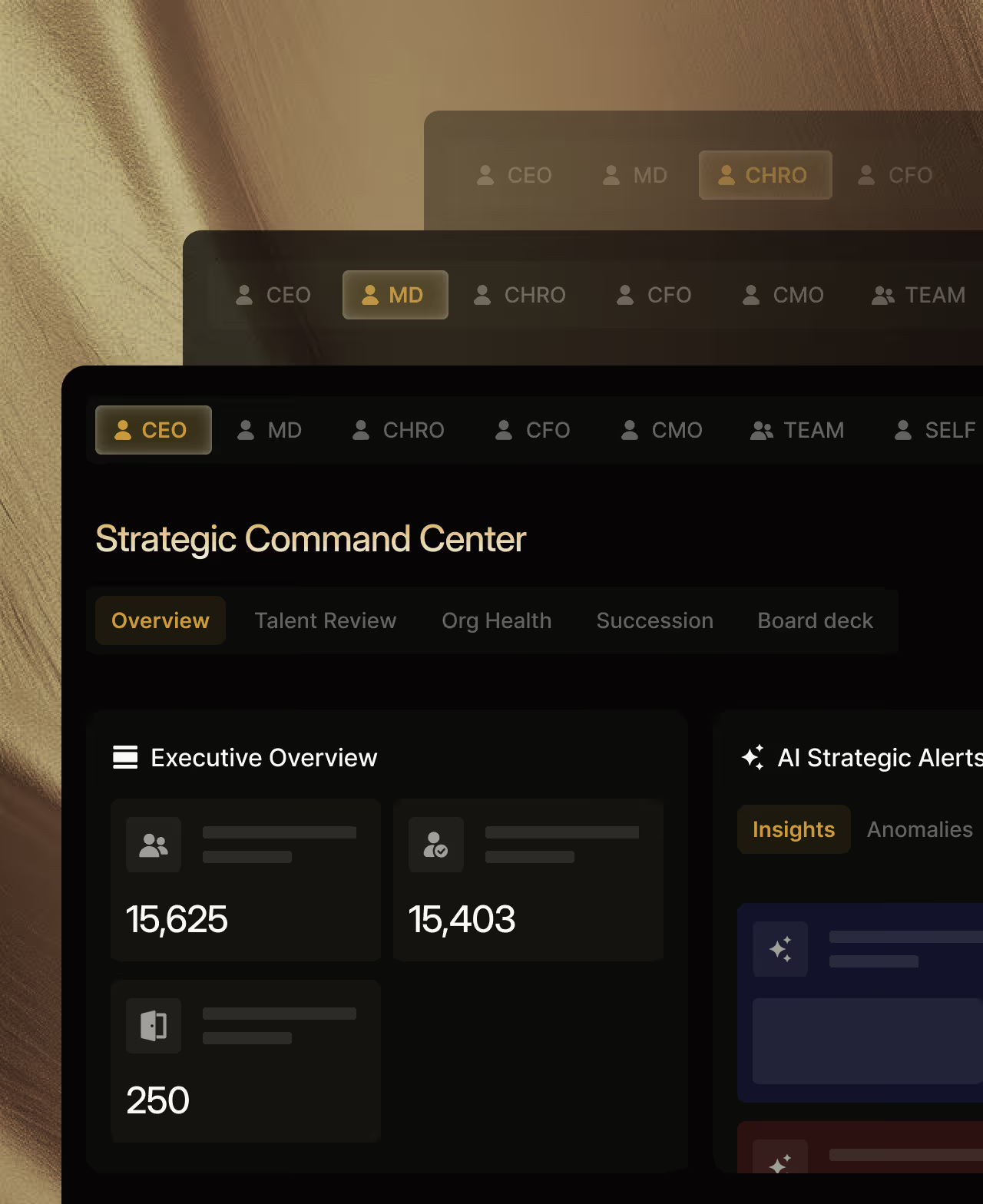
Ghrowth.ai lets CXOs ask questions of live HR data, such as attrition risk by team or Emiratisation progress by entity. It then tracks the actions that follow. The Zing Intelligence Hub adds 19 live Power BI dashboards with row-level security, so each persona sees only the data they need.
2. Performance and Pay in ZingGrow
ZingGrow connects goals, reviews and calibration to the Compensation Workbench, so performance and pay decisions run in one cycle. Pay equity reports by grade and gender are available for board review without a separate data pull.
3. WPS-Ready Payroll With ZingZeroTAP
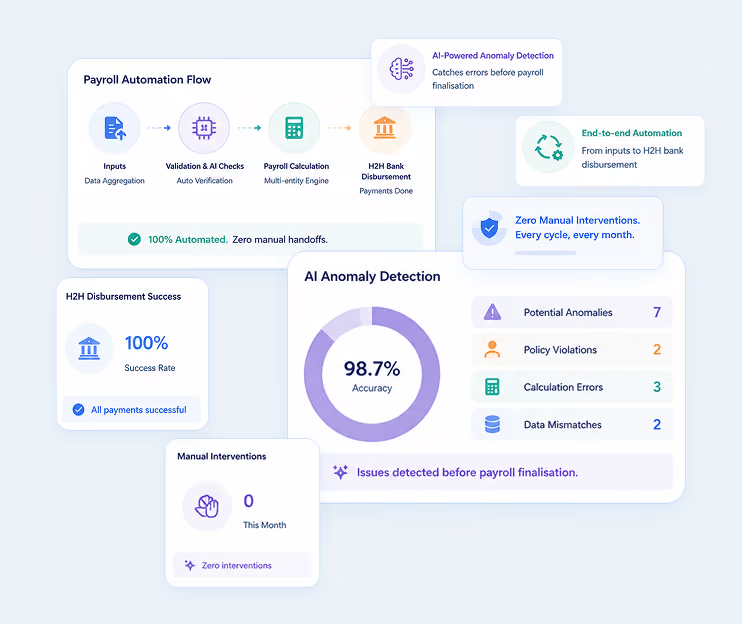
ZingZeroTAP runs zero-touch payroll across entities, with AI anomaly detection before each run. Salary files follow WPS requirements, and Emirati headcount and pay data feed compliance reporting from the same records.
Turning HR Trends Into Next Year's People Plan
All eight trends come down to ownership. An AI agent, an Emiratisation shortfall and an overloaded manager each need a named person and current data before anyone can act.
Start with the one or two trends closest to your strategic priorities, whether that is AI governance, Emirati retention or engineer attrition. Build the data and ownership for those first, then extend the same approach to the rest.
Annual plans built on last quarter's exports miss what has changed since. ZingHR's HCM platform keeps workforce, payroll and compliance data current across every UAE entity. Plan next year's HR priorities on live data. Book a demo today.
Further Reading
Two related guides cover the operational side of these trends for UAE employers:
- Shift rosters, overtime and site-level time tracking are compared in our review of the best attendance management systems in the UAE.
- Scheduling, leave and labour planning across multiple entities are covered in the best workforce management software in the UAE.
Frequently asked questions (FAQs)
No. The Dubai International Financial Centre (DIFC) and Abu Dhabi Global Market (ADGM) have their own employment laws. Other free zones generally follow federal labour law with their own registration rules. Emiratisation targets apply to mainland companies registered with federal labour authorities.
Review trends once a year during workforce planning and check progress each quarter. Regulatory changes, such as new Emiratisation milestones or WPS updates, need review as soon as they are announced.
Useful measures include time to fill critical roles, attrition by skill group and Emirati retention after 12 months. Approvals per manager and quarterly completion of role-linked learning add useful context.
Yes. Federal Decree-Law No. 33 of 2021 recognises part-time, temporary, flexible and remote work models, provided the contract records the arrangement. Employers still need to meet rules on hours, leave and WPS salary payments.
Yes. ZingHR holds Emirati headcount, roles, pay and tenure in one database, and Zing Intelligence Hub dashboards show progress by entity. Ghrowth.ai can answer questions on shortfalls against the target and track the actions HR takes to fix them.
Yes. ZingHR runs multi-entity HR and payroll on one platform, with 100+ integrations covering ERP, finance and identity systems. IT employers can manage contracts, access-linked onboarding and reviews for distributed teams in one place.
What to do next?
See ZingHR in Action
Join the 1,200+ enterprises that have replaced fragmented HR with one intelligent, future-ready platform. See ZingHR in 30 minutes.
Build the Organization You Want
Great HR drives retention, capability, and culture. ZingHR takes care of the operational layer so your people team owns the strategy.
Chandrasekar (Chandru) Subramanian
Chief Growth & Operations Officer — EMEA
Chandrasekar (Chandru) Subramanian is the Chief Growth & Operations Officer for EMEA at ZingHR, where he drives growth, strategic partnerships, and market expansion across international markets. With over two decades in international sales and revenue leadership, he has built and scaled operations across diverse geographies. Chandru works closely with organizations to accelerate digital HR transformation through ZingHR's HCM solutions. His focus is on sustainable growth, high-performing teams, and long-term value for customers and stakeholders.

Elevating Impact.
Defining Destiny
See how ZingHR's AI-powered Hire-to-ReHire platform frees your CPO to lead with purpose and deliver the outcomes your Board is watching for


ZingHR is the AI-powered Hire-to-ReHire platform built for one purpose to remove every transactional layer of HR from your organisation, permanently.