HR Metrics: Meaning, Examples & KPIs for Philippine HR Teams
HR metrics help Philippine HR teams turn workforce data into actionable decisions. Explore key HR metrics, examples, formulas and practical ways to track recruitment, retention, engagement, performance and workforce efficiency.

Table of contents
One unstitched HR platform to manage your entire workforce, from Hire to Re-Hire.
Talent Management solutions built for growing and exceptional people
Built-in compliance tools that update with changing regulations
Automated payroll, attendance, and leave management
Insights that help HR leaders make faster, better decisions

Key Takeaways
- HR metrics are quantitative measures HR teams use to track the efficiency and effectiveness of HR practices. They cover recruitment, retention, engagement, performance, learning and workforce productivity.
- The objectives are to turn people data into decisions, connect HR work to business outcomes and give leaders a common language for workforce discussions.
- A working set of HR metrics usually spans time to hire, cost per hire, quality of hire, turnover rate, retention of high performers, employee engagement score, revenue per employee, absenteeism rate and HR to employee ratio.
- ZingHR, the fastest growing HCM and payroll platform in the Philippines, runs HR metrics live across every entity through a native, Department of Labor and Employment (DOLE)-compliant stack backed by a local Centre of Excellence (CoE).
Are your employees engaged at work, or are they struggling with stress that could affect their performance and well-being? Are your HR decisions backed by workforce data, or are you relying on assumptions to understand what employees need?
According to Gallup’s State of the Global Workplace: 2026 report, 39% of employees in the Philippines are engaged at work, compared with 25% across Southeast Asia. However, 50% of employees in the Philippines experienced significant stress during the previous day, twice the regional average of 25%.
These figures highlight why employee engagement alone cannot tell the full story of workforce health. HR metrics help Philippine HR teams understand employee experiences, track recruitment and retention, monitor workforce costs, and assess whether HR initiatives are delivering results. They also give leadership the information needed to connect people-related decisions with business performance.
This guide explains what HR metrics mean, why they matter, which metrics to track across different HR functions, and how to use them to make informed workforce decisions. It also includes a practical checklist of HR metrics that Philippine businesses can use to measure performance and improve HR outcomes.
What are HR Metrics?
HR metrics are quantitative measures used to track the efficiency and effectiveness of HR practices inside an organisation. They cover the full arc of the employee lifecycle, from recruitment and onboarding to engagement, performance, learning and offboarding.
Time to hire shows how these measures work in practice. It measures the days between a candidate applying and accepting an offer. A lengthy hiring process can cost a company top candidates who accept offers from faster-moving rivals in markets such as Manila or Cebu. Tracking time to hire helps recruitment teams identify delays and measure whether their efforts to speed up hiring are working.
Human resource metrics are of two kinds. One is direct metrics, that measure HR activity, such as cost per hire, HR to employee ratio, and training hours per employee. These tell the HR leaders how the function is running.
The second is indirect metrics that help measure the impact of HR activity on the business. They portray how HR practices influence workforce and business performance. These include revenue per employee, absenteeism rate, employee engagement score, and more.
Objectives of HR Metrics: Why Tracking them Matters
Tracking HR metrics does three things for an organisation:
- Turn scattered records into decisions: Joining dates and exit dates sit in separate HRIS and payroll records. Combined by department, they give an early turnover rate for each team. If one team loses far more new hires within 90 days than the company average, HR knows where to review onboarding or the job description before hiring again.
- Put a business cost on workforce problems: Attrition sounds like an HR problem until someone prices it. Multiplying voluntary exits by cost per hire gives the replacement cost of turnover in pesos, a figure finance can weigh against the cost of a retention programme. Retention of high performers sharpens the picture further. A top performer’s exit costs more than a replacement salary, because output drops while the role sits empty and the new hire ramps up.
- Give leaders a common language: “Morale is low in operations” is an opinion. “Operations’ absenteeism rose for three straight quarters and voluntary turnover doubled” is a case finance and business heads can act on. Shared formulas also mean every team calculates turnover the same way, so meetings can move straight to the response.
The importance of HR metrics is clearest in the decisions they make possible. Turnover rate, split by tenure and exit reason, shows where resignations cluster. A spike among second-year employees points to career growth or pay progression, so a retention programme can target that group directly.
Aon's 2025 Salary Increase and Turnover Study projects a 20% attrition rate for the Philippines in 2026, the highest in Southeast Asia. Both realities are only visible because someone tracks the metric.
HR Metrics Examples: A List of Key Metrics by Category
HR metrics examples cluster into six categories, each solving a different piece of the workforce picture. A working HR intelligence platform surfaces most of them automatically.
1. Recruitment Metrics
Recruitment metrics measure how well the hiring process turns open roles into productive employees.
- Time to hire: Days between a candidate applying and accepting an offer. Short time to hire indicates a smooth hiring process; a long one loses candidates.
- Cost per hire: Total recruitment spend divided by hires made, covering job boards, agency fees, recruiter salaries and background verification.
- Quality of hire: The value a new employee brings, typically evaluated based on 90-day performance, manager feedback and 12-month retention.
2. Retention Metrics
Retention metrics track how well an organisation keeps its people, especially the ones it cannot afford to lose. Philippine HR teams watch these closely given the region's high attrition.
- Turnover rate: Terminations divided by average headcount over the period, expressed as a percentage. Voluntary turnover indicates potential problems inside the company; involuntary turnover reflects hiring quality upstream.
- Retention rate of high performers: The percentage of top-rated employees still with the organisation year over year. Every point of decline signals a growing risk to future results.
- Early turnover: Employees leaving within their first year. A high early turnover figure points to onboarding gaps or misaligned role expectations.
3. Engagement Metrics
Engagement metrics gauge how connected employees feel to their work and to the organisation.
- Employee engagement score: Composite score from pulse surveys measuring commitment, motivation and satisfaction. Engaged employees are more productive and less likely to quit.
- Employee Net Promoter Score (eNPS): Willingness of employees to recommend the organisation as a place to work, on a 0-to-10 scale. It maps sentiment cleanly across teams.
- Employee satisfaction: Survey-based measure covering work-life balance, management effectiveness and career growth, often paired with the engagement score for context.
4. Performance Metrics
Performance metrics link workforce output to business results.
- Revenue per employee: Total revenue divided by average headcount. It shows the efficiency of the organisation as a whole and works well for cross-year benchmarking.
- Goal attainment: Percentage of employee goals or OKRs closed on time. A view of execution discipline across the workforce.
- Rating distribution: The spread of performance ratings across the population, watched for grade inflation and calibration drift.
Also read: 7 Best Employee Management Systems in the Philippines
5. Learning and Development Metrics
Learning metrics measure whether investment in employee development is turning into capability.
- Training ROI: Financial and performance value of employee development programmes, benchmarked against training expenses and business outcomes.
- Training hours per employee: Average number of training hours completed per employee per year, tracked by role and business unit.
- Internal mobility rate: Percentage of roles filled through internal promotion or transfer, a strong signal for career growth culture.
6. HR Operational Metrics
Operational metrics tell HR leaders how the function itself is running.
- HR to employee ratio: Number of HR professionals per 100 employees. It shows how thinly HR is stretched across the workforce.
- Absenteeism rate: Unplanned employee absences in a given period as a percentage of total working days. Rising absenteeism often precedes a spike in voluntary turnover.
- Average headcount: Rolling average of employees on the payroll across the period. Feeds nearly every other HR metric as the denominator.
HR Metrics Formulas: Quick Reference
Use this quick reference to find the key HR metrics formulas you need to measure workforce performance, track trends, and make informed decisions.
HR metrics to track
Each of these HR KPIs pairs with a formula and a benchmark. Where the benchmark comes from matters: an industry average, a prior-year figure or a stretch goal each carries a different signal.
How to Choose the Right HR Metrics
HR teams can track hundreds of workforce indicators, but only a focused set will help answer the questions that matter. The selection should reflect your organisation’s priorities, workforce structure and business goals.
1. Start With the Business Question
Every HR metric should map to a business question the leadership team is already asking. If the CEO wants faster hiring, track time to hire and quality of hire. If the CFO worries about workforce cost, revenue per employee and cost per hire come first.
2. Pick a Small Set and Stick With It
A working HR analytics practice usually starts with 8-12 metrics. Adding more too soon dilutes attention. Consistency across quarters beats breadth in a single one.
3. Layer Direct and Indirect Metrics
Balance activity metrics (time to hire, cost per hire) with outcome metrics (quality of hire, revenue per employee). Direct metrics tell you what HR is doing. Indirect ones tell you whether it is working.
4. Benchmark Where It Helps
Industry benchmarks give context, but internal trend lines usually tell a sharper story. Track quarterly movement inside your own numbers, then compare to peer benchmarks for the metrics that carry board weight.
5. Feed the Metric Back Into Action
An HR metric without an owner is a report waiting to be ignored. Assign each metric to an HR business partner or recruitment lead, with a quarterly review and a defined action threshold.
Common HR Metrics Mistakes to Avoid
Analysing HR metrics well is a discipline. The mistakes below turn up across Philippine HR teams new to workforce analytics, and each has a straightforward fix.
- Chasing vanity metrics: Headcount trend charts and training hours per employee feel productive but rarely connect to business decisions. Anchor every metric to a business outcome first.
- Confusing correlation with causation: A dip in engagement scores after a manager change is a pattern. Layer metrics before drawing conclusions.
- Reporting without acting: Metrics compiled monthly and never discussed in a leadership review carry zero value. Build the review cadence before the dashboard.
- Ignoring data quality: HR metrics computed on messy employee records produce misleading numbers. Fix the data model before the analytics layer.
- Tracking too many at once: A 20-metric monthly deck loses everyone's attention by page three. Pick the 10 that matter and defend the choice.
How ZingHR Approaches HR Metrics in the Philippines
HR metrics work when the data feeding them is clean and current. ZingHR is the fastest growing HCM and payroll platform in the Philippines. It runs native, DOLE-compliant payroll and carries a local CoE. Every module writes to one unified database, so metrics update the moment underlying data changes.
1. One Database Feeding Every Dashboard
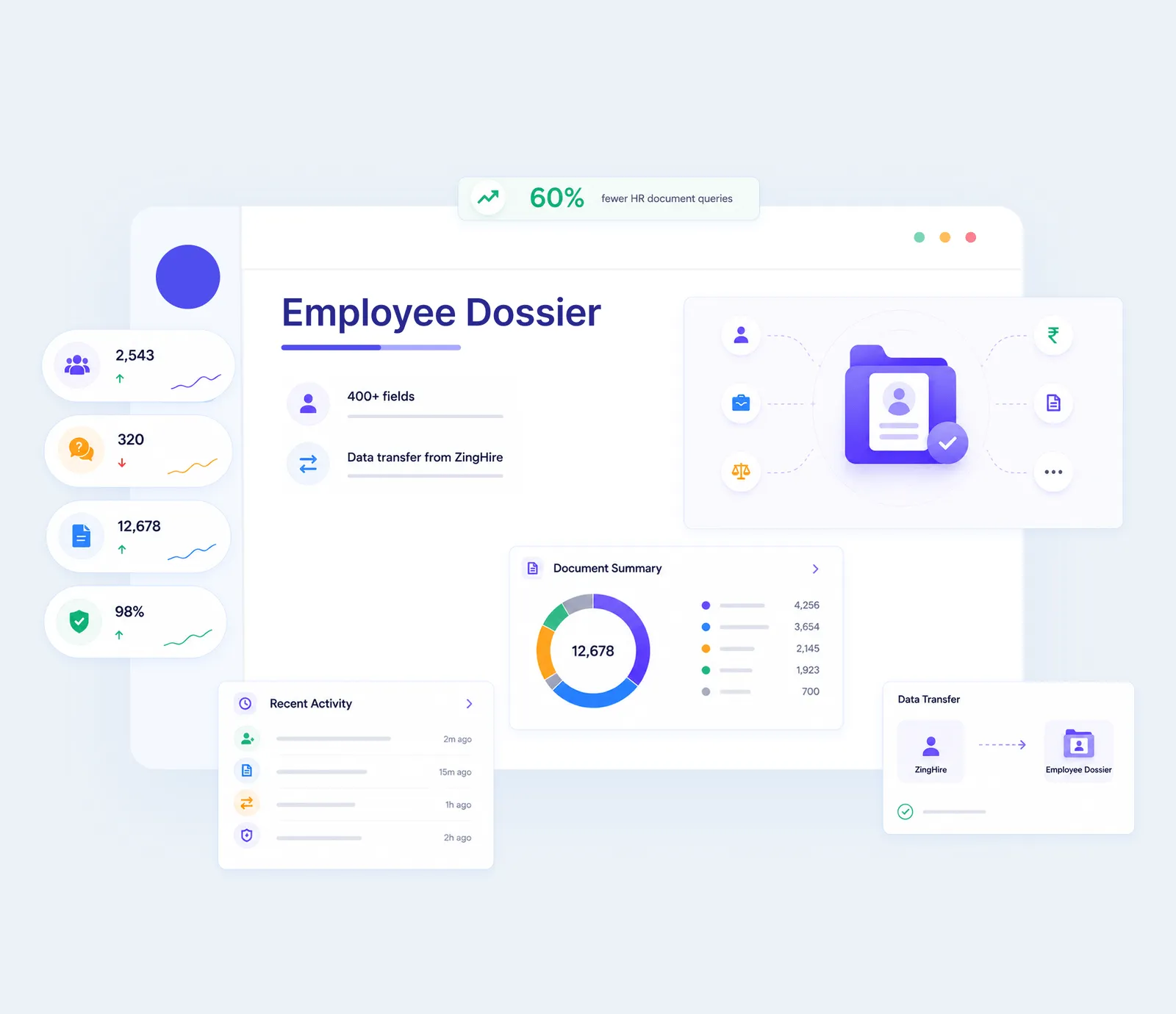
HR Launchpad holds the employee dossier with 400+ configurable fields. Every downstream module (recruitment, payroll, performance, learning) reads from the same record. Time to hire, cost per hire and quality of hire all compute from a shared data model, so numbers reconcile across teams.
2. ZingIntel With Live Analytics
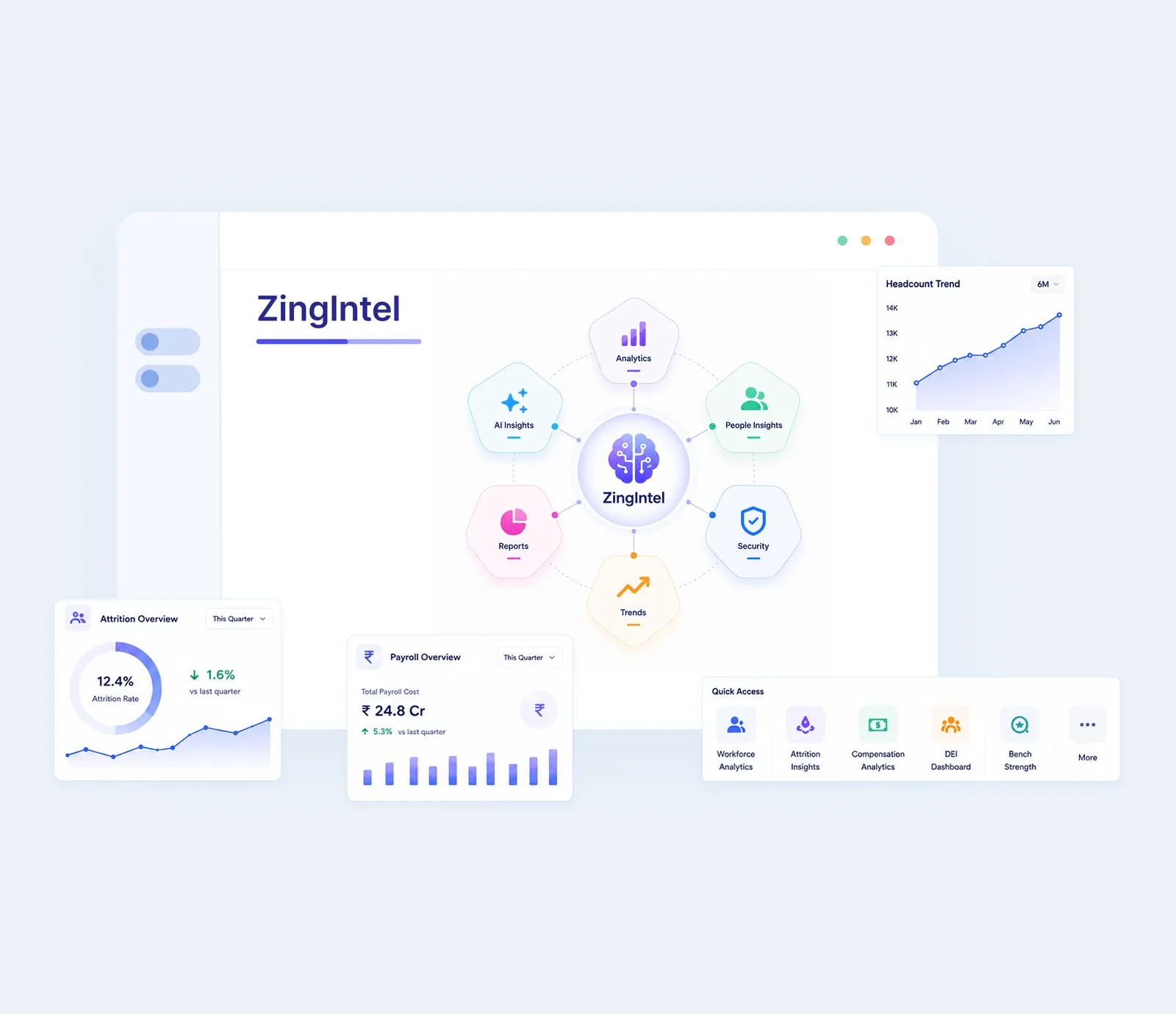
The Zing Intelligence Hub layers 19 live Power BI dashboards on top. Row-level security tunes each dashboard to the viewer: the CHRO sees the organisation, the HRBP sees their business unit, the manager sees their team.
HR metrics that used to need a special data pull surface on demand.
3. Native Philippine Payroll Feeding Workforce Cost Metrics
ZingZeroTAP handles zero-touch payroll natively in the Philippines.
Statutory processing runs in-house for Social Security System (SSS), Philippine Health Insurance Corporation (PhilHealth) and Home Development Mutual Fund (Pag-IBIG). Bureau of Internal Revenue (BIR) withholding, 13th-month pay and DOLE pay rules apply the same way.
Workforce cost metrics reconcile with finance automatically.
Customers such as Fast Logistics, Coway, Deloitte, Panasonic and transcosmos run their HR metrics on the same platform. Each one is tuned to Philippine statutory rules and business realities.
Build an HR Metrics Framework That Drives Action
HR metrics deliver a compounding return. Numbers HR leaders trust replace anecdotes. Board conversations move from workforce feelings to workforce facts.
Getting started is a matter of picking a small set of metrics and wiring them to clean data. Build a review cadence that turns numbers into action. ZingHR, the fastest growing HCM and payroll platform in the Philippines, runs HR metrics live across every entity. Native DOLE-compliant processing and a local delivery team sit behind every dashboard.
Book a Demo to see how ZingHR runs HR metrics live across every Philippine entity.
Frequently asked questions (FAQs)
8-12 metrics work for most organisations starting out. Balance direct measures like cost per hire and time to hire with outcome measures like revenue per employee and retention of high performers. Consistency across quarters beats breadth.
Operational metrics like absenteeism and time to hire benefit from weekly monitoring. Strategic metrics like engagement scores, turnover rate and revenue per employee suit quarterly business reviews. Annual reviews cover longer-arc metrics like training ROI and internal mobility.
Yes. Business process outsourcing and retail track early turnover closely because volume hiring drives cost. IT services watch quality of hire and 90-day performance. Manufacturing focuses on absenteeism and overtime. The metric list stays similar; the priorities shift with the operating model.
Yes, when the HRMS runs on a unified data model. ZingHR computes every core HR metric live across 19 Power BI dashboards, with row-level security tuning the view per persona. Metrics refresh as underlying data changes, removing manual reconciliation.
What to do next?
See ZingHR in Action
Join the 1,200+ enterprises that have replaced fragmented HR with one intelligent, future-ready platform. See ZingHR in 30 minutes.
Build the Organization You Want
Great HR drives retention, capability, and culture. ZingHR takes care of the operational layer so your people team owns the strategy.
Dr. Anupama Iyer
Director — HR
Dr. Anupama Iyer is Director — HR at ZingHR and an accomplished HR leader, consultant, facilitator, and academic with over two decades of experience in people practices and talent development. Her work spans HR consulting, training design, leadership development, and academia. Bringing both a practitioner's and an educator's perspective, she is passionate about building people-centric workplaces and helping organizations create cultures that enable growth, employee development, and long-term success.

Elevating Impact.
Defining Destiny
See how ZingHR's AI-powered Hire-to-ReHire platform frees your CPO to lead with purpose and deliver the outcomes your Board is watching for


ZingHR is the AI-powered Hire-to-ReHire platform built for one purpose to remove every transactional layer of HR from your organisation, permanently.