6 Employee Onboarding Software Platforms for Philippine Organizations
Compare six onboarding platforms on Philippine localization, workflows, analytics, and total cost of ownership.

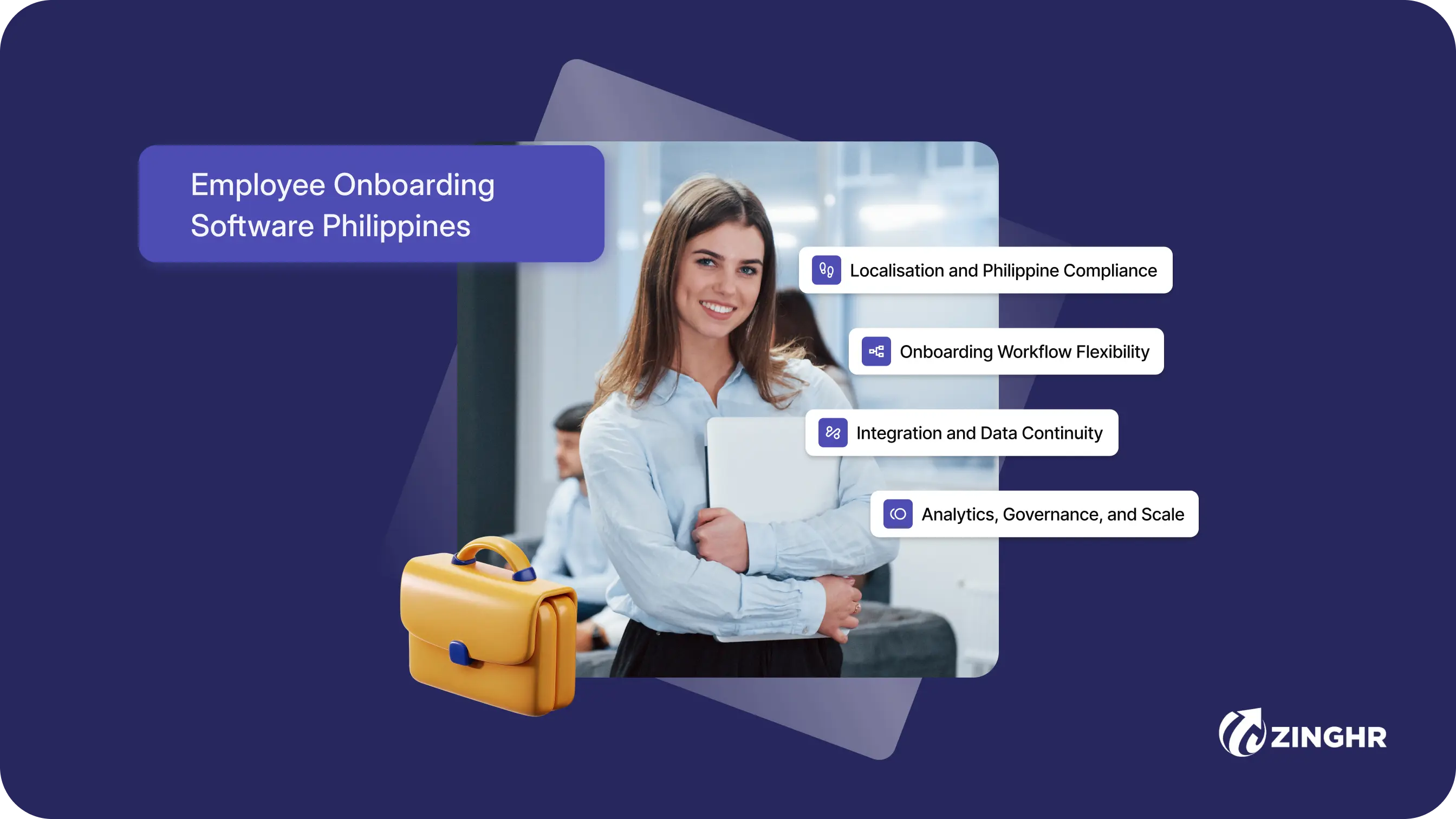
Table of contents
One unstitched HR platform to manage your entire workforce, from Hire to Re-Hire.
Talent Management solutions built for growing and exceptional people
Built-in compliance tools that update with changing regulations
Automated payroll, attendance, and leave management
Insights that help HR leaders make faster, better decisions

Key Takeaways
- Philippine onboarding software should support local compliance, flexible workflows, integrations, and time-to-productivity reporting.
- Growing, mid-market, and large organizations should weigh total cost of ownership and implementation effort alongside features.
- ZingHR is the fastest growing HCM and payroll in the Philippines. Its mobile-first HRIS system connects onboarding with native Philippine payroll, core HR, talent, workflows, integrations, and real-time analytics.
- Compare global, Philippine, and regional platforms against Philippine requirements, deployment scope, integrations, and total cost rather than assuming one category provides better local coverage.
- The right choice depends on HR maturity, existing business systems, industry, workforce size, and growth plans rather than ratings.
Aon projects a 20% attrition rate for the Philippines in 2026, the highest in Southeast Asia. One in five hires you onboard this year will need replacing next year, which puts a lot of weight on how the first week goes.
At that churn rate, onboarding runs constantly, so the software has to hold up under repetition rather than perform well once. You already know what it should deliver: a cleaner first day, tighter compliance, room to grow. The risk is what makes the decision hard. Replacing HR software disrupts daily operations, and the deeper worry is a platform that demos well, then piles on manual work and disconnected data within a year.
Philippine organizations often replace manual onboarding when paper-based 201 files, Department of Labor and Employment (DOLE) requirements, and multi-entity administration become difficult to manage consistently.
The guide compares six employee onboarding software, including broader HCM and HRIS systems, to help Philippine buyers assess features, pricing, integrations, and intended use.
Employee Onboarding Software Platforms at a Glance
Philippine organizations can assess onboarding within an HRIS system, a payroll-linked platform, or a broader HCM suite. The table maps each platform to its intended use, listed capabilities, pricing, and trial availability.
How We Evaluated the Employee Onboarding Software
We applied a consistent set of criteria across all six platforms to give Philippine buyers a clear basis for comparison.
1. Localization and Philippine Compliance
We checked support for DOLE and BIR (Bureau of Internal Revenue) requirements, 201 file management, probationary tracking, and statutory payroll rules across single and multi-entity operations. Generic software for employee onboarding often falls short here.
2. Onboarding Workflow Flexibility
We assessed configurable workflows spanning pre-boarding, day one, and the first 90 days. Each carries tasks, approvals, e-documents, and checklists tuned to HR, hiring managers, and IT, so the process matches how your teams work.
3. Integration and Data Continuity
We checked native and API integration with ATS, payroll, ERP and finance, identity provisioning, and learning systems, so the new-hire checklist runs end to end and skips duplicate data entry.
4. Analytics, Governance, and Scale
We weighed reporting on onboarding completion, time-to-productivity, and early attrition, plus role-based access, audit trails, and multi-entity scale for CXO and board oversight.
Detailed Evaluation of All 6 Platforms
1. ZingHR: Mobile-First Onboarding With Native Philippine Payroll
ZingHR is designed for growing, mid-market, and large organizations in the Philippines that need mobile-first onboarding connected to core HR, native Philippine payroll, talent, automated workflows, third-party integrations, and real-time analytics.
Its Philippine offering is supported by a local Center of Excellence and is built for the Philippines rather than adapted from another market. Payroll is native to ZingHR, not delivered by a local payroll partner, and supports DOLE compliance alongside 201-file processes, BIR, SSS, PhilHealth, Pag-IBIG, and 13th-month pay requirements.
ZingHR is the fastest growing HCM and payroll in the Philippines.
ZingHR Key Features
- Onboarding and Core HR: Digital forms, e-documents, checklists, employee records, and role-specific tasks connect recruitment with core HR.
- Philippine Payroll and Compliance: Native Philippine payroll connects new-hire data with attendance, statutory processes, and disbursement workflows. It supports DOLE, BIR, SSS, PhilHealth, Pag-IBIG, 201-file processes, and 13th-month pay without relying on a local payroll partner.
- Automated HR Workflows: Configurable workflows route onboarding tasks and approvals to HR, hiring managers, IT, and other teams.
- Real-Time HR Analytics: Real-time HR analytics and 19 Power BI dashboards provide visibility into onboarding, headcount, workforce operations, and payroll.
- AI-Powered HR Assistance: AI-powered HR assistance helps employees, managers, and HR teams access information and complete routine tasks.
- Integrations: Integrations connect ZingHR with business systems, biometric attendance devices, Microsoft 365, Google Workspace, and other applications.
- Mobile-First Experience: New hires, employees, and managers can access onboarding tasks, requests, approvals, documents, and HR information through a mobile-first experience.
ZingHR Pros and Cons
Pros:
- Native Philippine payroll rather than partner-delivered payroll
- Local Center of Excellence in the Philippines
- Built for Philippine workforce and statutory requirements
- DOLE-compliant processes with 201-file, BIR, SSS, PhilHealth, Pag-IBIG, and 13th-month pay support
- Mobile-first onboarding for distributed Philippine teams
- Connected onboarding, HR, payroll, talent, workflows, integrations, and analytics
Cons:
- Pricing is available on request
- Implementation scope and timing depend on organizational complexity
Apple App Store (Philippines): 4.3/5 (81 ratings)
Google Play: 4.6/5 (158K reviews)
ZingHR Pricing
ZingHR uses subscription pricing based on employee count, selected capabilities, and implementation scope. Schedule a Demo for a customized quote.
Verdict
ZingHR serves Philippine businesses that need mobile-first onboarding connected to native payroll, local compliance, core HR, talent, automated workflows, third-party integrations, and real-time analytics. Its local Center of Excellence supports a platform built for the Philippines rather than adapted from another market.
The regional client base spans logistics, manufacturing, and professional services, including Fast Logistics, Coway, Panasonic, and transcosmos.
2. Workday: Global HCM and Finance Integration
Workday serves large multinational organizations of 1,000 to 100,000+ employees standardizing onboarding at scale, including their Philippine entities. It suits organizations seeking new employee onboarding software, with dedicated HRIT teams and a mandate to align HR with finance across borders.
Workday Key Features
- Core HCM plus talent with onboarding connected to HR and finance within the Workday environment, allowing organizations to define shared processes and reporting across the modules they deploy.
- Structured onboarding with tasks and approvals following configurable business processes, so global standards hold while local steps still apply.
- Workday Journeys with guided new-hire experiences that carry employees through their first weeks with personalized steps and nudges.
- Analytics with Prism analytics and workforce planning supporting leadership reporting across onboarding and other workforce processes, according to the products and data sources included in the deployment.
- HR-finance integration and Workday Extend with a unified HR and finance model plus an extensibility layer that organizations can use to build applications and connect processes within their deployment.
Workday Pros and Cons
Pros:
- HCM capabilities for multi-entity and multinational organizations
- HR and finance within one vendor environment
- Analytics and workforce-planning capabilities
- Implementation-partner ecosystem
Cons:
- High cost and long implementation
- Requires dedicated HRIT teams
- UI can be complex for HR generalists
- Philippine payroll and statutory requirements may need third-party partners
Workday Pricing
Workday uses custom subscriptions, typically multi-module and multi-year. The vendor keeps pricing private, reflecting headcount and deployment scope.
Verdict
Workday serves multinational organizations combining HR and finance processes. Philippine buyers should assess whether its modules, implementation effort, and ongoing administration are proportionate to their onboarding requirements.
3. Darwinbox: Configurable HCM and Onboarding Across Asia
Darwinbox serves multi-entity organizations of 500 to 20,000+ employees seeking onboarding within a broader HCM suite across Asia. Its configuration and self-service capabilities are relevant to teams standardizing HR processes, while Philippine payroll processing is handled by a local provider integrated with the platform.
Darwinbox Key Features
- End-to-end HCM with onboarding connected to core HR and talent in one suite, so new-hire data stays consistent from offer through the first appraisal.
- Configurable onboarding workflows with document checklists and approval chains that adapt to roles and entities, allowing an office and an operating site to follow different steps within the same organization.
- App-based self-service that lets deskless and distributed hires complete onboarding tasks from their phones, with access to the tasks and documents assigned to their role.
- Asia localization and language support for HR processes across Southeast Asian entities.
- Analytics and a multi-entity architecture that give complex organizations reporting visibility across entities.
Darwinbox Pros and Cons
Pros:
- Regional localization and language support
- Configurable workflows across roles and entities
- Employee and manager application for distributed hires
Cons:
- Suited to mid-size and larger organizations only
- Integration ecosystem narrower than global giants
- Significant change management from legacy or paper onboarding
- Philippine payroll processing sits outside Darwinbox with a local provider
Darwinbox Pricing
Darwinbox uses subscription pricing per employee per month, modular by suite. The vendor keeps figures private, so expect a sales-led quote scoped to your headcount and chosen modules.
Verdict
Darwinbox serves organizations that want configurable onboarding and employee self-service while standardizing HR processes across several Asian countries.
4. SAP SuccessFactors: HXM for SAP-Standardized Organizations
SAP SuccessFactors serves upper-mid-market and large SAP or S/4HANA organizations of 1,000+ employees connecting recruiting and onboarding across regions. Existing SAP finance and ERP deployments shape the integration scope and implementation requirements.
SAP SuccessFactors Key Features
- Onboarding module with structured flows covering pre-hire through post-hire steps, mapping the full new-hire experience end to end.
- SAP Recruiting integration where candidate data carries into onboarding automatically, keeping recruiting-to-hire continuous.
- Global HR and payroll localization with broad country coverage supporting multi-country organizations that need consistent statutory handling.
- HXM (Human Experience Management) guided workflows and portals with role-based experiences and self-service that guide employees and managers through their tasks.
- S/4HANA and SAP ERP integration with configurable processes and ERP links for organizations connecting onboarding with an existing SAP environment.
SAP SuccessFactors Pros and Cons
Pros:
- Integration with SAP ERP and S/4HANA environments
- HR modules for multi-country operations
- Configurable processes across organizations
- Partner services for country-specific localization
Cons:
- Implementation complexity and cost
- UX perceived as less modern
- Heavy for lightweight standalone use
- More than smaller Philippine firms need
SAP SuccessFactors Pricing
SAP SuccessFactors uses subscription pricing per module, per employee, under custom agreements. SAP keeps figures private, so cost depends on your modules and implementation partner.
Verdict
SAP SuccessFactors serves organizations already using SAP ERP or S/4HANA. Buyers should assess onboarding scope, Philippine localization, implementation cost, and ongoing administration.
5. peopleHum: Recruitment and Onboarding for SMBs and Mid-Market Organizations
peopleHum serves firms of 50 to 2,000 employees seeking recruitment, onboarding, and engagement within one platform. Teams can assess whether its workflows, implementation requirements, and administrative controls match their operating model and the scope of HR processes they want to consolidate.
peopleHum Key Features
- Applicant tracking and recruitment with hiring and onboarding in one flow, so candidate data carries into the new-hire record and stays entered once.
- Onboarding workflows with task lists and document collection guiding new hires through their first days with automated reminders.
- Performance management with goals and reviews connected to the same record, keeping the early employee lifecycle in one place.
- Engagement surveys with pulse feedback helping smaller HR teams read sentiment during onboarding and beyond.
- Automation and web and mobile access with routine HR tasks automated for distributed teams.
peopleHum Pros and Cons
Pros:
- HR capabilities for SMB recruitment and onboarding
- Recruitment, onboarding, performance, and engagement modules
- Automation for routine HR tasks
- Web and mobile access for distributed teams
Cons:
- Less depth and configurability than larger HCM suites
- Fewer Philippine statutory references
- Smaller integration ecosystem
- Limited governance and analytics for very large organizations
peopleHum Pricing
peopleHum uses subscription pricing per employee per month, modular by capability. Pricing is private, so confirm your exact rate and modules with the vendor during evaluation.
Verdict
peopleHum serves smaller organizations that want recruitment and onboarding together. Larger organizations should test governance, reporting, workflow configuration, and transaction volumes against their requirements.
6. ADP: Payroll-Led HR and Onboarding
ADP serves mid-market and larger buyers of 50 to 5,000+ employees who place payroll and compliance at the center and want onboarding tied to those records. It suits organizations that treat accurate pay and tax as essential.
ADP Key Features
- Onboarding in Workforce Now with digital forms and e-signatures routing new hires into core HR and payroll from day one.
- Payroll and tax compliance capabilities, with payroll processing and regulatory handling depending on the ADP product, country coverage, and services included in the agreement.
- Time and attendance with scheduling and tracking connected to payroll, keeping hours and pay aligned.
- Benefits administration with enrollment and benefits data alongside the new-hire record for a single source of truth.
- Recruiting integration and reporting with ADP Recruiting feeding onboarding, and HR and payroll reports available for reviewing employee records and payroll activity.
ADP Pros and Cons
Pros:
- Payroll-processing and regulatory-compliance capabilities
- HR and payroll within one vendor environment
- Support services based on selected products and scope
- Established platform and service operations
Cons:
- Philippine-specific flows may need regional configuration
- UX can feel legacy
- Complex pricing; add-ons raise cost
- Less flexible for complex global onboarding journeys
ADP Pricing
ADP uses subscription pricing per employee per month, varying by module and edition, under custom quotes. Precise current figures stay unlisted, and add-ons can raise the total, so scope your edition carefully.
Verdict
ADP serves organizations that need onboarding connected with payroll processes. Buyers should confirm the product available in the Philippines, localization, workflows, and service requirements.
Pick the Right Onboarding Platform in the Philippines
Philippine statutory requirements, team structure, and growth trajectory all narrow the field. These five questions help you compare overlapping onboarding features and build a shortlist around your operating requirements, existing systems, and implementation capacity.
1. Your Needs and Priorities
Start with what the decision hinges on. If onboarding connected to HCM, native Philippine payroll, and real-time analytics matters most, prioritize a unified suite. If payroll and compliance dominate, lead with a payroll-first platform.
When you need onboarding alone, a lighter tool may suit the requirement and control spending.
2. Team Structure and HR Maturity
Match the platform to the team that will run it. Dedicated HRIT or COE teams can support configuration, integrations, data governance, and ongoing administration across a multi-module deployment.
Leaner HR functions should test everyday administration and configuration needs, then confirm the specialist support required after go-live rather than assuming a regional platform will be easier to operate.
3. Headcount and Growth Trajectory
Size the choice to where you are heading, beyond where you stand today. Fast-scaling, multi-entity organizations need proven multi-country scale and governance.
Stable mid-size firms can choose simpler payroll-integrated tools and pay only for the capacity they use.
4. Industry and Systems Landscape
Your existing stack helps define the evaluation. SAP users should assess SuccessFactors integration requirements; finance-driven firms should examine how employee records, payroll data, and finance processes connect in each proposed deployment.
Philippine organizations should test local requirements directly, then assess any additional country coverage they need. Regional presence alone does not establish the scope of compliance, integrations, or support included in a proposal.
5. Budget and Total Cost of Ownership
Count the full cost beyond the license alone. Compare implementation, integrations, data migration, training, support, and ongoing administration alongside subscription fees. Ask each vendor to quote the same headcount, modules, entities, and rollout scope so you can compare total cost and time-to-value on a consistent basis.
Quick Shortlist for Philippine Employers
- Choose ZingHR if you need mobile-first onboarding connected to native Philippine payroll, HCM, compliance, workflows, integrations, and real-time analytics.
- Choose Workday if you are a global organization combining HR and finance at scale.
- Choose Darwinbox if you need configurable HCM workflows across Asian entities and can connect Philippine payroll through a local provider.
- Choose SAP SuccessFactors if you already use SAP ERP or S/4HANA.
- Choose peopleHum if you are an SMB seeking recruitment and onboarding in one HRIS system.
- Choose ADP if payroll and compliance lead the onboarding decision.
Recommended Platforms by Industry
Employee Onboarding With ZingHR
Onboarding sets up every record that payroll, compliance, and performance depend on later. In ZingHR, the details a new hire submits in week one become their payroll profile, government enrollments, and talent record without being keyed in a second time.
In the Philippines, 201 files, SSS, PhilHealth, and Pag-IBIG registration, BIR forms, and DOLE requirements all start on day one. ZingHR's Philippine product was built locally, runs payroll natively, and is backed by a Center of Excellence in the country.
HR teams track onboarding completion across sites in Power BI dashboards, and new hires finish forms and documents from a mobile-first app before their first shift.
Onboarding That Builds a Smarter Workforce
When onboarding data flows into workforce reporting, early attrition becomes a signal you act on in week three. HR moves from administrative processing to measurable business impact. The workforce numbers your board reviews reflect ground reality in real time.
For Philippine organizations choosing employee onboarding software, the goal reaches past a better first day. The aim is a platform that compounds in value as you scale, keeping compliance clean and cost predictable while workforce health stays visible.
ZingHR connects mobile-first onboarding with native Philippine payroll, HCM, compliance, automated workflows, third-party integrations, and real-time analytics. As the fastest growing HCM and payroll in the Philippines, it serves growing, mid-market, and large organizations while supporting broader Southeast Asian operations where relevant.
Schedule a Demo to see how ZingHR supports employee onboarding in the Philippines.
Frequently asked questions (FAQs)
SMB-focused tools can go live within a few weeks. Global suites take several months, given localization and integration work alongside change management. Multi-entity operations and payroll configuration extend deployment, so scope these early with your vendor and implementation partner for a predictable rollout.
Look for DOLE and BIR form handling with 201 file management. Confirm probationary-period tracking and statutory payroll rules. Statutory enrollment should span SSS and PhilHealth contributions alongside Pag-IBIG Fund. Software that automates these reduces manual errors and audit risk, especially for organizations hiring across multiple locations or legal entities in the country.
Most employee onboarding systems connect to payroll and ERP through API or native integrations. They also link to ATS and learning systems. ZingHR connects onboarding with native Philippine payroll, core HR, talent, and performance workflows. New-hire records remain within one HRIS system from offer through subsequent employee-lifecycle processes.
For SMB tools a free trial helps. Larger-scale evaluation depends on scoped demos, proofs of concept, and reference checks. Test localization and workflow configuration against your real onboarding volumes. Check integration depth and analytics before committing, beyond a self-service trial alone.
Track onboarding completion rates and time-to-productivity. Watch first-90-day attrition and the HR administrative hours you save. ZingHR provides real-time HR analytics and 19 Power BI dashboards that can bring onboarding and early employee-lifecycle information into leadership reporting. Onboarding becomes a measurable part of workforce operations rather than a one-time administrative task.
What to do next?
See ZingHR in Action
Join the 1,200+ enterprises that have replaced fragmented HR with one intelligent, future-ready platform. See ZingHR in 30 minutes.
Build the Organization You Want
Great HR drives retention, capability, and culture. ZingHR takes care of the operational layer so your people team owns the strategy.
Rajat Luthra
Chief Operating Officer — Southeast Asia
Rajat Luthra is the Chief Operating Officer for Southeast Asia at ZingHR, where he leads business growth, customer success, and workforce transformation across Indonesia, Malaysia, the Philippines, Singapore, Thailand, and Japan. With nearly two decades spanning enterprise technology, entrepreneurship, and financial services, he brings a distinctive blend of strategic and operational expertise. Before ZingHR, Rajat co-founded VdoSelect, a pioneering video-interviewing platform that helped organizations accelerate hiring. He is passionate about using technology to strengthen talent strategies and build agile, future-ready workforces.

Elevating Impact.
Defining Destiny
See how ZingHR's AI-powered Hire-to-ReHire platform frees your CPO to lead with purpose and deliver the outcomes your Board is watching for


ZingHR is the AI-powered Hire-to-ReHire platform built for one purpose to remove every transactional layer of HR from your organisation, permanently.