7 Best Workforce Planning Tools for Philippines Enterprises
A decision-stage comparison of seven enterprise workforce planning tools, with features, pricing, ratings, and a clear per-platform verdict.
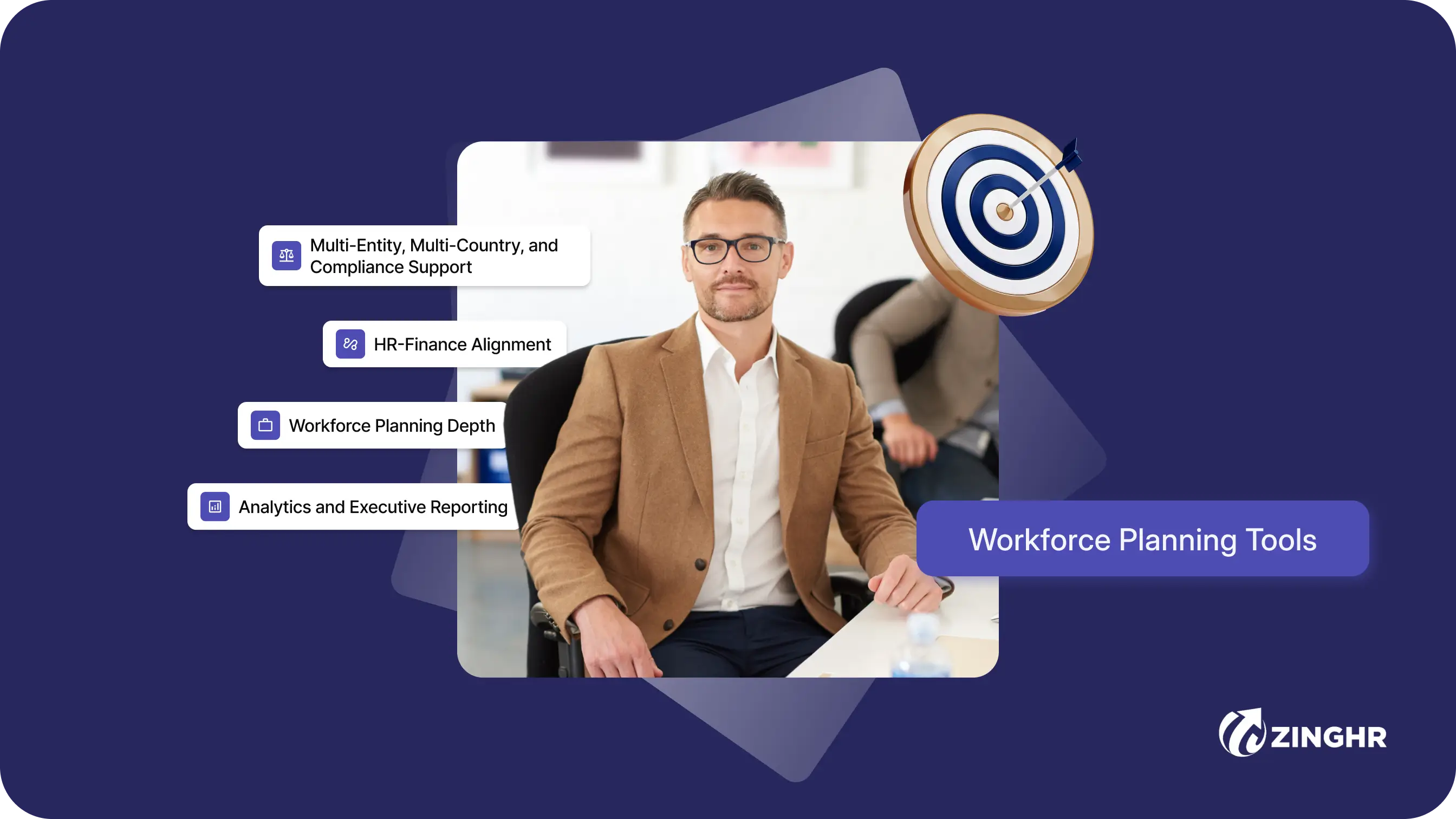
Table of contents
One unstitched HR platform to manage your entire workforce, from hire to rehire.
Talent Management solutions built for growing and exceptional people
Built-in compliance tools that update with changing regulations
Automated payroll, attendance, and leave management
Insights that help HR leaders make faster, better decisions

- Workforce planning tools now bridge HR and finance. Scenario modelling and cost visibility matter as much as core HR features.
- Enterprises with 1,000+ employees should prioritise multi-entity controls and compliance depth ahead of lightweight planning add-ons.
- ZingHR combines unified Human Capital Management (HCM) with agentic intelligence, giving boards and CXOs one command centre for workforce decisions.
- Pricing across most enterprise platforms is quote-based, so total cost should count implementation and change-management effort, not licences alone.
- The right choice follows from your team structure and industry regulation more than feature counts.
Every workforce planning vendor makes the same pitch. One system covering HR data, headcount planning, and cost visibility.
The meaningful question is whether any of them delivers on it for an enterprise operating across several Philippines legal entities, each with different labour rules, currencies, and approval chains.
The guide compares the best workforce planning tools used by Philippines enterprises today on planning depth, multi-entity compliance, analytics, and total cost of ownership.
How We Evaluated the Workforce Planning Software Tools
Four criteria shaped the comparison, weighted for enterprise-grade, multi-entity buyers across the Philippines. Each factor below reflects a genuine decision point for boards and CXOs planning across jurisdictions.
Our Methodology
- Vendor documentation and official product or solution pages for each platform.
- Publicly available positioning, feature, and integration information.
- Third-party ratings and reviews from G2 and Gartner Peer Insights where available.
- Category evaluation criteria weighted for enterprise, multi-entity buyers.
- Consistent per-platform scoring on planning depth, compliance, analytics, and fit.
1. Workforce Planning Depth
Planning depth separates real tools from simple headcount reports. We checked whether each platform models headcount and hiring scenarios across business units and geographies, going beyond reporting on current payroll figures.
2. HR-Finance Alignment
Planning helps only when finance trusts the numbers. We assessed how well each tool connects workforce plans to compensation and budget forecasting, so the CHRO and CFO work from the same assumptions.
3. Multi-Entity, Multi-Country, and Compliance Support
Philippines enterprises treat this as essential. We checked support for multiple legal entities and local labour rules across jurisdictions, plus currency handling and approval chains for organisations answering to several regulators at once.
4. Analytics and Executive Reporting
Executive reporting decides whether leaders act on a plan. We weighed whether each platform delivers board-ready dashboards and predictive insight that CXOs and HRBPs can use directly, without a separate data team running the numbers.
Best Workforce Planning Tools at a Glance
Seven workforce planning software compared on the criteria enterprise buyers use most. Scan the table for quick positioning before reading the full platform verdicts.
Caption: Snapshot comparison of seven workforce planning tools for Philippines enterprise buyers. Ratings shown as verified at time of rePhilippinesrch.
1. ZingHR: Best for AI-Led Enterprise Workforce Planning
ZingHR Is Best For
ZingHR fits enterprise and upper mid-market organisations with 1,000 to 10,000+ employees running operations across Philippines legal entities. It suits boards and CXOs who want one command centre covering HCM, managed payroll, and workforce planning.
ZingHR Key Features
- Payroll Services (Zero-Tap Payroll): Fully managed outsourced payroll with zero-touch gross-to-net processing, statutory compliance, and bank disbursements across Philippines. AI-powered anomaly detection identifies payroll variances before finalisation, ensuring accurate workforce cost data for headcount planning, budgeting, and executive reporting.
- HCM Launchpad: A core HR platform with 400+ configurable employee attributes, position management, vacancy-to-requisition automation, and employee lifecycle workflows including confirmations, transfers, and separations. It provides a single workforce record to support organisation design and long-term workforce planning.
- Employee Engagement: ZingSocial surfaces engagement and retention analytics with sentiment scoring across teams. Captain Zingo handles HR queries 24/7 via conversational AI, answering leave, policy, and approval questions without a helpdesk ticket.
- Intelligence Hub: ZingIntel with 19 Power BI dashboards on a single live database with no batch delay, ZingBot AI assistant on WhatsApp and Microsoft Teams, Zingo conversational automation, and a no-code Workflow Engine with a full, immutable audit trail.
ZingHR Pros and Cons
Pros
- Managed payroll plus zero-touch multi-entity engine across Philippines
- Unified HCM reduces vendor fragmentation and reconciliation overhead
- Clearly differentiated AI and analytics layer for board-level planning
- Board-ready strategic reporting via live dashboards, not month-end exports
- Strong fit for multi-entity payroll standardisation across jurisdictions
Cons
- Public pricing not listed; requires a demo to size correctly
- Validate depth for non-Philippines geographies if the footprint is global
- Feature breadth needs careful scoping to avoid overbuying
- Independent public review data limited compared to Tier-1 global suites
Gartner Peer Insights: 4.6/5 (362 ratings)
ZingHR Pricing
Custom pricing. Managed-payroll scope and entity count drive the cost. Request a demo for a quote that reflects your entity count and jurisdictions.
Verdict
A strong choice for Philippines enterprises that want unified HCM and agentic intelligence with outsourced payroll in one governed command centre. Organisations including Fast Logistics, Coway, Burger King, Deloitte, Panasonic, and transcosmos use ZingHR to support complex workforce operations across the Philippines and the wider APAC region.
2. Darwinbox: Best for Configurable Multi-Country Enterprise HR
Darwinbox Is Best For
Darwinbox suits large, complex, multi-country enterprises across tech, retail, manufacturing and BFSI. It fits teams across APAC that need configurable workflows and a modern UX, especially where local processes differ sharply between countries.
Darwinbox Key Features
- Hire-to-retire employee database with configurable org structures, multi-entity policy management, and approval hierarchies.
- Scenario planning and headcount tracking across business units and Philippines countries.
- AI-powered shortlisting, structured interview workflows, and auto-triggered onboarding on offer acceptance.
- OKR goal-setting, review cycles, and succession planning across the talent pipeline.
Darwinbox Pros and Cons
Pros
- Strong fit for complex enterprise HR across APAC
- Broad HCM coverage reduces vendor sprawl
- Mobile-first UX popular in APAC markets
- Multi-entity, multi-country configurability for complex org structures
Cons
- Limited pricing transparency
- Configurability raises implementation effort and timeline
- Narrower fit for small or simple HR stacks
- Limited independent public review evidence
Gartner Peer Insights: 4.7/5 (600 ratings)
Darwinbox Pricing
Custom pricing. Quote-based enterprise contracts scoped to headcount, modules, and the countries in play.
Verdict
A strong APAC enterprise option where configurability and mobile experience outweigh the added setup complexity.
3. Sprout Solutions: Best for Philippine Workforce Planning and Payroll
Sprout Solutions Is Best For
Sprout Solutions fits organisations with 100 to 10,000+ employees operating primarily in the Philippines. It suits businesses that want workforce planning closely connected to local payroll, statutory compliance, attendance, and workforce management without the complexity of a global enterprise HCM platform.
Sprout Solutions Key Features
- Workforce planning and reporting with real-time headcount visibility.
- Philippine payroll supporting BIR, SSS, PhilHealth, Pag-IBIG, and statutory compliance.
- Time and attendance with biometric integrations, shift scheduling, and leave management.
- HRIS with employee records, self-service, and workforce analytics.
Sprout Solutions Pros and Cons
Pros
- Built specifically for Philippine payroll and statutory compliance
- Strong integration between HR, payroll, and workforce management
- Local implementation and customer support
Cons
- Less suited to complex multi-country workforce planning
- Advanced scenario modelling is less comprehensive than global enterprise platforms
- Regional expansion may require additional systems
G2: Not available
Gartner Peer Insights: Not available
Sprout Solutions Pricing
Custom pricing. Quote-based according to headcount, modules, and implementation requirements.
Verdict
Solid for Philippines and APAC enterprises that prioritise compliance and scale; validate advanced planning depth and cross-border coverage against your roadmap.
4. Workday: Best for Global HR-Finance Workforce Planning
Workday Is Best For
Workday fits large global enterprises with complex HR and finance operations. It suits organisations that need integrated planning across workforce, compensation, and financial models, where the CFO and CHRO plan from the same numbers.
Workday Key Features
- Headcount and cost scenario modelling with direct finance alignment for shared CFO and CHRO planning.
- Skills-based talent identification and succession planning across business units and geographies.
- Configurable compensation structures and absence policies with payroll linkage.
- Enterprise-grade workforce dashboards with predictive insights for boards and finance leaders.
Workday Pros and Cons
Pros
- Deep HR and finance capability for global planning
- Strong scenario modelling via Adaptive Planning
- Mature analytics and reporting for board-level decisions
- Proven global fit across enterprise deployments
Cons
- Expensive and time-intensive to deploy
- Complex administration versus lighter suites
- May be more platform than Philippines-focused mid-market teams need
- Local Philippines payroll often requires partner integration
Gartner Peer Insights: 4.4/5 (828 ratings)
Workday Pricing
Custom pricing. Budget for a substantial implementation and integration effort alongside licences.
Verdict
Best when finance-grade scenario planning and global governance justify the investment and the longer rollout.
5. SAP SuccessFactors: Best for SAP-Standardised Multinationals
SAP SuccessFactors Is Best For
SAP SuccessFactors’s workforce planning software fits large multinationals already standardised on SAP ERP. It suits organisations wanting unified HR across regions and business units, where finance and HR data need to live in one connected system.
SAP SuccessFactors Key Features
- Structured hiring workflows from requisition to offer, with automatic SAP ERP position management integration.
- Configurable compensation structures and succession planning linked to the regional talent pipeline.
- Embedded dashboards with prebuilt KPIs for HR, finance, and workforce planning executives.
- Country-specific localisation packs for Philippines markets, supported through SAP's certified partner ecosystem.
SAP SuccessFactors Pros and Cons
Pros
- Strong fit for SAP-centric environments
- Broad global coverage and localisation depth
- Deep governance and process control for regulated industries
- Good ERP and finance alignment for joint HR-finance planning
Cons
- Complex to implement and administer
- Limited pricing transparency
- May be excessive for mid-market or Philippines-only deployments
- Local Philippines compliance typically relies on partner localisation
Gartner Peer Insights: 4.4/5 (1,023 ratings)
SAP SuccessFactors Pricing
Custom pricing. Budget for licence costs plus significant implementation and integration effort, especially where the wider SAP setup is involved.
Verdict
The default when a global SAP ERP setup makes tight HR-finance integration the leading priority.
6. peopleHum: Best for SMB and Mid-Market All-in-One HR
peopleHum Is Best For
peopleHum fits SMBs and mid-market organisations wanting a simpler all-in-one HR suite. It suits teams needing hiring and performance in one place, with payroll integrations, staying lighter than a large enterprise deployment.
peopleHum Key Features
- AI-enabled resume screening, interview scheduling, and onboarding workflows with job board integrations.
- Employee Net Promoter Score (eNPS) tracking, pulse surveys, and recognition tools for distributed teams.
- Time tracking, leave management, and approval workflows for mid-market operations.
- Payroll connectivity via third-party integrations and mobile self-service for employee HR transactions.
peopleHum Pros and Cons
Pros
- Broad HR coverage in one platform for mid-market needs
- Simpler than large enterprise suites to deploy and administer
- Good mix of HR, engagement, and performance tools
Cons
- Less suited to very large or complex global organisations
- Workforce planning depth thinner than specialist enterprise tools
- Limited public pricing and independent rating data
Gartner Peer Insights: 3.2/5 (2 ratings)
peopleHum Pricing
Custom pricing. Request a quote scoped to your headcount and the modules you need.
Verdict
A pragmatic pick for smaller and mid-market teams; large enterprises will likely outgrow its planning depth.
7. ADP: Best for Cross-Jurisdiction Payroll and Compliance
ADP Is Best For
ADP fits organisations of all sizes that put payroll and compliance first, alongside workforce administration. It suits enterprises running people across multiple Philippines jurisdictions, where tax and labour rules change by country and accuracy stays essential.
ADP Key Features
- Full-service payroll across 140+ countries with local statutory calculations, tax filings, and bank disbursement.
- Scheduling, time tracking, and labour costing with biometric device integration for shift-based operations.
- Benefits management covering health, retirement, and employee perks across multiple jurisdictions.
- Workforce dashboards covering payroll costs, headcount, and compliance trends for HR and finance leaders.
ADP Pros and Cons
Pros
- Strong payroll and compliance pedigree across jurisdictions
- Handles complex labour and tax environments at scale
- Broad HR and workforce suite with large market credibility
Cons
- Product breadth complicates the buying decision and implementation
- Limited pricing transparency
- Best fit depends heavily on geography and size of operation
G2: 4.4/5 (149 reviews, Comprehensive Services)
Gartner Peer Insights: 4.2/5 (75 ratings, Enterprise HR)
ADP Pricing
Custom pricing. Scope against payroll volume and the countries in play, plus the modules you activate.
Verdict
Best where payroll accuracy and multi-country compliance lead the decision over deep scenario planning.
Pick the Best Workforce Planning Software in the Philippines
Workforce type, compliance footprint, and planning ambition each point the decision differently. Work through the factors below to reach a shortlist you can defend.
1. Your Needs and Priorities
Start with the outcome you owe the board. If deep scenario modelling and cost visibility drive the mandate, lean towards finance-grade planning suites.
If broad HCM consolidation and one clean data spine matter more, prioritise unified platforms that reduce vendor sprawl.
2. Team Structure
Centralised HR and finance teams get the most from enterprise planning suites, since one group owns the model.
Distributed teams across countries need strong self-service and local compliance, so field managers and HRBPs can act quickly rather than waiting on head office.
3. Number of Employees
At 1,000+ employees, multi-entity controls and governance become essential, and so does analytics. Volume exposes weak approval chains and thin reporting fast.
Select a platform built to handle many legal entities and high transaction loads, with automation replacing manual workarounds.
4. Industry
Regulated and labour-intensive sectors, from BFSI and pharma to manufacturing and staffing, put compliance and payroll accuracy first.
Your industry's inspection and reporting demands should shape the shortlist as much as any planning feature.
5. Budget
Treat the licence as one line. Weigh implementation and integration costs, plus admin overhead and change management, across the first two to three years. The cheapest licence can carry the highest total cost when rollout drags and adoption stalls.
Quick Shortlist for Philippines Enterprises
- Choose ZingHR if you want unified HCM, managed payroll, and agentic AI analytics in one command centre for a multi-entity Philippines enterprise.
- Choose Darwinbox if configurability and mobile-first experience across many countries top your list.
- Choose Sprout Solutions if you run high-volume, compliance-heavy India or APAC operations.
- Choose Workday if finance-grade scenario planning and global governance justify the investment.
- Choose SAP SuccessFactors if you are standardised on SAP ERP and need tight HR-finance integration.
- Choose peopleHum if you are an SMB or mid-market team wanting a simple all-in-one HR suite.
- Choose ADP if cross-jurisdiction payroll and compliance are the leading requirement.
Best Workforce Planning Tools by Industry
Why ZingHR for Workforce Planning
Workforce planning tools tend to pick one strength and build around it. Payroll accuracy, scenario modelling, or analytics. ZingHR connects all three in one platform, and the gains compound across every Philippines entity.
Agentic Intelligence, powered by Ghrowth.ai, goes further than a reporting layer. The Zing Intelligence Hub surfaces attrition risk, cost variances, and headcount gaps as they develop, giving Boards and CXOs numbers they can act on in the same meeting where the issue comes up.
Zero-Tap Payroll handles the operational side: gross-to-net calculations, statutory filings, and bank disbursement run automatically across every Philippines entity. That keeps the data spine clean, which means the workforce plan that finance approves is built on the same numbers payroll is running.
What Changes When Workforce Planning Works
Headcount and cost decisions become faster and defensible, backed by numbers the board can trace to their source rather than a spreadsheet that nobody fully trusts. When a restructuring or hiring freeze lands on the agenda, the impact models in hours rather than weeks, and the leadership team walks into the conversation with an answer.
The more lasting change is in how HR and finance work together. HR and finance plan from one version of the numbers, and workforce cost becomes a shared, forecastable line. Compliance moves from a quarterly scramble to an audit-ready default. Executive visibility replaces guesswork with live dashboards showing where talent and cost sit across every entity and country.
ZingHR brings this together for Philippines enterprises: unified HCM and agentic intelligence, plus managed Zero-Tap Payroll, in one governed command centre.
Request a demo to see how ZingHR's agentic intelligence serves your HR needs.
Frequently asked questions (FAQs)
A Human Resources Information System (HRIS) records and manages employee data and payroll, along with core transactions. Workforce planning tools go further, modelling future headcount and cost, plus org design and hiring scenarios across entities. The HRIS tells you where you are today; planning tools help you decide where you go next.
Enterprise timelines usually run three to nine months, depending on entity count, integrations, data quality, and change management. Configurable global suites sit at the longer end, while focused deployments move faster. Clean data and a clear governance model shorten the timeline more than any single feature.
Support varies widely, so validate country coverage before signing. Several platforms rely on payroll partners in the Philippines market. ZingHR handles multi-entity payroll through its zero-touch engine via ZingZeroTAP, standardising the data spine across jurisdictions so planning and cost stay consistent as you scale.
Most platforms apply AI to forecast attrition and flag cost trends, surfacing planning insights in dashboards. Maturity differs sharply between vendors. ZingHR uses agentic intelligence through its Zing Intelligence Hub, powered by Ghrowth.ai, moving beyond automation towards strategic execution and governance with board-ready insight CXOs can act on directly.
Prepare clean org structures and employee master data. Add position and grade frameworks, compensation and budget figures, plus historical attrition and hiring records. Confirm entity and jurisdiction mappings too. Better input data upfront cuts implementation time and improves forecast accuracy, reducing the reconciliation work your team faces later.
What to do next?
See ZingHR in Action
Join the 1,200+ enterprises that have replaced fragmented HR with one intelligent, future-ready platform. See ZingHR in 30 minutes.
Build the Organization You Want
Great HR drives retention, capability, and culture. ZingHR takes care of the operational layer so your people team owns the strategy.
<script type="application/ld+json">
{
"@context": "https://schema.org",
"@type": "FAQPage",
"mainEntity": [
{
"@type": "Question",
"name": "What is the difference between workforce planning tools and a standard HRIS?",
"acceptedAnswer": {
"@type": "Answer",
"text": "A Human Resources Information System (HRIS) records and manages employee data and payroll, along with core transactions. Workforce planning tools go further, modelling future headcount and cost, plus org design and hiring scenarios across entities. The HRIS tells you where you are today; planning tools help you decide where you go next."
}
},
{
"@type": "Question",
"name": "How long does it take to implement enterprise workforce planning software?",
"acceptedAnswer": {
"@type": "Answer",
"text": "Enterprise timelines usually run three to nine months, depending on entity count, integrations, data quality, and change management. Configurable global suites sit at the longer end, while focused deployments move faster. Clean data and a clear governance model shorten the timeline more than any single feature."
}
},
{
"@type": "Question",
"name": "Do workforce planning tools support multi-entity payroll across the Philippines?",
"acceptedAnswer": {
"@type": "Answer",
"text": "Support varies widely, so validate country coverage before signing. Several platforms rely on payroll partners in the Philippines market. ZingHR handles multi-entity payroll through its zero-touch engine via ZingZeroTAP, standardising the data spine across jurisdictions so planning and cost stay consistent as you scale."
}
},
{
"@type": "Question",
"name": "How do these platforms use AI for workforce planning and forecasting?",
"acceptedAnswer": {
"@type": "Answer",
"text": "Most platforms apply AI to forecast attrition and flag cost trends, surfacing planning insights in dashboards. Maturity differs sharply between vendors. ZingHR uses agentic intelligence through its Zing Intelligence Hub, powered by Ghrowth.ai, moving beyond automation towards strategic execution and governance with board-ready insight CXOs can act on directly."
}
},
{
"@type": "Question",
"name": "What data should we prepare before rolling out a workforce planning tool?",
"acceptedAnswer": {
"@type": "Answer",
"text": "Prepare clean org structures and employee master data. Add position and grade frameworks, compensation and budget figures, plus historical attrition and hiring records. Confirm entity and jurisdiction mappings too. Better input data upfront cuts implementation time and improves forecast accuracy, reducing the reconciliation work your team faces later."
}
}
]
}
</script>

Elevating Impact.
Defining Destiny
See how ZingHR's AI-powered Hire-to-ReHire platform frees your CPO to lead with purpose and deliver the outcomes your Board is watching for


ZingHR is the AI-powered Hire-to-ReHire platform built for one purpose to remove every transactional layer of HR from your organisation, permanently.