Best Workforce Management Software in Philippines: 7 Platforms Compared
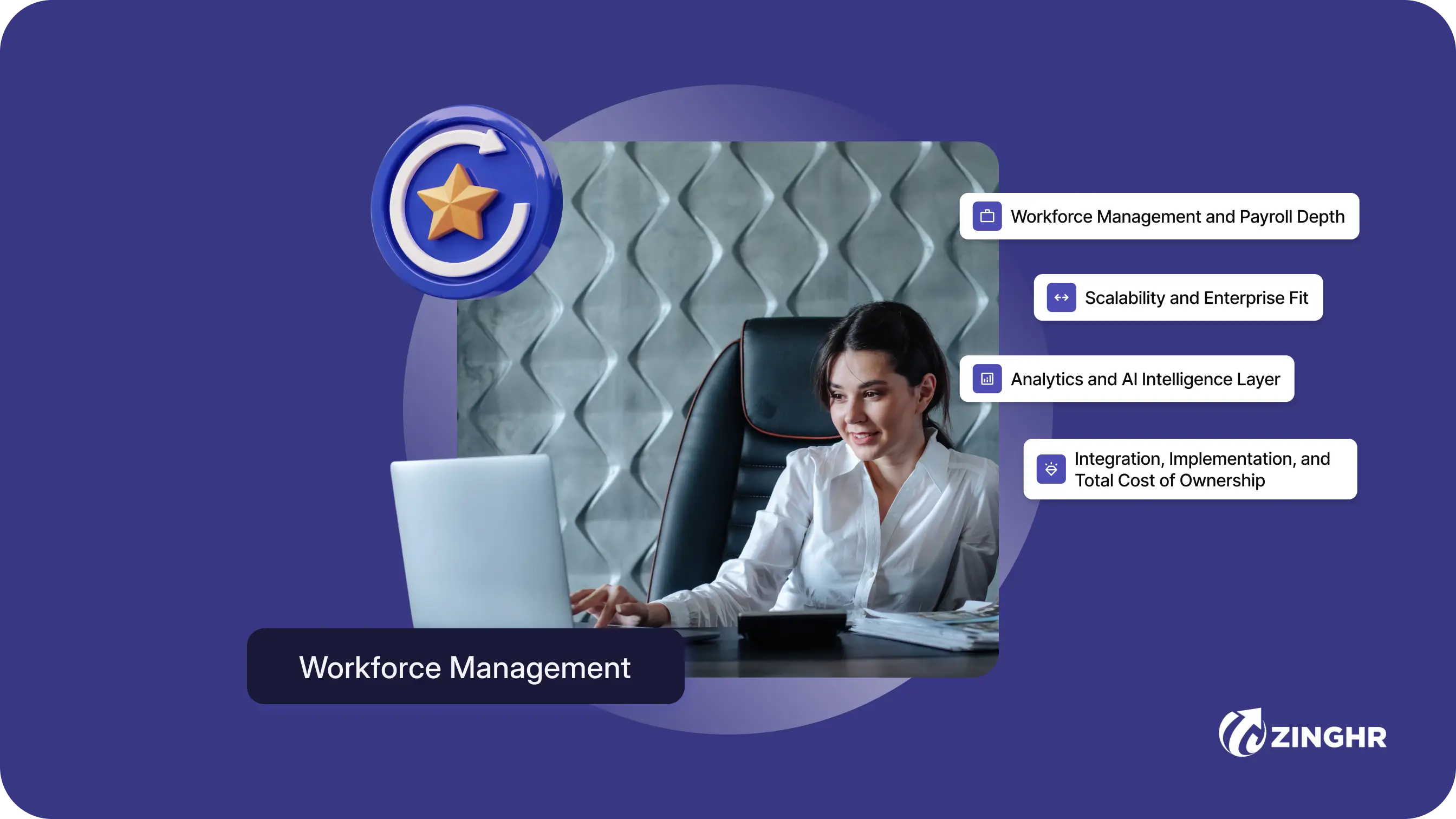
Table of contents
One unstitched HR platform to manage your entire workforce, from hire to rehire.
Talent Management solutions built for growing and exceptional people
Built-in compliance tools that update with changing regulations
Automated payroll, attendance, and leave management
Insights that help HR leaders make faster, better decisions

- Workforce management software now covers scheduling, attendance, payroll, compliance, and analytics. Enterprises should assess depth across all five capabilities before shortlisting.
- Fit depends on size and complexity. Some platforms suit global multinationals, others fit mid-market or SMB teams. Match the tool to your operating model.
- Payroll and statutory compliance handling often decides the choice, especially multi-entity, multi-country automation for enterprises consolidating fragmented systems.
- ZingHR stands out for zero-touch, multi-entity payroll and an embedded agentic intelligence layer built for board-level workforce decisions.
- Costs, timelines, and analytics maturity vary widely across platforms. Weigh long-term value over headline features.
Philippine enterprises don’t go looking for workforce management software on just another Tuesday. A payroll run that took three people two days to reconcile, attendance data that never reached the system on time, compliance gaps found only when the audit starts. For organisations with 1,000+ employees, multiple entities, and rotating shifts, that’s a normal month.
This guide compares seven workforce management software examples on payroll depth, compliance handling, scalability, and 3-5 year cost, so CXOs and CHROs can shortlist fast and defend the pick.
How We Evaluated the Platforms
Four criteria and a methodology check drove the comparison, weighted for Philippine enterprise operating models. Each factor below reflects a decision point that shapes long-term fit.
1. Workforce Management and Payroll Depth
We reviewed scheduling, roster management, time and attendance, and overtime rules, then checked how tightly each connects to payroll and statutory compliance. For enterprises consolidating HR systems, this integration usually wins or loses value.
2. Scalability and Enterprise Fit
We assessed whether each platform can support 1,000+ employees, multiple legal entities, and complex org structures while protecting performance and governance.
Proven enterprise depth was weighted over feature checklists that impress in a demo and strain at scale.
3. Analytics and AI Intelligence Layer
We assessed dashboard quality, predictive insight, and AI assistants. We judged how well each platform turns workforce data into real-time, board-level intelligence, replacing static reports leadership has to chase each month-end.
4. Integration, Implementation, and Total Cost of Ownership
We weighed the API and connector ecosystem, time-to-value, admin overhead, and Total Cost of Ownership (TCO) over three to five years. Sticker price tells part of the story. Implementation and ongoing effort often cost more.
Workforce Management Software at a Glance
Use this snapshot to compare the best workforce management software in the Philippines before exploring each solution in more detail.
1. ZingHR: Best for Zero-Touch Multi-Entity Enterprise Payroll
ZingHR Is Best For
ZingHR fits enterprises and multi-entity organisations with 1,000 to 10,000+ employees operating across the Philippines and the wider SEA, Indian, and GCC regions. These teams need zero-touch, compliant payroll and board-level workforce intelligence from one HCM command centre. It fits boards and C-suite executives who want execution, analytics, and governance running from one platform.
ZingHR Key Features
- ZingHR Workforce Management and ZingZeroTAP: Rostering, shift scheduling, and attendance with 10+ clock-in modes feed a zero-touch payroll engine that closes monthly runs before the admin logs in. The link between time data and pay output is direct, automated, and auditable.
- ZingHR HCM Launchpad: Org structures, position hierarchies, and workforce policies sit in one governed foundation. Every leave rule, shift configuration, and approval chain traces back to a single source rather than propagating across disconnected spreadsheets.
- Zing Intelligence Hub: Workforce cost, attendance patterns, and headcount data run on 19 live Power BI dashboards from one database, updating in real time. ZingBot AI assistant handles workforce queries via WhatsApp and Microsoft Teams without routing them through a reporting team.
- ZingHire and ZingGrow: Open roles feed into headcount plans the moment a vacancy is triggered. ZingGrow connects OKRs, performance calibration, and workforce cost revisions, keeping people data current across the planning cycle.
- ZingHR Employee Engagement: ZingSocial tracks engagement and retention signals across the workforce, surfacing burnout risk before it affects productivity or attendance patterns. Captain Zingo handles leave, attendance, and policy queries 24/7 via conversational Retrieval-Augmented Generation (RAG)-based AI, reducing HR helpdesk volume.
ZingHR Pros and Cons
Pros
- Zero-touch, multi-entity Workforce Management and payroll via ZingZeroTAP
- Embedded Agentic Intelligence layer built for boards and CXOs
- End-to-end HCM covering talent acquisition, talent management, engagement, and payroll
- Configurable workflows for Philippine-specific approvals and compliance
Cons
- Ecosystem and third-party integrations more regionally focused than global giants
- Public pricing transparency limited; a sales conversation is needed for accurate sizing
- Enterprise focus typically means longer implementation and change management
- Independent public review data limited compared to Tier-1 global suites
Gartner Peer Insights: 4.6/5 (362 ratings)
ZingHR Pricing
Custom pricing. Quote-based SaaS priced by module and employee count, with a fully managed payroll option. Book a demo for more information.
Verdict
The best pick for enterprises that want compliant, zero-touch multi-entity payroll plus real-time, board-level workforce intelligence from a single agentic HCM platform. Its customer base, which includes Fast Logistics, Coway, Burger King, Deloitte, Panasonic, and transcosmos, reflects its strength in supporting enterprise payroll at scale across the Philippines and APAC.
2. Darwinbox: Best for Mid-Market and Enterprise HCM in Emerging Markets
Darwinbox Is Best For
Darwinbox suits mid-market and enterprise organisations with 500 to 5,000+ employees across India and adjacent SEA and MENA markets, wanting unified HCM with localised payroll and faster rollout than legacy suites.
Darwinbox Key Features
- Hire-to-retire employee database with configurable org structures, multi-entity policy management, and approval hierarchies.
- Roster and shift scheduling, attendance, leave, and compliance workflows for distributed and multi-country teams.
- AI-powered candidate shortlisting, structured interview workflows, and auto-triggered onboarding on acceptance.
- Payroll and attendance integrations with multi-country statutory compliance (validate per SEA market).
Darwinbox Pros and Cons
Pros
- Broad end-to-end HCM in one platform
- Strong India, SEA, and MENA fit with localised compliance
- Fast implementation compared with legacy suites
Cons
- Lighter out-of-the-box presence in North America and Western Europe
- Deep customisation adds services cost and complexity
- Public pricing and free trial unavailable
Gartner Peer Insights: 4.7/5 (600 ratings)
Darwinbox Pricing
Custom pricing. Quote-based, sized to headcount and chosen modules.
Verdict
A strong unified-HCM choice for scaling enterprises across India and the wider SEA and MENA regions, where deployment speed and localisation outweigh global-giant scale.
3. Workday: Best for Global Multinationals Unifying HR and Finance
Workday Is Best For
Workday suits large global enterprises with 1,000+ employees seeking one system spanning HR, finance, and planning. Philippine CFO and CHRO report from the same data model rather than reconciling separate systems.
Workday Key Features
- Global system of record covering all employee data and org management with immutable audit trails across every legal entity.
- Headcount and cost scenario modelling with finance alignment via Workday Adaptive Planning.
- Skills-based talent identification and succession planning across business units and geographies.
- Real-time data flow between Workday HCM and Financial Management for shared planning assumptions.
Workday Pros and Cons
Pros
- Deep integrated HR and finance for global boards
- Strong analytics, scenario planning, and Workforce Management reporting
- Large global implementation-partner ecosystem
Cons
- High total cost of ownership
- Long, resource-intensive implementations
- Philippine payroll and DOLE handling often needs partners or add-ons
Gartner Peer Insights: 4.4/5 (828 ratings)
Workday Pricing
Custom pricing. Enterprise subscription based on modules and employee count.
Verdict
The benchmark for global multinationals needing unified HR-finance and heavy-duty governance, provided budget and implementation capacity allow.
4. SAP SuccessFactors: Best for SAP-Centric Global Enterprises
SAP SuccessFactors Is Best For
SAP SuccessFactors fits large global organisations with 1,000+ employees already running SAP ERP, wanting HR and workforce management tools inside their existing SAP financial backbone to remove integration friction.
SAP SuccessFactors Key Features
- Global core HR with a unified data model and native SAP ERP and S/4HANA integration across Philippine and global entities.
- OKR and goal-setting framework with calibration tools and succession planning across the regional talent pipeline.
- Embedded workforce analytics with KPIs for HR, finance, and workforce planning executives.
- A large certified partner ecosystem covering localisation, industry-specific configuration, and ongoing support.
SAP SuccessFactors Pros and Cons
Pros
- Deep SAP ERP and finance integration for existing SAP customers
- Global core HR and Workforce Management for multinationals
- Strong talent modules and configuration options
Cons
- Complex, partner-dependent implementation with high total cost of ownership
- User Experience (UX) can feel less modern depending on configuration
- Long deployment cycles unsuited to fast-moving mid-market teams
Gartner Peer Insights: 4.4/5 (1,023 ratings)
SAP SuccessFactors Pricing
Custom pricing. Enterprise, modular subscription, quoted by module and headcount.
Verdict
The natural fit for SAP-heavy enterprises that need HR and Workforce Management inside their existing SAP financial backbone.
5. peopleHum: Best for SMB and Mid-Market All-in-One HR
peopleHum Is Best For
peopleHum suits SMBs and mid-market teams up to roughly 1,000 employees wanting an accessible, affordable all-in-one HR, recruitment, and engagement platform over a heavyweight HCM suite.
peopleHum Key Features
- Basic HR administration, document management, and org structure for SMB and mid-market teams.
- AI-enabled resume screening, interview scheduling, and structured onboarding workflows with job board integrations.
- Time tracking, leave management, and approval workflows for single-entity or simple multi-entity operations.
- Mobile self-service for HR requests, payslip access, and manager approvals.
peopleHum Pros and Cons
Pros
- Designed for SMBs with fast setup and accessible price point
- Combines HR, recruitment, and engagement in one tool
- User Interface (UI) geared to non-technical HR users
Cons
- Limited Workforce Management and payroll depth versus enterprise vendors
- Better suited to single-country, non-unionised environments
- Smaller ecosystem and fewer enterprise integrations
Gartner Peer Insights: 3.2/5 (2 ratings)
peopleHum Pricing
Custom pricing. SaaS subscription, typically per employee per month by module.
Verdict
A practical choice for smaller, simpler organisations. Enterprises with multi-entity payroll and complex Workforce Management needs will likely outgrow it.
6. ADP: Best for Payroll-First Buyers at Any Scale
ADP Is Best For
ADP fits organisations of every size that put robust payroll, time, and compliance first, wanting deep tax and labour-law expertise + outsourcing or Professional Employer Organisation (PEO) flexibility over a fully unified HCM experience.
ADP Key Features
- Managed and outsourced payroll services with strong statutory and tax compliance coverage across jurisdictions.
- Scheduling, time and attendance, and labour tracking with biometric and mobile device integration.
- Employee data management, benefits administration, and HR reporting across company sizes and locations.
- Pre-built integrations with ERP, accounting, and HR system through the ADP partner ecosystem.
ADP Pros and Cons
Pros
- Market-leading payroll and Workforce Management across company sizes
- Deep compliance expertise for complex tax and regulatory environments
- Flexible SMB-to-enterprise range plus outsourcing and PEO options
Cons
- HR experience and User Interface less unified than modern HCM suites
- Multi-product portfolio can complicate the buying decision
- Add-on modules and managed services can raise total cost
G2: 4.4/5 (149 reviews, Comprehensive Services)
Gartner Peer Insights: 4.2/5 (75 ratings, Enterprise HR)
ADP Pricing
Custom pricing. Varies by product and headcount. Map your required modules before requesting a quote.
Verdict
The go-to when payroll and compliance rank as the top priority and outsourcing flexibility matters more than a fully unified HCM experience.
7. uKnowva: Best for AI and EI-Driven Mid-Market Workforce Management
uKnowva Is Best For
uKnowva suits mid-market and growing enterprises from 50 to 5,000+ employees that want an AI and Emotional Intelligence (EI)-driven HRMS with workforce management, project tracking, and social engagement built in. It appeals to HR teams that value configurability and engagement alongside core time, attendance, and payroll features.
uKnowva Key Features
- Time, attendance, and leave management with virtual biometric and geo-fenced clock-in for distributed workforces.
- Project and timesheet management covering project analytics, task allocation, team management, and timeline auditing.
- Social intranet with eNPS, burnout index, and recognition tools for employee engagement and retention tracking.
- Extension store with 100+ AI apps covering offline attendance, workflow automation, and helpdesk integrations.
uKnowva Pros and Cons
Pros
- AI and EI features including chatbot, burnout index, and social intranet
- Free Lite trial available for evaluating fit before committing
- Philippines office in Makati for local support and deployment
- Extension store with 100-plus apps for customisation and extensibility
Cons
- Workforce Management depth for complex Philippine shift operations needs explicit validation
- Very limited G2 reviews compared to established enterprise vendors
- India-centric design; Philippines and SEA adaptation may require configuration work
Gartner Peer Insights: Not available
uKnowva Pricing
Custom pricing. Free Lite edition available.
Verdict
A configurable, AI and EI-driven HRMS for mid-market teams wanting workforce management, project tracking, and engagement in one extensible platform.
Choose the Best Workforce Management Software
Compliance requirements, operating model, and team capacity each pull the decision differently. The following criteria will help you evaluate workforce management solutions and identify the software that delivers lasting value.
1. Your Needs and Priorities
Start with your biggest pain. Payroll and compliance depth, unified HR and finance, or board-level AI insight each point to a different platform.
For AI-driven HRMS with a free trial, uKnowva is worth evaluating. Naming the problem you most need solved is the fastest way to narrow a crowded field.
2. Team Structure and Operating Model
Mature HR-IT and CIO teams can absorb highly configurable suites and the admin they demand. Leaner HR teams get more value from managed services and faster implementation. Be honest about the internal capacity you can commit after go-live.
3. Number of Employees and Complexity
At 1,000+ headcount with multiple legal entities, you need workforce management system software that holds up under scale and governance. Simpler organisations can safely consider lighter mid-market tools that would strain in a multi-entity, multi-country environment.
4. Industry and Geography
Match sector strength and regional compliance coverage to where you actually operate. A platform tuned for India, SEA, and MENA behaves differently from a global-first suite. Confirm supported countries and statutory automation before shortlisting.
5. Budget and TCO
Weigh licensing, implementation, integration, and admin cost over three to five years, beyond the sticker price. The cheapest licence can become the most expensive system once services and ongoing effort are counted.
uKnowva's free Lite trial reduces evaluation risk for mid-market buyers.
Quick Shortlist for Philippine Enterprises
- Choose ZingHR if you need zero-touch multi-entity payroll plus board-level agentic intelligence in one command centre.
- Choose Darwinbox if you want a fast-to-deploy unified HCM tuned for India, South-east Asia, and MENA.
- Choose Workday if you are a global multinational unifying HR, finance, and planning.
- Choose SAP SuccessFactors if you run on SAP ERP and want HR inside that financial backbone.
- Choose peopleHum if you are an SMB wanting an affordable all-in-one HR tool.
- Choose ADP if payroll, tax, and compliance are your top priority with outsourcing flexibility.
- Choose uKnowva if you are a mid-market team wanting AI and EI-driven workforce management, project timesheets, and engagement with a free trial to validate fit.
Recommended Platforms by Industry
Why ZingHR for Workforce Management
ZingHR works as the strategic command centre for Philippine enterprises that want payroll to do more than clear accounts. It combines unified HCM with Agentic Intelligence, powered by Ghrowth.ai, so Boards and CXOs get governance and measurable outcomes from one platform instead of a collection of disconnected tools.
The zero-touch philosophy behind ZingZeroTAP removes manual intervention across multi-entity payroll, cutting operational risk and lifting the load off HR and finance. Compliance readiness across SEA geographies and complex entity structures is engineered into the payroll and Workforce Management engine from the start.
Where other suites leave data silos and execution gaps, the Zing Intelligence Hub closes them, turning workforce data into real-time, board-ready intelligence.
What Changes When Workforce Management Gets It Right
The right workforce management system in the Philippines changes how leadership sees and steers the business. Consolidated data replaces scattered spreadsheets, real-time visibility replaces month-end guesswork, and payroll cycles run faster and cleaner across every entity. Operational risk falls because compliance is built into the process from the outset.
HR becomes a strategic function, where workforce decisions come from evidence over instinct, and where the board can see the impact of people’s decisions on cost, productivity, and growth. The hours that used to go into reconciliation go into the decisions those numbers were always meant to inform.
ZingHR is built for exactly that outcome: zero-touch, multi-entity payroll and agentic, board-ready intelligence unified in one command centre. Request a demo to explore it yourself.
Frequently asked questions (FAQs)
Workforce management software focuses on scheduling, time and attendance, and labour compliance. A Human Resources Management System (HRMS) covers the broader employee lifecycle. Many modern platforms combine both into one workforce management system, giving enterprises scheduling, payroll, talent, and core HR over separate, disconnected tools.
Timelines range from a few weeks for lighter tools to several months for global suites with complex configurations. Multi-entity payroll and integrations extend rollouts. Platforms engineered for fast deployment help enterprises reach value sooner while still supporting complex compliance requirements.
Coverage varies widely. Some platforms support dozens of countries natively, while others rely on regional strength or partner networks. Enterprises should confirm supported countries, statutory automation, and audit trails before committing. ZingHR's ZingZeroTAP engine handles this natively for Philippine and SEA multi-entity structures.
Track reduced payroll errors, faster cycle times, lower overtime leakage, improved compliance, and admin hours saved. ROI from board-level analytics ties these to business outcomes. ZingHR's Zing Intelligence Hub surfaces these metrics in real time, helping leadership quantify value beyond simple cost savings.
For SMBs, a free trial helps validate fit quickly. Both peopleHum and uKnowva offer free trials, making them accessible for teams evaluating before committing. Enterprises with multi-entity payroll and integrations usually benefit more from a configured demo mapped to their workflows than from a self-serve trial.
What to do next?
See ZingHR in Action
Join the 1,200+ enterprises that have replaced fragmented HR with one intelligent, future-ready platform. See ZingHR in 30 minutes.
Build the Organization You Want
Great HR drives retention, capability, and culture. ZingHR takes care of the operational layer so your people team owns the strategy.

Elevating Impact.
Defining Destiny
See how ZingHR's AI-powered Hire-to-ReHire platform frees your CPO to lead with purpose and deliver the outcomes your Board is watching for


ZingHR is the AI-powered Hire-to-ReHire platform built for one purpose to remove every transactional layer of HR from your organisation, permanently.